What should you look for when choosing?
Start with the shot you want to take and the space available for setting up your camera. Then choose a suitable lens and accessories. The camera body alone won’t determine whether you can capture your board or close-up as you’d like.
| What to consider |
What to look for when buying |
Who should prioritise this? |
| Framing the whole board |
Compare the angle of view of the supplied lens with the distance and height available in your studio. A zoom lens gives you more choice over framing, but it isn’t automatically suitable for extreme close-ups. |
If you want to capture the whole board with its styling and can’t easily move the camera further away, this is probably your first consideration. Around 36% of consumers say capturing the whole board is their top buying priority. |
| Photographing small details |
Check the maximum magnification of the exact lens and whether it’s included in the kit. Canon gives a maximum magnification of 0.16× for the RF-S 18-45mm at 45 mm with autofocus; Nikon specifies 0.67× for the separate NIKKOR Z DX MC 35mm f/1.7 macro lens. |
If you want to fill the frame with a rind or other small textures, the lens is at least as important as the camera. Around 29% of consumers give detail shots top priority. |
| Lighting and stable focusing |
Consider whether you can soften window light and whether a tripod will fit in the position you want. Nikon recommends diffused daylight and a white card reflector; Nikon contributor Anna Janecka describes a tripod as a useful aid for accurate focusing. |
If you want to create a repeatable set-up at home and need to position the camera precisely, controlling the light and keeping the camera steady may matter more than extra camera features. Around 21% of consumers prioritise these factors. |
| Filming the preparation too |
Check the video features and the lens supplied with the exact model. Give video specifications less weight if you only take still photos. |
If you want to film the preparation or presentation as well as the cheese board, you’ll need different features than you would for photography alone. Around 14% of consumers give using a camera for both photos and videos top priority. |
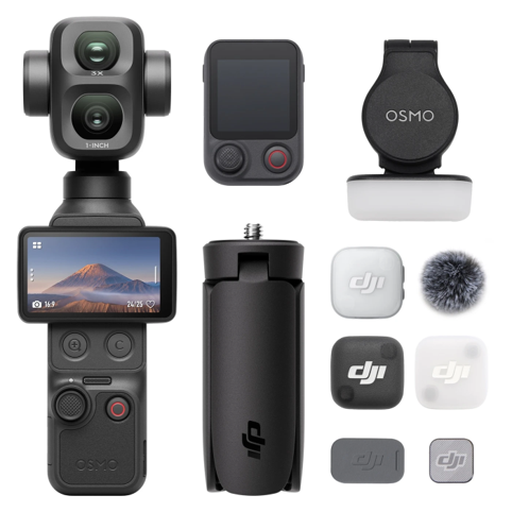
Joybuy product
This Joybuy pick is aimed at anyone who wants to film the preparation as well as take photos. For cheese details, check separately whether the camera and your chosen shooting distance will work for the framing you want.
 No image available
Osmo Pocket 4P Vlog Combo – black
Suitable if you want to film the preparation as well as take photos; check that its recording features meet your video requirements.
The product description lists a 1-inch sensor and a 20 mm f/2.0 wide-angle lens.
The description lists video up to 4K and 4K/240 fps in slow-motion mode; 4K/240 fps is only available in that mode.
View at Joybuy
Frequently asked questions
Do you need to buy a macro lens straight away to photograph a whole cheese board?
No, not if you mainly want to capture the whole board. A zoom lens can help you adjust the framing; for small details, compare the maximum magnification of the lens you’ll actually be using.
How should you set up the lighting and camera at home?
Try soft light from the side. Nikon recommends diffused daylight and white card as a reflector; for carefully framed close-ups, a tripod can help keep the camera steady.
Where can you check the total cost before buying?
Check whether the version you’re buying includes just the camera body or also the lens you want, and allow for any equipment you may need for your set-up. The Dutch government states that any additional costs, such as delivery charges, must be disclosed by the seller as part of the purchase agreement.
Who should you contact if a camera bought as a consumer is faulty?
According to the Dutch government, the seller must provide a solution if a product is faulty. The Netherlands has no fixed statutory two-year guarantee period; what you can expect depends, among other things, on the product and the information provided at the time of purchase. A manufacturer’s guarantee is additional protection.
Do you have a cooling-off period when buying a camera online in the Netherlands?
According to the Dutch government, when you buy from a business at a distance, you usually have a 14-day cooling-off period. Check the terms of the specific transaction; according to this guidance, an online purchase from a private individual doesn’t count as a distance purchase.


