
Tile sellers with colour-critical catalogues
For anyone who wants to capture tile colours and finishes consistently. A fixed lighting set-up and a colour reference are important too.


Choose a camera set-up based on the image size you need to deliver, the distance available for the lens and how closely you need to control colour and fine detail. For full tiles, the angle of view and a repeatable set-up are key; for small glaze details, a compatible macro lens may be useful. More megapixels or a composite image will not, by themselves, solve inconsistent lighting, reflections or an incorrect camera angle.
For anyone who wants to capture tile colours and finishes consistently. A fixed lighting set-up and a colour reference are important too.
If you photograph whole tiles or small collections in a limited home studio, you need to match the lens, shooting distance and framing to one another.
For individual images of small surface textures, the combination of camera mount, macro lens and working distance matters.
Start by asking whether you mainly need full-tile shots, close-up details or images that are easy to compare. Then check that the lens and shooting distance suit your studio, and decide whether a consistent RAW and colour-reference workflow is right for you.
| What to consider | What should you check? | Who is this important for? |
|---|---|---|
| Consistent colour | Consider shooting in RAW and photograph a colour reference under the lighting you use for the tiles. | If I want to compare glazes between shots, I like to keep the lighting and colour correction under control. Around 33% of consumers say colour is their top buying priority. |
| Fitting the whole tile in the frame | Measure the tile and shooting distance; check the lens’s angle of view and test the framing with the camera as square to the tile as possible. | When I want to capture the whole tile and its edges within my studio space, the lens needs to suit the distance I have available. Around 27% of consumers prioritise full-tile images. |
| Small surface textures | Check the lens mount, magnification and working distance for the exact camera and lens combination. | If I want to photograph crazing, relief or small glaze features separately, I check whether a macro lens can capture them at the scale I need. Around 20% of consumers prioritise small details. |
| A consistent shooting workflow | Find out whether composite images are necessary and whether the subject, camera and lighting can remain stable throughout the series. | For repeat shoots, I want to keep the settings and conditions consistent without adding steps my workflow doesn’t need. Around 20% of consumers prioritise a repeatable workflow. |
A creative colour style is not the same as a consistent, controllable representation of different tile colours and finishes.
Photograph a colour reference under the lighting you use, then assess the files using your intended editing workflow.
Allow extra time to keep the lighting and editing consistent.
A macro lens is designed for close-ups, but the angle of view of a particular combination can make it harder to frame a whole tile from the distance available. Nikon lists magnification of up to 1:1 for the Z MC 50mm f/2.8; on a DX camera, the same lens gives a narrower angle of view than on full frame.
Before buying, check both a full-tile frame and the close-up you want to take, and make sure the mount and working distance are suitable.
Depending on your shooting distance, you may need a second lens or more room to move away from the tile.
The higher-resolution files cited by Fujifilm and Nikon are created by combining multiple shots; they are not the resolution of a single shot.
Compare the single-shot resolution separately with the potential composite output. Choose multi-shot only if you can keep the camera, tile and lighting stable throughout the series and have access to the required software.
This workflow requires multiple shots, a stable set-up and processing with suitable software.
The EOS R50 is an APS-C mirrorless camera you could consider for full tiles and general product shots, provided the lens you choose suits your shooting distance.
The Z system offers the option of a dedicated macro lens for details; the Z6III is also an option for a fixed multi-shot workflow.
The X-T5 is an option if you want a 40.2 MP single shot or are considering Pixel Shift Multi-Shot with a fixed studio set-up.
The α7 IV is a full-frame option if you want to combine tile photography with other photography and video work.
This selection includes compact digital cameras and Sony cameras with zoom lenses. Before choosing, check that the lens can frame the whole tile from your available shooting distance and that the set-up suits your need for colour control or close-ups.
 No image available
The listed 12× optical zoom may be useful if you want to adjust the framing; test whether the angle of view is suitable for the whole tile from your shooting distance.
The product name lists 64 MP, 12× optical zoom, 4K and Wi-Fi.
 No image available
A compact camera could be an option if you’re looking for a small camera; use a test frame to check that the tile and its edges fit in your studio.
The product name lists 44 MP, 4K and 16× zoom.
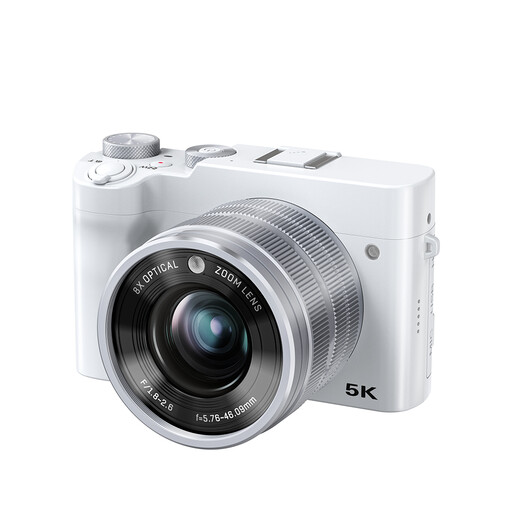 No image available
The listed zoom may help you adjust the framing, but it does not tell you on its own whether the camera can capture a whole tile from the distance available.
The product name lists 8× optical zoom, 5K, 64 MP and a dual lens. The product description mentions a manual focus and zoom ring.
 No image available
The included zoom lens offers a range of focal lengths for adjusting the framing; check the angle of view for your tile size and shooting distance.
The product description lists a 24.2 MP APS-C sensor, Sony E mount and Product Showcase Setting.
 No image available
This combination includes a zoom lens; compare the framing at the required distance with the tile you want to photograph.
The product description lists a 24.2 MP APS-C sensor, Sony E mount and electronic viewfinder.
No. For a full tile, first assess the angle of view and the shooting distance available. A macro lens is mainly useful when you want to capture small features at a larger scale; Nikon, for example, specifies magnification of up to 1:1 for the Z MC 50mm f/2.8.
Keep the lighting as consistent as possible and photograph a colour reference under the same lighting you use for the tile. Calibrite describes using this type of reference for camera colour profiles and colour balance; assess the result outside a creative camera colour style too.
It may be suitable if you need larger composite files and can keep the subject, camera and lighting stable throughout the series. Nikon specifies a stationary subject on a tripod for the Z6III; Fujifilm lists merging software for the X-T5’s 160 MP composite result. That resolution does not apply to a single shot.
When you buy as a consumer, you generally have a statutory cooling-off period of up to 14 days after delivery; ACM ConsuWijzer also explains the exceptions. You are also covered by the statutory warranty if the product does not do what you could reasonably expect under normal use. ACM ConsuWijzer does not give a single, fixed two-year period for this. If you’re buying for your business, check which rules apply to your purchase.
Not without permission. According to the Dutch government, you may only use other people’s copyright-protected photos publicly with the creator’s permission; you may not distribute or publish a private copy made for personal use.