Choose your camera set-up based on the smallest detail you want to show, and check the close-up capabilities of the specific lens or camera. A compact camera with a microscope mode lets you take close-ups without changing lenses, while with a mirrorless camera you need to check the suitable macro lens and what’s included in the kit separately. Diffused light and a steady set-up help you assess gloss and sharpness clearly.
Who should consider this?
Sellers who want to show small details
If you want to capture chips, crazing or maker’s marks separately, suitable magnification and precise focusing matter more than the camera body alone. Canon lists 0.5× magnification for the RF 85mm F2 Macro IS STM; Nikon lists 0.67× for the NIKKOR Z DX MC 35mm f/1.7.
Sellers of glazed tableware
If you want to show the colour and shape as well as the condition of the surface, you should also consider your lighting set-up. Adobe describes soft light as suitable for product photography; check test shots to see whether the gloss and surface remain clear.
Sellers photographing a variety of objects
If you often photograph different ceramic pieces, you can weigh up a dedicated close-up mode against a mirrorless camera with interchangeable lenses. The first option avoids changing lenses for close-ups; with the second, you need to check that your chosen lens is compatible with the camera body and can capture the level of detail you want.
What should you look for?
| What to consider |
What should you check? |
Who is this important for? |
| Small details |
Compare the magnification and working distance of the specific lens; take a test shot of a small detail. |
If I want to show a chip or maker’s mark on its own, it needs to appear large enough and in sharp focus. Around 33% of consumers prioritise capturing details. |
| Gloss and colour |
Try diffused light and check whether both glossy and matte areas remain clear. |
When I want to show the glaze colour and surface texture, I don’t want highlights to obscure important areas. Around 27% of consumers prioritise how gloss and colour are rendered. |
| A repeatable workflow |
Check whether you can use the same set-up to take both an overview shot and the close-up you want. |
If I photograph lots of different objects, I want to move quickly from an overall shot to a detailed one. Around 20% of consumers prioritise a repeatable workflow. |
| Complete kit |
Check which lens is included, the mount and which other components you’ll need for your workflow. |
If you want to avoid having to buy an additional lens later, check the complete kit rather than just the camera body. Around 20% of consumers prioritise what’s included in the kit. |
Pitfalls to avoid
-
Comparing camera bodies alone
The stated magnifications apply to specific lenses, not automatically to every camera body or standard zoom lens. Without the right lens, a small detail may not appear large enough in the frame.
Before choosing a camera kit, check exactly what’s included, the lens mount and the reproduction ratio.
A suitable macro lens may need to be purchased separately.
-
Confusing focusing distance with working distance
The minimum focusing distance is not the same as the space between the front of the lens and the subject. For the Sony SEL30M35, Sony lists a minimum focusing distance of 9.5 cm and a minimum working distance of 2.4 cm separately.
Compare both distances and take test shots, especially if you need to position a light close to glossy ceramics.
-
Mistaking a reflection for an accurate rendering of the glaze
Adobe explains that direct light can create harsh highlights and shadows. A polarising filter can reduce reflections, but it also changes how the gloss appears.
Try diffused light and, if necessary, photograph important areas from more than one angle.
Your chosen set-up may need space for diffused light or a suitable filter; also check that the filter size matches the lens.
Brands to consider
OM SYSTEM
The Tough TG-7 is a compact camera option with a built-in microscope mode for close-ups without changing lenses.
- OM SYSTEM lists focusing from 1 cm and a resolution of 12 megapixels.
- The lens is fixed. The LG-1 light guide is included with the micro adventure kit reviewed, but is not automatically part of the camera when bought on its own.
Canon
The EOS R50 is a mirrorless camera, so you need to assess the body and your chosen close-up lens separately.
- Canon lists 24.2 effective megapixels for the EOS R50 and support for RF and RF-S lenses.
- Canon lists 0.5× magnification for the separate RF 85mm F2 Macro IS STM; check whether that’s enough and whether the lens is included in your chosen kit.
Nikon
The Z50II with the NIKKOR Z DX MC 35mm f/1.7 is a combination worth looking into for both overview and close-up shots.
- Nikon lists a maximum reproduction ratio of 0.67× for this separate lens.
- Check whether the lens is included in the kit on offer. An equivalent focal length is not the same as the reproduction ratio.
Sony
The ZV-E10 II is a mirrorless camera option; the SEL30M35 is a separate APS-C macro lens.
- Sony lists a maximum magnification ratio of 1.0× and a minimum focusing distance of 9.5 cm for the SEL30M35.
- The minimum working distance from the front of the lens is 2.4 cm; this limited space can affect where you position your lights. Check whether the lens is included.
Joybuy products
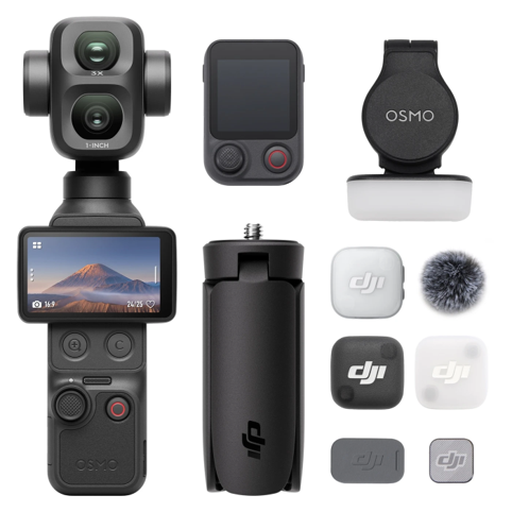
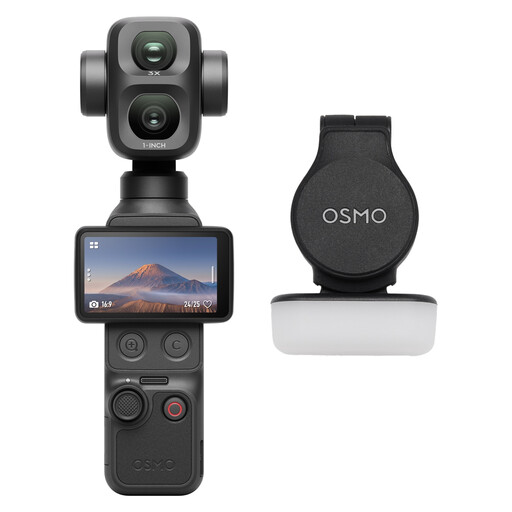
This selection includes two Osmo Pocket 4P combinations. The product names indicate the bundle variant; check the product details and whether the camera is suitable for the close-up ceramic photos you want to take.
 No image available
Osmo Pocket 4P – Vlog Combo, black
If you’re considering this model for ceramic photography, check whether its close-up capabilities suit the details you want to capture.
Bundle variant: Vlog Combo. Colour: black.
View at Joybuy
 No image available
Osmo Pocket 4P – Standard Combo, black
If you’re considering this model for ceramic photography, check whether its close-up capabilities suit the details you want to capture.
Bundle variant: Standard Combo. Colour: black.
View at Joybuy
Frequently asked questions
Are lots of megapixels enough to capture a small chip?
No. The number of megapixels alone doesn’t determine how large a small detail appears in the frame. Also check the close-up mode or magnification of the specific lens, and focus on the area you want to show. Canon lists 24.2 effective megapixels for the EOS R50; magnification depends on the lens used.
What can I do if only a narrow strip of my close-up is in focus?
Keep the camera steady and check that the relevant part of the surface is in focus. Nikon describes focus stacking as a method that combines shots taken at different focus points to increase depth of field. Check that your camera and workflow support the shots you need.
What warranty and cooling-off period apply to online purchases in the Netherlands?
For a consumer purchase, the statutory warranty depends on what you could reasonably expect from the product under normal use, explains ACM ConsuWijzer. For an online purchase by a consumer, the cooling-off period generally ends 14 days after delivery. If you’re buying for your business, don’t assume that the same consumer rights apply.
Can I use another seller’s photos in my ceramic listing?
Not without permission: according to the Dutch government, you need the creator’s permission to use someone else’s copyright-protected photos. It’s best to take your own photos or ask for permission before using them in your listing.


