
Overhead filming maker
You want to show the whole book, your hands and the process in one fixed shot. That makes the available height and a stable mount important. The Consumentenbond discusses using a tripod when filming at home.


Start with the space and height available: check that the book, your hands and the process all stay in frame and in focus at the same time. A webcam works well with a fixed computer setup, a mirrorless camera gives you more choice of lenses and framing, and a compact gimbal camera is easier to move around. For a fixed overhead view, any camera will need a stable mount.
You want to show the whole book, your hands and the process in one fixed shot. That makes the available height and a stable mount important. The Consumentenbond discusses using a tripod when filming at home.
You want to be able to pack away your filming setup after use, and decide whether a webcam connected to a computer or a camera you can move around is better suited to your space. Logitech describes a downward-facing position for the MX Brio; DJI lists the Osmo Pocket 3 as weighing 179 g.
You want to show small stitches and paper details clearly, perhaps with a spoken explanation, without accidentally making your housemate identifiable in the footage. The Dutch Data Protection Authority explains that publicly shared footage is treated differently from material for personal or household use.
A good fit if: you film in a fixed workspace and have a computer available while recording.
Bear in mind: the computer, cable routing and camera position all affect where you can place the camera; a downward-facing position does not guarantee that every detail will be in focus.
A good fit if: you want to switch regularly between a view of your work surface and close-ups, and are happy to choose your lens and mount carefully.
Bear in mind: the camera body alone does not determine the angle of view or focusing distance; check which lens and accessories are included with the model.
A good fit if: you want to move the camera between filming angles regularly as you work on a project.
Bear in mind: a fixed lens limits your choice of angle of view; you will still need a suitable mount for a fixed overhead view.
| Consideration | What should you check? | Who is this important for? |
|---|---|---|
| Overhead view | Measure your work surface and the available camera height. Check that the book, your hands and your tools all stay in frame together, and that the mount is stable. | If I want to show a complete bookbinding process, I need to frame the work surface from the mounting position available to me. Around 33% of consumers prioritise an overhead view. |
| Setting up and storing away | Check where the computer, cable, clamp or tripod will go, and whether you can easily put the camera away afterwards. | If I share a desk with someone, I want to be able to clear my workspace after filming. Around 27% of consumers prioritise a filming setup that is quick to put away. |
| Close-ups | Record a test shot of the smallest process you want to show. With a mirrorless camera, the usable distance also depends on the lens you choose. | If I want to explain stitches or materials up close, I need to show those details clearly. Around 20% of consumers put close-ups first. |
| Sound and privacy | Test your voice and the sounds of your work, and check both the picture and sound before publishing. Agree filming times with your housemate. | If I record an explanation in a shared room, I want to be easy to hear without accidentally including my housemate in a public video. Around 20% of consumers say this is their main concern when buying. |
A high resolution does not tell you whether the whole book will fit in frame from the height available to you, or whether a small stitch will be in focus.
Before choosing a camera type, record a test shot with a book of the size you usually work with. Check both the framing and the focus at the distance you plan to use.
Stabilisation is no substitute for a secure, fixed position for a camera that will be suspended above your work for an extended period.
Consider the camera and its mount together, and test whether the setup stays stable during your usual hand movements.
A separate, suitable mount may be needed for a fixed overhead view.
The body alone does not confirm that your work surface will fit in frame at the desired distance, or that small details will be in focus.
Check the exact model and test your chosen lens at the available working height and detail distance.
Depending on the model you choose, you may need to buy a suitable lens and support separately.
Your housemate could also appear or be heard in a video you share later. The Dutch Data Protection Authority distinguishes between personal or household use and footage shared publicly.
Agree filming times and check the finished video before publishing it. If anyone is recognisable in the footage, also check which privacy rules apply.
The MX Brio is a webcam for a fixed computer workspace; Show Mode is designed to show work on a desk.
The EOS R50 is a mirrorless camera for anyone looking to tailor their choice of lens and overhead setup to their workspace.
The ZV-E10 II is an interchangeable-lens camera for anyone who wants to create different shots.
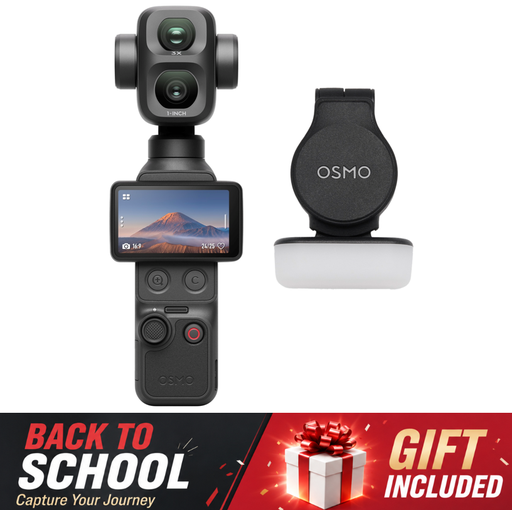
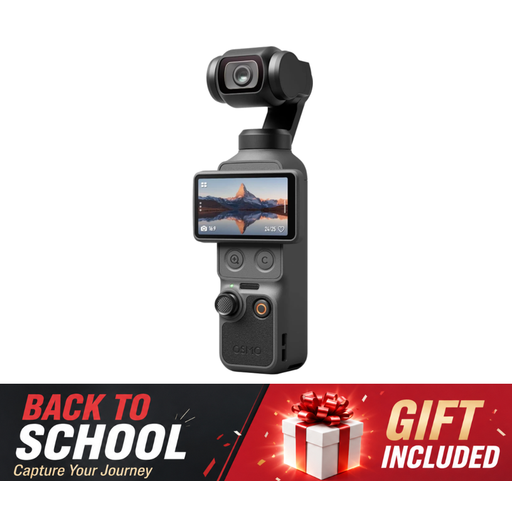
The Osmo Pocket 3 is a compact camera for makers who switch between filming angles during a project.
This product selection focuses on compact gimbal cameras and webcams for a fixed computer setup.
 No image available
A compact pocket gimbal camera for anyone looking for a portable filming setup; check how you can safely mount it above your work.
This version is listed as Standard Combo and Black.
 No image available
A monitor with an integrated webcam for anyone filming at a fixed computer workspace; bear in mind how much room it will take up on a shared desk.
27-inch QHD IPS display, 100 Hz and integrated webcam.
 No image available
A pocket gimbal camera for anyone who wants to change filming angles while recording; test whether the angle of view captures the book and your hands from your mounting distance.
1″ CMOS, 4K/240fps, 3-axis stabilisation, 2× lossless zoom, 107GB built-in storage and a 2″ rotatable screen.
 No image available
A pocket gimbal camera for a portable setup; check whether the included handle and mount are suitable for your fixed overhead view.
1″ CMOS, 4K/240fps, 3-axis stabilisation, 2× lossless zoom, 14-stop dynamic range, 107GB built-in storage and handle with 1/4″ thread.
 No image available
A desktop webcam for a fixed computer setup; test whether the clip mount and angle of view suit the space available above your work surface.
Autofocus, dual built-in microphones, privacy shutter and EU version.
It can work with a fixed computer setup, but test it at your desk to see whether the whole work surface and small processes are in focus. Logitech describes Show Mode as a way to show work on a desk, not as a guarantee that every book or detail will fit in frame.
Record a test shot using your usual hand movements and check that both the camera and its mount stay stable. If you’re using a webcam, consider where the computer and cable will go; a compact gimbal camera also needs a suitable mount for a fixed overhead view.
If you’re buying a mirrorless camera, check whether the lens you need is included and whether you’ll need a suitable mount. For a consumer purchase in the Netherlands, the seller must provide a solution if a product is faulty, according to the Government of the Netherlands. For online purchases from a business, you usually have a 14-day cooling-off period; check which terms apply to your purchase.
First, check which privacy rules apply to recording and publishing the footage. The Dutch Data Protection Authority says that the exception for personal or household use does not apply to footage shared publicly or with a wider audience; you will need a lawful basis under the GDPR, which in many cases means consent. Where possible, point the camera at your work and check both the picture and sound before publishing.