Which set-up is right for you?

Collector focused on small details

You want to capture lettering, fastenings and signs of wear individually. Magnification, focusing and room for lighting are important considerations for macro photography, as described by Canon Netherlands and Nikon Netherlands.

Creator of consistent catalogue photos

You photograph several badges against the same dark background and want a repeatable crop, exposure and level of sharpness. Canon Netherlands recommends a tripod for consistent product composition; Canon and Nikon also describe considerations for macro photography.

Beginner with a compact set-up

You want to take close-ups without changing lenses and check whether the chosen shooting distance works with your lighting. OM SYSTEM describes the TG-7’s close-up capabilities.

What should you look for?

Compact camera with close-up mode

Choose this option: if you want to take close-ups quickly without changing lenses; OM SYSTEM states that the TG-7’s microscope mode can focus from 1 cm.

Consider: the lens is fixed, so check whether there’s enough room to light the badge at the short shooting distance.

Mirrorless camera with a macro lens

Choose this option: if you want to match the lens to the crop you need for the badge; Nikon specifies 1:1 magnification for the NIKKOR Z MC 50mm f/2.8, while Canon specifies 0.5× for the RF 85mm F2 Macro IS STM.

Consider: check the lens mount and what’s included in the kit. The magnifications mentioned apply to these specific lenses, not every camera body or kit.

Mirrorless camera with a standard zoom lens

Choose this option: if a wider crop showing the whole badge is enough for now and you’d like the option of choosing another lens later.

Consider: according to Canon, the RF-S 18-45mm achieves a maximum of 0.25× in the manual focusing mode described. Check whether the crop suits your badge.

Consideration What to look for when buying Who it matters to
Magnifying small details Compare the magnification of the exact lens, or the camera’s close-up mode, with the crop you need. I want to capture small lettering and worn areas clearly. Around 33% of consumers give detail magnification their highest priority.
Lighting a badge against a dark background Check the space in front of the lens, and plan the lighting and background as separate parts of your set-up. When I photograph a badge against a dark background, I want to be able to control the light on its surface. This is the priority for around 27% of consumers.
Keeping relief and series of shots in focus Check that the camera has the focusing or bracketing feature you need and that you can keep the set-up still. I want to photograph raised details or several badges with a similar crop. Around 20% of consumers prioritise consistent sharpness.
A complete, easy-to-handle set Check the exact kit contents, lens mount and whether close-up lighting is included. I want to get started easily and know in advance which parts are included in my set. Around 20% of consumers value a straightforward set-up most.

Common buying mistakes

  • Comparing only the camera body or the word ‘macro’

    Magnification depends on the specific lens. For example, Canon specifies 0.25× for the RF-S 18-45mm in the MF mode described and 0.5× for the separate RF 85mm F2 Macro IS STM.

    Compare the exact lens included with the crop you want for your badge.

    A suitable macro lens may need to be bought separately as part of your set-up.

  • Confusing the focusing distance with the space in front of the lens

    Nikon gives a minimum focusing distance of 0.16 m for the NIKKOR Z MC 50mm f/2.8, with around 5 cm between the front of the lens and the subject when focusing close up. These measurements don’t tell you the same thing about the space available for lighting.

    Check the space in front of the lens at the magnification you actually want to use.

    You may need a different lens or lighting set-up if the available space isn’t suitable.

  • Assuming a dark background completes the set-up

    You’ll still need to light the badge appropriately. Canon recommends a tripod as an aid to consistent composition in product photography.

    Plan the camera, badge, background and lighting together, and check what’s included in your chosen kit.

    A stable support or separate lighting may be needed as part of the set-up.

Camera brands as a guide

Canon

Canon EOS R mirrorless cameras offer an option with separately selected RF macro lenses.

  • Canon specifies 0.5× magnification for the RF 85mm F2 Macro IS STM and lists the EOS R10 and EOS R50 among its compatible cameras.
  • Canon describes focus bracketing for the EOS R10.
  • The RF-S 18-45mm isn’t the same as a dedicated macro lens; check which lens is included in the kit. The details given are manufacturer specifications.

Nikon

Nikon Z mirrorless cameras can be paired with separately selected Z macro lenses.

  • Nikon specifies 1:1 magnification for the NIKKOR Z MC 50mm f/2.8 and lists the Z50II as a DX camera that can use Z macro lenses.
  • According to Nikon, the front of the 50mm lens can be around 5 cm from the subject when focusing close up. Check whether there’s room for lighting at that distance.
  • These details apply to the lens mentioned, not to a standard zoom kit.

OM SYSTEM

The Tough TG-7 is a compact camera with a fixed lens and built-in close-up mode.

  • OM SYSTEM states that it can focus from 1 cm.
  • The micro adventure kit reviewed includes an LG-1 light guide and an extra battery; don’t assume these are also included with the camera on its own.
  • Check whether the short shooting distance leaves enough room to light a badge properly. These are manufacturer details, not an independent comparison.

Cameras on Joybuy

The Joybuy products below are cameras described as vlog or pocket models. Before buying, check separately whether their close-up capabilities and lighting are suitable for photographing badges.
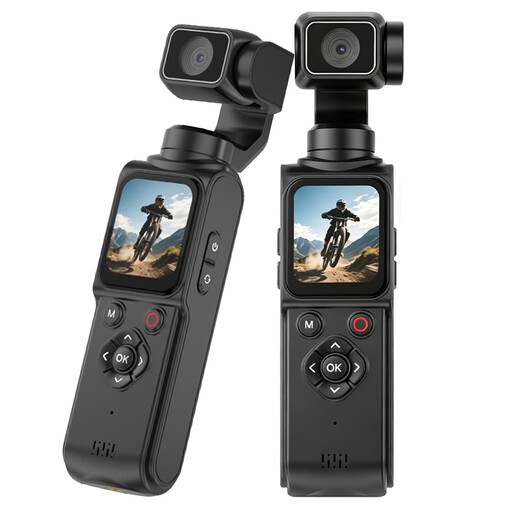
KINSI Mini Vlog Camera

KINSI Mini Vlog Camera

For badge photography, consider this only if the close-up crop and lighting you need are achievable with your set-up.

The product name lists 4K, 64 MP, Wi-Fi, a 330° rotating lens, a 1.72-inch touchscreen, face recognition, a tripod and Type-C.

View on Joybuy

DJI Osmo Pocket 3 Creator Combo

DJI Osmo Pocket 3 Creator Combo

Consider this model for badge photography only after checking that its close-up crop and lighting are suitable for your subject.

The product name lists a 1-inch CMOS sensor, 4K video at up to 120 fps, 3-axis stabilisation, fast focusing and an included microphone.

View on Joybuy

Songdian Pocket Camera, pink

Songdian Pocket Camera, pink

With this pocket model, first check whether its close-up capabilities and lighting are good enough to capture the details on your badges.

The product name lists 4K, 44 MP and 16× digital zoom; the description mentions autofocus.

View on Joybuy

Frequently asked questions

Do I need to buy a 1:1 macro lens for every badge?

No, it depends on how much of the frame you want the whole badge or the detail to fill. Nikon’s 1:1 specification applies to the NIKKOR Z MC 50mm f/2.8; check whether a wider crop with your chosen lens or close-up mode will be enough.

How can I take a series of badge photos with the same crop?

Keep the camera and background in fixed positions, and use a stable support. Canon describes a tripod as an aid to consistent composition; for raised details, Canon describes focus bracketing for the EOS R10.

What should I check is included before buying?

Check that your chosen kit includes the lens and any lighting or camera support you need. According to OM SYSTEM, the OM SYSTEM TG-7 micro adventure kit includes an LG-1 light guide; don’t assume this is also included with the camera on its own.

What warranty applies to a camera I buy as a consumer in the Netherlands?

According to the Dutch government, you’re entitled to a product that works properly, but the Netherlands has no fixed statutory warranty period. If a product is faulty, the retailer is your point of contact; an additional manufacturer’s warranty doesn’t replace this legal right.

Do I have a cooling-off period when buying a camera online in the Netherlands?

For eligible distance purchases from a business, the Dutch government generally provides a 14-day cooling-off period. According to government guidance, an online purchase from a private seller isn’t covered by the same distance-selling rules; check the terms of your transaction.
