Who is this camera guide for?

Anyone looking to capture the details of acorns

You want to fill the frame with veins, caps or texture. So, look at the magnification and working distance of the complete camera and lens combination. Sony Netherlands explains how magnification and working distance affect macro photography.

Anyone walking in changeable weather

You may be taking photos in the rain or in blowing sand, so it’s worth considering the protection specified for the model. OM Digital Solutions and Ricoh Imaging publish protection specifications for their rugged compact cameras.

Anyone looking to photograph both details and landscapes

You want to use the same kit for close-ups and wider shots, and you can bring a suitable interchangeable lens. Canon and Nikon describe macro lenses for their respective camera systems.

What should you look for when buying?

Rugged compact camera

A good fit if: you want to take close-up photos without changing lenses and protection on your walk is important. OM Digital Solutions says the TG-7 can focus as close as 1 cm; Ricoh Imaging describes a close-up mode and ring light for the WG-8.

Consider: the lens is fixed, and the manufacturer’s protection ratings don’t guarantee damage-free use.

Mirrorless camera with a macro lens

A good fit if: you want to choose lenses for photographing acorn details and other subjects. Canon lists a maximum magnification of 0.5× for the RF 35mm F1.8 MACRO IS STM lens; Nikon specifies 1:1 for the NIKKOR Z MC 50mm f/2.8.

Consider: macro performance depends on the specific lens, not just the camera body. Check the lens mount, what’s included in the box and how you’ll protect the kit by the coast.

What to consider What should you check? Who should consider this most?
Capturing acorn details Check the maximum magnification, focusing distance and working distance for the exact camera and lens combination. If you want to capture veins or texture in detail, magnification should be your first criterion. Around 36% of consumers prioritise acorn details.
Sand, rain and moisture Compare the protection specifications for the exact model and read the instructions for maintaining its seals. If you take photos in changeable weather, you’ll want to consider protection without treating it as a guarantee against damage. Around 29% of consumers give protection their highest priority.
Travelling light Compare the complete kit you’ll need, including the lens, rather than looking at the camera body alone. If you want to carry as little separate equipment as possible on your walk, a ready-to-use kit matters. Around 21% of consumers prioritise lightweight, simple equipment.
Photographing other subjects too Check the lens mount and the magnification of the lens you actually plan to use. If you want to photograph landscapes as well as acorns, a choice of lenses may matter more than having a fixed lens. Around 14% of consumers give versatility and lens choice their highest priority.

Common buying mistakes

  • Relying only on ‘macro’ or a focusing distance in centimetres

    The minimum focusing distance alone doesn’t tell you how large an acorn will appear in a photo. Working distance is also different from the distance at which a lens can focus.

    For the complete camera and lens combination, compare the maximum magnification, minimum focusing distance and working distance with the framing you want.

  • Assuming a mirrorless camera body is a complete macro kit

    A lens’s macro capabilities don’t automatically apply to every lens that fits the same body.

    Check the lens mount, magnification and full package contents before choosing a kit. You may need to buy a suitable lens separately.

  • Assuming waterproof means maintenance-free or indestructible

    Ricoh Imaging warns that its protection tests don’t guarantee damage-free use. Sand around the seals and the recommended maintenance are still important considerations.

    Read the manual for the exact model and check the seals and maintenance instructions, especially after exposure to seawater.

  • Assuming all accessories are included

    Accessories vary by model and offer. For example, Ricoh Imaging states that an SD card isn’t included with the WG-8.

    Check what’s in the box and decide what you’ll need for your walk. You may need to buy a memory card or spare battery separately.

Camera brands to consider

OM SYSTEM

The Tough TG-7 is a rugged compact camera with a fixed lens, designed for close-up photography without changing lenses.

  • OM Digital Solutions lists focusing from as close as 1 cm and water and dust protection for the TG-7.
  • These manufacturer specifications aren’t an independent comparison of image quality. The lens is fixed, and the camera has around 12 effective megapixels.

PENTAX

The WG-8 is a rugged compact camera from Ricoh Imaging, with a digital microscope mode and ring light.

  • Ricoh Imaging specifies that the WG-8 is protected at depths of up to 20 m for a maximum of two hours.
  • Ricoh Imaging warns that its tests don’t guarantee damage-free use. The protection specification isn’t a guarantee against sand or damage.

Canon

The EOS R50 is a mirrorless camera with an RF mount, which can be paired with a separately chosen RF lens.

  • Canon lists a maximum magnification of 0.5× for the RF 35mm F1.8 MACRO IS STM lens.
  • That magnification applies to the lens named above, not to the camera body alone. Check whether the lens is included in the kit.

Nikon

The Z system offers an interchangeable-lens option for anyone looking to choose a suitable macro lens.

  • Nikon specifies 1:1 magnification for the NIKKOR Z MC 50mm f/2.8 lens.
  • The lens requires a compatible Z camera; this lens specification doesn’t mean every Nikon kit is suitable for coastal weather.

Sony

Sony’s E-mount lets you choose the camera and the macro lens you want separately.

  • Sony Netherlands explains that you can check maximum magnification in the lens specifications, and that focusing distance is measured from the sensor.
  • The features of a specific lens don’t automatically apply to all Sony cameras or indicate how well they’re protected against coastal weather.

Joybuy cameras for this subject

These Joybuy products are cameras for photography. Check each model to see whether its lens and focusing capabilities are suitable for close-ups of acorns.

Songdian Pocket Camera 4K 44MP 16X Zoom Pink

Songdian Pocket Camera 4K 44MP 16X Zoom Pink

The title describes this model as a pocket camera for photography and video. Check whether its close-up capabilities suit the framing you want.

The product name lists 4K, 44MP and 16X digital zoom. Digital zoom alone doesn’t tell you anything about macro magnification or focusing distance.

Joybuy
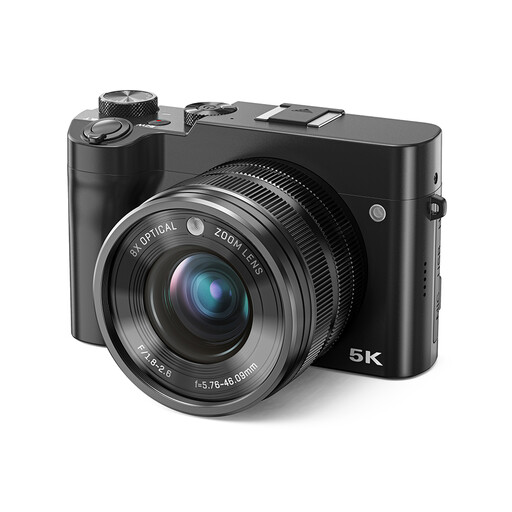
Songdian Digital Camera 5K 64MP 8X Optical Zoom Black

Songdian Digital Camera 5K 64MP 8X Optical Zoom Black

The product description warns against using the camera in damp environments, which is an important limitation on a coastal walk.

The product name lists 5K, 64MP and 8X optical zoom. Check its close-up focusing capabilities and bear the moisture warning in mind.

Joybuy

Frequently asked questions

Is a focusing distance of 1 cm enough to fill the frame with an acorn?

Not necessarily. Check the maximum magnification and working distance of the complete camera and lens combination too. Focusing distance is usually measured from the sensor, not from the front of the lens.

What should I check after using my camera in sand or seawater?

Follow the manual for the exact model and check the seals for sand before using the camera. OM SYSTEM provides specific cleaning instructions for the TG-7; don’t automatically apply them to a mirrorless camera that isn’t specified for use in water.

What extra items might I need to buy for a camera kit?

Check whether the lens you need, a memory card and possibly a spare battery are included. Ricoh Imaging says the WG-8 is supplied without an SD card. With a mirrorless camera, close-up performance also depends on the lens included in the kit.

In the Netherlands, do I lose my right to a guarantee after two years?

No. According to ACM ConsuWijzer, there’s no fixed period for the statutory guarantee in the Netherlands. What matters is how long you could reasonably expect the product to last under normal use. If the seller is responsible for a fault, they’re the person to contact.

Can I photograph acorns anywhere in the dunes and share the photos online?

Not without taking the rules for the specific location into account. According to the Dutch government, provinces decide what is and isn’t allowed in their nature reserves. For identifiable people in photos, the Dutch Data Protection Authority distinguishes between private use and wider publication. Check local access rules before leaving the path.
