
Teachers filming from above
If the writing hand obscures the pen stroke, positioning the lights so that the stroke remains visible can help. Ulanzi recommends diffused lights on either side of the work surface as a starting point.


For an overhead-filmed calligraphy lesson, two diffused light sources placed on either side of the paper are a useful starting point for reducing hand shadows; Ulanzi suggests starting at around 45 degrees. Then choose between a COB light with a suitable softbox, a diffused LED panel or a compact light, depending on the space available, power supply and light spread you need. Record a test clip to check for shadows, reflections, white balance and flicker, and check that the exact model complies with product requirements before you buy.
If the writing hand obscures the pen stroke, positioning the lights so that the stroke remains visible can help. Ulanzi recommends diffused lights on either side of the work surface as a starting point.
If you want to capture white paper and the shade of the ink accurately, assess the lighting alongside your camera’s white balance. Canon Europe explains that the colour of the light affects how white appears on camera.
In a small filming area, you’ll need to balance the light spread you want against the space available for lights, stands and your camera. Ulanzi’s compact VL49 RGB is an example of a small light, but its specifications don’t show that a single unit will illuminate an entire writing surface evenly.
First, decide where the light needs to fall and how much table space you have. Then assess colour rendering and test your final light and camera settings for flicker.
| What to consider | What should you check? | Who is this important for? |
|---|---|---|
| Shadows and reflections | Record a test clip of a full line of writing. Try diffused lights on either side of the paper, and move them if shadows or reflections interfere with the active pen stroke. | If your hand moves across the paper as you write, you’ll want the pen stroke to remain visible. Around 36% of consumers give shadow-free pen strokes top priority. |
| Paper and ink colour | Test with the paper and ink you actually use. Check the white balance under the final lighting; an adjustable light colour is no substitute for a suitable camera setting. | If you want to keep a white background or ink colour consistent on camera, assess the light and camera together. Around 29% of consumers prioritise colour consistency. |
| Space, power and what’s included | Check whether the model you choose runs on mains power or a battery, and what’s included for mounting, diffusion, the softbox and stand. Also measure the available space beside the paper and camera. | If you have a small table or a distant plug socket, you’ll want to know how the light will fit and how it’s powered. Around 21% of consumers make positioning and power their top priority. |
| Flicker in video | Test your intended dimming level, frame rate and shutter speed together. For a 50 Hz mains frequency, Sony suggests 1/50 or 1/100 second as possible shutter speeds; check the results with your camera and light. | If you want to avoid bands in your footage, test the light source with your camera settings before filming the lesson. Around 14% of consumers give flicker top priority. |
How the light spreads across the paper depends on diffusion and positioning, not just light output. You may need to buy a suitable softbox, stand or other light modifier separately.
Check what’s included in the exact kit and test the hand shadow with the light modifier you plan to use.
Ulanzi lists a fixed colour temperature of 5500 K for the standard VL49; the VL49 RGB has adjustable colour temperature and RGB features. The names therefore refer to different models.
Check the full model name and specifications before choosing a light.
Visible bands also depend on the combination of light source and camera settings. A manufacturer’s claim doesn’t automatically tell you how the light will perform with your recording settings.
Record a short test clip using your intended dimming level, frame rate and shutter speed. For an environment with a 50 Hz mains frequency, Sony suggests 1/50 or 1/100 second as possible shutter speeds.
The SL60IIBi is a mains-powered COB light for use with a suitable Bowens light modifier.
The COB 60x S is a compact COB light with a Bowens mount, for makers who want to use a compatible light modifier.
The RGB660 PRO II is an LED panel for anyone looking to position a directional, flat light source.
The RC 60B Lite Edition is a portable COB light that may be useful if you need built-in power.
The VL49 RGB is a compact supplementary light for a small or portable filming setup.
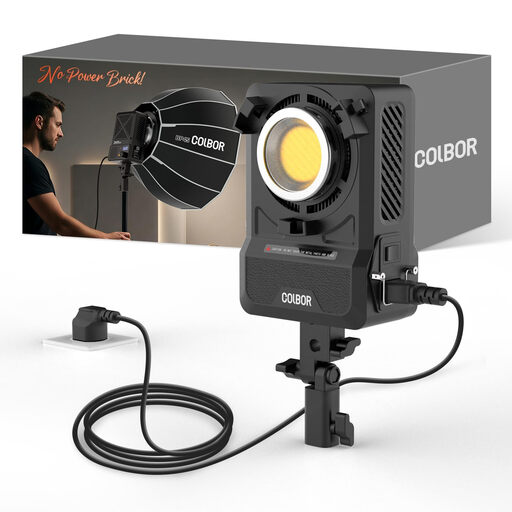
This product selection features a bi-colour COB video light with a Bowens mount, for use with a compatible light modifier.
 No image available
The Bowens mount is useful if you want to use a compatible light modifier to direct the light onto your writing surface.
The product name lists a bi-colour range of 2700 K–7000 K and a built-in power adapter design.
For this exact model, check that the relevant product compliance has been confirmed, and whether the light modifier and stand you need are included in the selected kit.
Two diffused light sources on opposite sides of the paper are a useful starting point; Ulanzi suggests starting at around 45 degrees. Write a test line and move the lights if a shadow or reflection falls across the active pen stroke. This angle isn’t a fixed requirement.
The colour of the light affects how the camera records white. Check the white balance using your actual paper under the final lighting, rather than simply changing the light’s colour temperature. Canon Europe explains how different light can affect the perceived colour of white.
Record a test clip using your intended light settings and camera settings. For environments with a 50 Hz mains frequency, Sony suggests 1/50 or 1/100 second as possible shutter speeds; check which setting works with your camera and light source.
No, this varies by model and kit. NEEWER states that the RGB660 PRO II light model reviewed doesn’t include a stand; SmallRig describes softboxes for the RC 60B Lite Edition as optional accessories. So check what’s included in the kit you choose.
The Netherlands Food and Consumer Product Safety Authority and Business.gov.nl explain that electrical and electronic products must comply with the applicable European rules, and that CE marking is mandatory for this product category. Check that the exact light model and any power supply comply; general product information doesn’t automatically confirm that a specific model does.