
Vandaag of morgen in huis

Kwaliteit gegarandeerd

Welkomstaanbiedingen ontgrendelen: GRATIS bezorging | Tot 80% korting | Gratis 30 dagen JoyPlus-proefperiode
Download de app
A dark wardrobe, a kitchen cabinet without a window or a poorly lit hallway does not always require wiring or a drill. Cabinet lighting with a motion sensor switches on automatically when you approach. A wireless solution is especially practical for rental homes and smaller spaces.
Even so, many LED cabinet lights look alike. A low price or a high LED count does not necessarily indicate ease of use. Pay particular attention to the sensor, battery, light colour and mounting method.
A PIR motion sensor detects changes in heat and movement. In a cabinet, it only works well when the sensor is aimed at the area where you move. If you install the light too high or too far inside a cabinet, it may switch on too late.
Check the specified detection range and whether the light is suitable for a small space. The 30 and 40 cm models in this selection specify a range of 3 to 5 metres. That is more than sufficient for a cabinet, although the exact performance also depends on positioning and surroundings.
Wireless cabinet lighting relies on a rechargeable battery. If the battery cannot be charged through a standard USB connection, you may need a separate cable or adapter. Also check whether the product information specifies the battery capacity.
According to the product description, the 30 and 40 cm lights below feature an integrated 1100 mAh battery and charge via DC 5V, 0.5A. This is convenient with a laptop, power bank or compatible USB charger. Runtime per charge depends not only on capacity, but also on brightness, the number of activations and how long the light stays on each time.
A high lumen rating is not automatically comfortable in a wardrobe or bedroom. Bright, cool-toned light can be useful when looking for items, but may feel less suitable beside a bed. Consider the combination of brightness and adjustable colour temperature instead.
A light with three colour settings offers more flexibility than a model with just one fixed setting. Bear in mind that the stated lumen values come from the product information. Without independent testing, it is best to treat them as product specifications rather than a guarantee of a particular lighting experience.
A PIR motion sensor is ideal when the light should switch on automatically as you walk past or open a cabinet. For a drawer or small cabinet, a basic sensor light may be sufficient. In a hallway or pantry, a larger detection range is more convenient.
Some models also use gesture control. The Motion Sensor Night Light with 36 LEDs specifies touch-free operation for switching on and off and adjusting the brightness. This can be useful when you want to operate the light without touching a button.
Measure the shelf, cabinet wall or underside of the kitchen cabinet before ordering. An ultra-thin cabinet light measuring 10 mm fits in more locations than a thicker model, but also check whether the mounting is sufficiently secure.
Consider these mounting options:
Do not use a light in a damp environment unless the product information confirms that it is suitable for such conditions. According to their warnings, the models mentioned are not intended for exposure to water or excessive moisture.
For kitchen cabinet lighting or a workbench, cool white light is often practical. In a bedroom or wardrobe, warm white light can create a calmer atmosphere. The 30 and 40 cm models offer three ranges:
Adjustable colour temperature means you do not need a different light for every room. Keep in mind that colour rendering can vary between products; check the images and specifications on the product page.

Why it’s a good fit: A set of four is practical when you want to illuminate several drawers, shelves or small cabinets at once without immediately buying individual lights.
You can distribute the lights across different locations, so one lamp does not have to cover a wide cabinet. Before buying, check the available information on power and mounting.
Four lights in one package, designed for drawers and smaller storage compartments.

Why it’s a good fit: At 20 cm long, it is suitable for a wardrobe, narrow shelf or smaller alcove where a longer under-cabinet light would not fit.
The compact size reduces the chance of the light catching on clothing or cabinet doors. Check the product page for up-to-date battery and mounting information.
20 cm length and a silver finish, well suited to smaller cabinets and shelves.

Why it’s a good fit: The 40 cm length and 61 LEDs are designed for wider shelves, kitchen cabinets, pantries or a work area.
The 10 mm-thick housing takes up very little space. The PIR sensor and three light colours make it less cumbersome to search manually or recharge the light repeatedly.
61 LEDs, PIR detection at 3–5 metres, 1100 mAh battery and two lights per set.
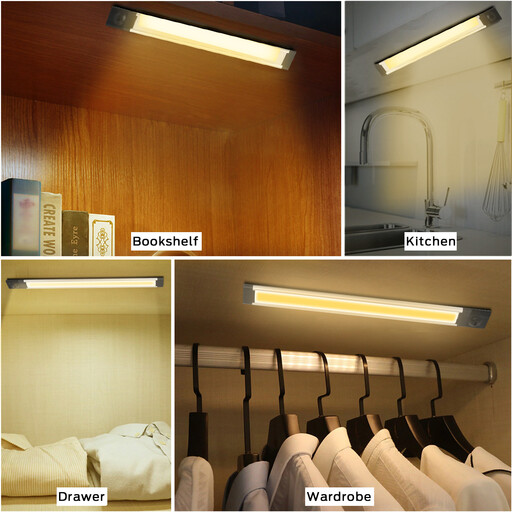
Why it’s a good fit: Thanks to its magnetic mounting and hanging hooks, this light can be used in a wardrobe, hallway, garage, staircase or storage room.
There is no need to drill, and you can remove the light for charging. The manufacturer specifies a colour temperature range of 2800K–6500K and a luminous flux of 400 lm.
26 × 4 × 1 cm, aluminium and ABS construction, magnetic mounting, dimming function and USB-rechargeable design.
For a narrow wardrobe or a single kitchen cabinet, 30 cm may be sufficient. According to the product description, the 30 cm version has 41 LEDs, the same 3–5 metre PIR detection range, three colour temperatures and a 1100 mAh battery.
The 40 cm version has 61 LEDs and therefore illuminates a longer shelf. This makes it the more logical choice for under-cabinet lighting above a worktop or for a wide wardrobe. However, more LEDs do not automatically mean lower energy consumption; check the stated power rating and charging frequency for that.
Browse a current selection of rechargeable cabinet lights and compare size, sensor, light colour, mounting and charging method for each product.
Clean the surface, allow it to dry completely and install the light according to the mounting instructions. Magnetic mounts, adhesive strips and hanging hooks are common options. Make sure the cabinet wall is smooth and free from grease. Position the sensor so that your movement is not blocked by a shelf or door.
This varies depending on the battery, brightness setting and usage. A light that switches on briefly each time you open a cabinet uses less energy than one that remains on for several minutes as hallway lighting. The stated battery capacity, such as 1100 mAh on some models in this article, helps with comparisons but does not, by itself, indicate a fixed runtime.
A USB-rechargeable light uses electricity only while charging. Running costs depend on its power rating, how often you charge it and your electricity tariff. For an accurate calculation, you need the wattage and charging time. So do not focus solely on the term “energy-efficient”; check the technical specifications on the product page.
