
Vandaag of morgen in huis

Kwaliteit gegarandeerd

Welkomstaanbiedingen ontgrendelen: GRATIS bezorging | Tot 80% korting | Gratis 30 dagen JoyPlus-proefperiode
Download de app
A dark wardrobe, kitchen cupboard or shelf can quickly become inconvenient. A cabinet light with a motion sensor might seem like a simple solution, but not every LED cabinet lamp suits every space. Some lights are too thick, run out of battery quickly, or only react when you've already bumped your head against the cupboard door.
That's why Joybuy's Product Recommendation Officer is here to help you focus on verifiable product specifications rather than just marketing claims. This way, you can make a more targeted choice for wireless cabinet lighting that suits your home, your usage and your installation spot.
A PIR motion sensor reacts to movement and temperature differences within its detection zone. The range and viewing angle determine whether the light comes on when you open a cupboard or walk past a shelf. A sensor with a range of 3 to 5 metres can be practical in a bedroom or hallway, but it might be too sensitive if the light is positioned opposite a busy walkway.
So, check the following:
A light can provide plenty of illumination, yet still be unusable if it knocks against clothes, crockery or a cupboard door. When looking at an ultra-slim LED light, pay attention not only to the length but also to the thickness and width.
The 40 cm version from the product description measures 400 x 38 x 10 mm. The 30 cm variant is 300 x 38 x 10 mm. A thickness of 10 mm makes installation under a shelf or on the inside of a cupboard easier, but do measure the available space beforehand.
Wireless cabinet lighting only works well when charging is straightforward. A built-in battery with a USB connection can be handy, as you can use a laptop, power bank or USB charger for it. However, do check the charging voltage and current. For the rechargeable cabinet lights mentioned, that is DC 5 V and 0.5 A.
A longer burn time is sometimes described in vague terms in product texts. Without a specified usage time per charge, you can't set a firm expectation. How often you need to charge depends on factors such as the number of activations, the brightness level chosen and the duration of each use.
For a wardrobe or kitchen cupboard, a sensor at the front or underside is often practical. Position the light so that your hand or body can activate the sensor directly. Also check that the light isn't too close to a metal edge or an obstacle.
A PIR motion sensor light is designed for automatic detection, but its performance can vary from room to room. A sensor is not a replacement for a regular switch when you need light for an extended period.
A light with three colour temperatures offers more choice for different situations:
Bear in mind that the number of LEDs is not the same as the light output. The product information for the 40 cm light mentions 61 LEDs and the 30 cm version 41 LEDs, but a lumen value is missing. So, use the number of LEDs only as additional information, not as a full indication of brightness.
For rental properties or situations where you don't want to drill, a cabinet light without drilling with self-adhesive tape is a practical option. First, clean and dry the surface. Do not mount the light in a place where moisture, steam or direct splashes of water occur. The lights described are made from ABS plastic, metal, LED components and electronic parts. The manufacturer recommends cleaning with a soft, dry cloth and warns against excessive moisture.
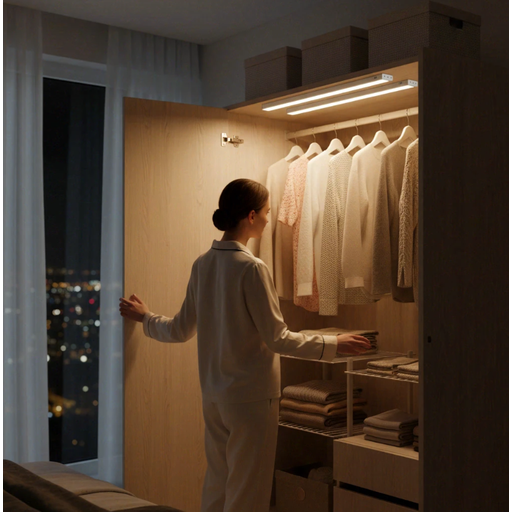
Why this suits the profile: The 30 cm length is suitable for smaller cupboard compartments, shelves and bedside tables. The set includes two lights for multiple spots around the home.
The product specification states a thickness of 10 mm, a PIR range of 3–5 metres and USB charging. This means you can check in advance whether the light fits your cupboard.
41 LEDs, three colour temperatures, built-in 1100mAh battery and installation with self-adhesive tape without drilling.
Why this suits the profile: The longer light bar is intended for wide shelves, wardrobes and under-cabinet lighting in the kitchen where a larger area needs to be illuminated.
The dimensions, charging details and sensor range are clearly stated. This prevents you from having to rely solely on terms like "long battery life" or "bright light".
61 LEDs, three light colours, 400 mm length, 1100mAh battery and two lights per pack.
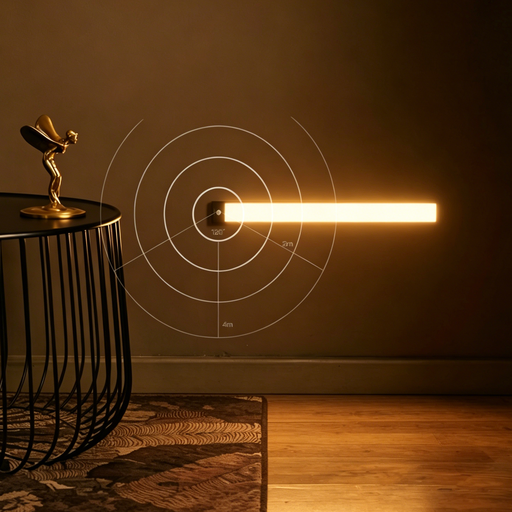
Why this suits the profile: The compact 20 cm length is ideal for small compartments, narrow shelves and targeted lighting in a wardrobe.
The short housing reduces the chance of the light protruding. Before purchasing, do check the current product page for charging method, sensor range and installation information.
Compact size and designed for cupboard use; the available product information is more limited than for the two USB-rechargeable variants.
We've put together a full, up-to-date list of products that fully meet these strict selection criteria and comply with current European safety regulations.
For a kitchen, a light under a cupboard is suitable as long as it is not placed directly above a wet sink or hob. For a wardrobe, the sensor position is more important than a high light output: the light needs to react as soon as you open the door or reach for clothes.
A PIR sensor detects movement within the specified range and switches the LED light on automatically. For the models described, that range is 3 to 5 metres. The light then switches off again according to the set mode. Check the product page to see whether the shut-off time is adjustable.
The usage time per charge depends on the number of activations, the light colour and the burn time. A built-in 1100mAh lithium battery gives information about the battery capacity, but not automatically about the exact number of hours of use. So, keep an eye on the charging indicator and recharge the light in good time via USB.
Yes, you can with models that support installation using self-adhesive tape. This works particularly well on a smooth, clean and dry surface. Check regularly that the fixing is still secure. In a damp room or on a dusty, rough surface, the tape may not adhere as well.
