
Vandaag of morgen in huis

Kwaliteit gegarandeerd

Welkomstaanbiedingen ontgrendelen: GRATIS bezorging | Tot 80% korting | Gratis 30 dagen JoyPlus-proefperiode
Download de app
A cabin suitcase may seem easy to choose at first glance. Yet the wrong size, awkward wheels and misleading capacity figures regularly lead to disappointment. A suitcase sold online as a cabin case will not automatically comply with every airline’s hand-luggage rules.
Marketing terms such as “extra strong”, “lightweight” or “suitable for all airlines” do not tell the whole story either. Always check the exact dimensions, empty weight and practical layout. Below, you’ll find out what to look for before buying a trolley suitcase for a city break, business trip or holiday lasting a few days.
A 20-inch suitcase can vary considerably from one model to another. Therefore, check the length, width and depth, including protruding parts such as wheels, handles and locks. Airlines apply different hand-luggage limits. Always check your airline’s current conditions before departure.
An expandable suitcase requires extra attention. The additional zip can provide more packing space, but when expanded, the suitcase also becomes deeper. This may affect whether it is accepted as cabin baggage.
An ABS suitcase is often a practical choice because of its low weight and shape retention. A PC suitcase, made from polycarbonate, is often described in product information as having a strong, flexible hard shell. However, the material alone does not determine how a suitcase performs on the move.
Also pay attention to the quality of the zips, corner protection, telescopic handles and wheels. A hard-shell suitcase with a good exterior can still be impractical if the handle has too much play or the wheels do not turn smoothly.
Capacity is sometimes measured without taking the lining, dividers and wheel housing into account. So, look at the internal layout. A suitcase with compression straps, a wet-and-dry compartment or internal zipped pockets may be more efficient to use than a model with just one large compartment.
For a suitcase for 3 to 5 days, litres are not the only important factor. Your choice of clothing, shoes and any laptop will also determine whether the packing space is sufficient.
For air travel, these three details are the starting point:
For example, a compact 18-inch trolley may offer a capacity of 30 litres, while a larger model may carry more luggage thanks to its wider shell but be accepted as hand luggage less often.
ABS, PC and combinations of plastics each have their own characteristics. ABS is often chosen for a relatively lightweight hard shell. In product descriptions, PC is often presented as a material offering a good combination of flexibility and protection. Also assess:
According to NINETYGO product information, the zip on the Rhine 2.0 has been tested for more than 2,500 cycles and a pulling force of 800 N. This is a product specification provided by the brand and is not a guarantee that every item will perform identically under all conditions.
A suitcase with spinner wheels usually has four double or single 360° wheels. This makes it easy to manoeuvre through stations, airports and hotel corridors. Check that the wheels turn smoothly in every direction and do not protrude too far.
A cabin suitcase with a TSA lock can be useful when luggage needs to be opened during security checks. A TSA lock does not prevent someone from physically damaging the suitcase, nor does it replace careful use. Set the default code straight away according to the instructions and keep your new code somewhere safe.

Why it suits this profile: This compact trolley has a capacity of 30 litres and weighs 2.5 kg according to the product information. That makes it suitable for travellers looking for their first cabin suitcase for short trips.
The exact dimensions of 52 x 34 x 22 cm and weight of 2.5 kg are clearly stated. However, check these details against your airline’s rules.
ABS hard shell, adjustable handle extending to 100 cm, combination lock and internal compartments.
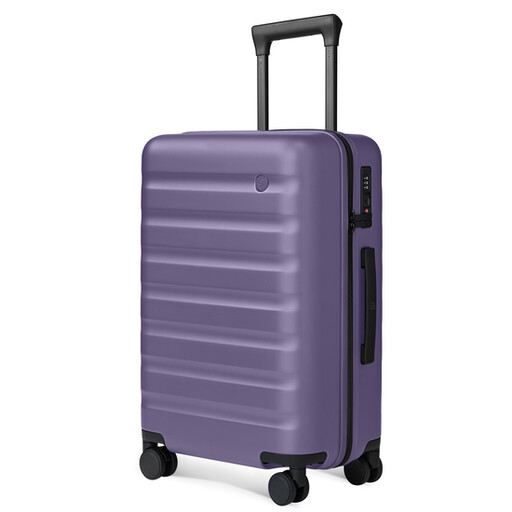
Why it suits this profile: This model is designed for travellers who place a high value on organised packing space, a PC hard shell and smooth manoeuvring during short holidays.
The dimensions of 56 x 38.5 x 23 cm are specified. According to the product information, the TSA lock and handles are recessed, so they protrude less.
PC material, double 360° wheels, compression straps, waterproof PVC zipped compartment and TSA lock.
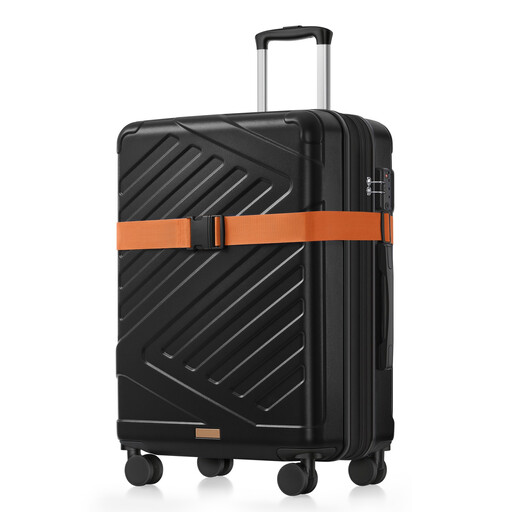
Why it suits this profile: This expandable hard-shell suitcase is ideal for travellers who need extra packing space and clear internal separation. Given its size, checking the airline’s requirements is particularly important.
The product information states 75 x 50 x 30 cm, 4.9 kg and a maximum static load of 18 kg. Do not fill the suitcase beyond its internal dimensions, and only use the expansion feature if the carrier permits it.
ABS hard shell, TSA lock, expandable capacity, 360° spinner wheels and a wet-and-dry layout.
We’ve put together a complete, up-to-date list of products that fully meet these strict selection criteria and the applicable European safety regulations.
Check before ordering:
This varies by airline, ticket type and route. Check the permitted length, width, depth and maximum weight directly with the carrier. A model sold as a cabin suitcase is not automatically suitable for every flight.
That depends on your priorities. ABS is often chosen for a relatively lightweight hard shell. PC may appeal to anyone who values a sturdy shell with some flexibility. Also consider the total weight, zip, wheels, handle and internal layout.
Its lifespan depends on how often you travel, how heavily you pack and how you handle the suitcase. Avoid overloading it, do not pull the trolley over rough surfaces, and regularly check the wheels, zips and handles. Good product specifications are useful when comparing models, but they do not guarantee a fixed service life.
