
Vandaag of morgen in huis

Kwaliteit gegarandeerd

Welkomstaanbiedingen ontgrendelen: GRATIS bezorging | Tot 80% korting | Gratis 30 dagen JoyPlus-proefperiode
Download de app
A blender can prepare smoothies, soups, sauces, dips and baby food in next to no time. However, not every appliance is suited to the same tasks. A compact smoothie maker can be useful for everyday use, while a multifunctional blender requires more space and power. A stick blender or hand blender may also be the right choice if you mainly want to blend ingredients directly in a pan or bowl.
The most important question, therefore, is not which blender looks the most impressive, but which specifications suit the way you plan to use it. Pay particular attention to these three common pitfalls.
A higher wattage may sound appealing, but it does not tell you how well an appliance will blend on its own. The blade design, jug shape, maximum operating time and available programmes all play a part. A 600 W blender may be suitable for fruit, vegetables and lighter preparations, while a 1200 W model makes more sense for larger portions or harder ingredients.
Also check whether the manufacturer specifies a maximum operating time. According to the product information, the 600 W ochama Multifunction Blender must not run continuously for more than one minute and must then be allowed to rest. This is important if you want to prepare several portions one after another.
The capacity shown on the packaging is not always the same as the amount you can process safely. The instructions and maximum fill line are the deciding factors. For one or two people, a 1.2 to 1.5-litre jug can be practical. Families or users who prepare several glasses at once may want to consider 1.75 to 2.1 litres.
A large glass jug does take up more space and may be heavier to clean. Measure the appliance’s height beforehand and check that it will fit beneath your kitchen cupboards.
A chopper, whisk or measuring cup can be useful, but only if you actually use these accessories. Consider how easily the parts come apart and which components are dishwasher-safe. The motor unit must never be submerged in water, whatever the model.
Also check blade safety. Always unplug the appliance before changing an accessory or cleaning the blade. Extra care is needed with a blender that includes a chopper, as the blades are often placed loose inside the bowl.
For simple smoothies, sauces and soft ingredients, an appliance with 450 to 650 W may be sufficient. A powerful blender with a higher wattage offers more reserve when processing frozen fruit, hard vegetables or larger quantities, but it will not automatically produce better results every time.
A blender with several speed settings gives you more control over the texture. A low setting is suitable for gently mixing liquids, while a higher setting helps with thicker mixtures. A turbo or pulse function provides short bursts of power, for example when roughly chopping or processing ice.
A glass jug is generally heavier than a plastic one, but feels more solid and is dishwasher-safe on some models. Always check the specific product information, as dishwasher suitability may vary between components.
A 600 to 800 ml measuring cup is useful for individual smoothies and small quantities of sauce. A larger jug is more practical for soup or several portions. For hot preparations, pay attention to the safety instructions. Do not use boiling liquids unless the manual expressly permits this. Some hand blenders, including certain Russell Hobbs models, state that liquids must first be allowed to cool below 80 °C.
If you regularly make frozen drinks, you will need a blender with an ice crusher or a pulse function. Do not just look for the words “ice crushing” in a title; check the instructions as well. According to the product information, the Braun MQ55254M is intended to crush ice using the SizeControl chopper. Do not simply use the stick blender attachment for this purpose.
For nuts, herbs, meat or hard cheese, a chopper is often more practical than a large jug. Check the capacity: a small 350 or 500 ml chopping bowl is suitable for limited quantities, not for preparing a complete meal.

Why it suits this profile: This model combines a 1.5-litre jug with three speeds and accessories for tasks including chopping, grinding and preparing baby food. According to the product information, the appliance is designed for home use and is easy to dismantle.
The three speed settings make the wattage more meaningful in everyday use. However, bear in mind the stated maximum operating time of one minute per cycle.
600 W motor, 1.5-litre capacity, ice-crushing function and components that are described as easy to clean.

Why it suits this profile: The 2.1-litre jug, 1200 W motor, 14 manual speeds and four programmes offer plenty of flexibility for households that regularly prepare larger quantities.
The capacity, maximum fill line and safety lock are central considerations, so you are not buying based on motor power alone.
1200 W, 2.1-litre jug, 700 ml cup, ice crusher and automatic programmes according to the product description.
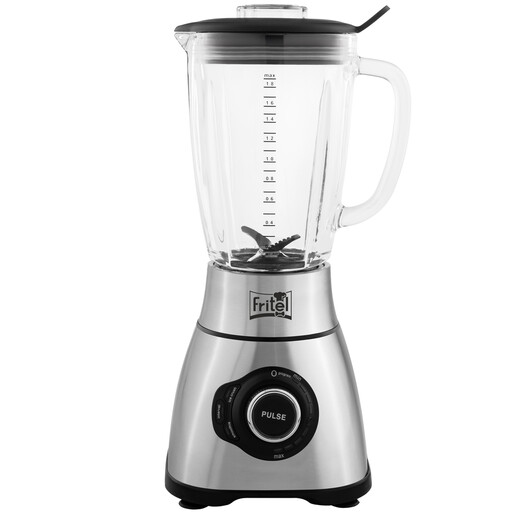
Why it suits this profile: This model has a 1.8-litre glass jug, nine speed settings and programmes for ice crushing, smoothies and interval blending. It is well suited to users who prepare a variety of recipes and have a permanent place for the appliance on the worktop.
The programmes and removable blade set provide more useful information than a power claim alone. However, the glass jug does make the appliance heavier.
1.8-litre glass jug, ice-crush programme, pulse function and dishwasher-safe components according to the product information.
A hand blender is compact and can be used directly in a pan or measuring jug. This is practical for soup, sauces and small portions. According to the product description, the Braun MQ55254M Multiquick 5 Pro has 1000 W, 25 speed settings, a turbo function and a 3-in-1 chopper. The Braun MQ10.201MWH has a simpler design with 450 W, one speed, a 600 ml measuring cup and a 350 ml chopper.
A stick blender generally requires less storage space than a jug blender. If you mainly expect to make smoothies for several people or want to process a lot of ice, a traditional blender is the more logical choice. For puréeing food in a pan every day, a stick blender may be more efficient.
We have put together a complete, up-to-date list of products that fully meet these strict selection criteria and the applicable European safety regulations.
The lifespan depends on how often it is used, how it is cleaned and whether you follow the operating time specified in the manual. Allow the motor to cool down between demanding blending cycles and do not process ingredients that the appliance cannot handle. The statutory guarantee in the EU is generally at least two years for consumers, but check the terms for each product.
This varies by model. Always check the manual and warnings. Avoid boiling liquids unless this is expressly permitted. When using a stick blender, it is also important to keep the blending foot fully submerged in the liquid to minimise splashing.
Energy consumption is determined by the wattage and operating time. An appliance rated at 1200 W uses 0.02 kWh theoretically when running for one minute; the actual cost depends on your energy tariff. Higher power does not automatically mean high running costs when the appliance is used for short periods. Focus on choosing a suitable capacity and avoid unnecessarily long programmes.
