
Vandaag of morgen in huis

Kwaliteit gegarandeerd

Welkomstaanbiedingen ontgrendelen: GRATIS bezorging | Tot 80% korting | Gratis 30 dagen JoyPlus-proefperiode
Download de app
Buying a trampoline seems straightforward, until you have to choose between a mini trampoline, a fitness model, an outdoor trampoline with a safety net or a folding trampoline. Marketing copy often focuses on the number of springs, a high maximum load or “silent” suspension. But these features don’t tell the whole story.
The most common buying mistakes come down to three pitfalls:
Looking only at the maximum load
A trampoline rated for 70 kg, 80 kg, 120 kg or 204 kg isn’t automatically suitable for every use. Its size, stability, suspension and handle also affect how comfortable and easy to control it feels.
Confusing indoor and outdoor use
An indoor trampoline isn’t necessarily built to withstand rain, wind and prolonged exposure to damp. An outdoor trampoline also needs enough clear space, level ground and, often, anchoring.
Mistaking safety features for risk-free use
A safety pad, foam cover or safety net can help support the design, but won’t prevent every accident. Always check the manufacturer’s assembly instructions, usage restrictions and warnings.
Check whether the stated weight is the maximum user weight, rather than just the frame’s load capacity. Allow for clothing, shoes and any extra movement. Models for children are available with a capacity of 25 kg, while fitness trampolines for adults often support 70 kg, 80 kg, 120 kg or more.
A trampoline for home use is generally used by one person at a time. So even if its load capacity is high, that doesn’t mean several people can jump on it at once.
Steel springs provide a familiar, direct rebound. With a mini trampoline that uses springs, a full foam cover over them is useful, as it makes it less likely for feet to come into contact with the spring system.
A quiet trampoline with elastic bands or bungee cords can be a good choice for flats and living-room workouts. Product descriptions for various models say that elastic bands are designed to provide a quieter rebound with less impact. This is a product feature, not a guarantee that the trampoline will be completely silent. The floor, footwear and workout intensity also make a difference.
Also check the number of springs or bands, whether the tension can be adjusted and whether replacement parts are available.
Measure not only the trampoline’s diameter, but also its height, including the handle or safety net. A trampoline with a handle can provide extra support during exercises, especially for beginners. The handle should be firmly attached and mustn’t wobble.
A folding trampoline is suitable for smaller homes, but check whether its folded size will really fit in a cupboard, storage space or under a bed. A 40-inch model is more compact than a 48-inch model, but it often has a smaller jumping surface too.
For outdoor use, you’ll need level ground and enough clearance from walls, trees and other obstacles. Some outdoor trampolines specify around 2 metres of clear space around and above the trampoline. Always follow the product’s specific instructions.

Why it suits this profile: This compact model is designed for indoor fitness, has an adjustable handle and arrives largely pre-assembled. The maximum user weight is 70 kg.
The product information clearly states the load capacity and describes a foam cover over the springs. Do check that 70 kg is suitable for your needs.
40-inch size, folding design, adjustable handle and 36 steel springs.
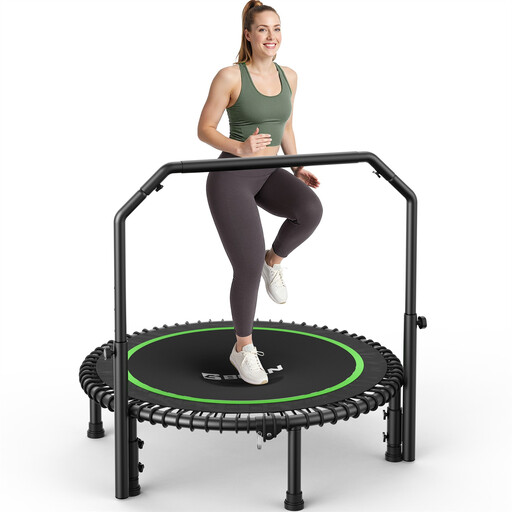
Why it suits this profile: The product description lists a steel frame, bungee cords, an adjustable handle and a maximum load of 204 kg. This makes it suitable for adults looking for a model with a generous load capacity.
The specifications list the load capacity and type of suspension separately. Before buying, still check that you have enough space and that the handle can be fitted securely.
Bungee suspension, adjustable handle, 102 cm size and a maximum load of 204 kg, according to the product information.
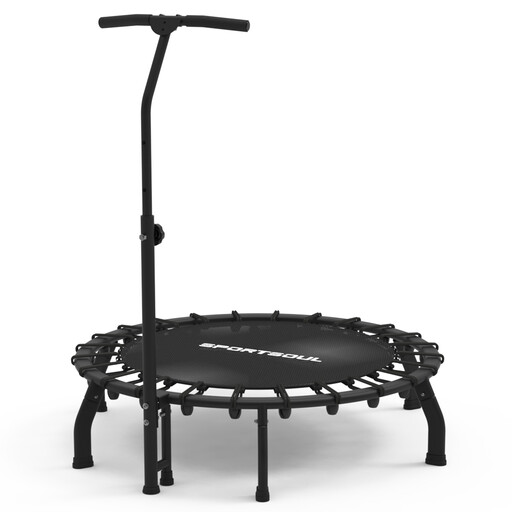
Why it suits this profile: This model is designed for indoor cardio and has a maximum user weight of 120 kg. The elastic bands and pre-assembled jumping mat are practical for regular workouts at home.
The description specifies elastic bands, rather than making only a general claim about comfort. Noise levels still depend on the floor and workout intensity.
42-inch diameter, 120 kg load capacity, elastic bands and minimal assembly, according to the product information.
A trampoline for children should mainly suit their age, height and the stated weight limit. SPORTSOUL 36-inch models with a capacity of 25 kg are designed for children and lighter users. Some versions have an adjustable T-handle; another model lists a full foam cover over the springs.
For the garden, Bestway Xtreme Air models are available in 2.44 metres and 3.05 metres. Both product descriptions mention a safety net, a zip fastening, foam around the poles and suitability for ages 6 and over. The 2.44-metre model has a maximum load of 80 kg; the 3.05-metre model is rated for 90 kg.
When choosing an outdoor trampoline, make sure you have:
A safety net reduces the chance of a child landing outside the jumping surface, but it doesn’t replace supervision or correct assembly.
We’ve put together a complete, up-to-date list of products that meet these strict selection criteria and the applicable European safety regulations.
For an indoor rebounder, you’ll need a level floor, enough ceiling height and clear space around it. With an outdoor trampoline, remember to account not only for its diameter, but also for the height of the safety net and the clear zone around the frame. Measure the space before ordering.
Its lifespan depends on the materials, how often it’s used, how it’s stored and how well it’s maintained. Regularly check the mat, springs or elastic bands, frame, foam pad and safety net. Outdoor models generally stay in good condition for longer if you store them somewhere sheltered during prolonged rain, storms or winter weather.
A rebounder trampoline can be used for light cardio and balance exercises. Some product descriptions also mention rehabilitation as a possible use. This doesn’t mean the product has been certified as medically suitable. If you have health concerns, an injury or are recovering from a medical condition, it’s best to consult a doctor or physiotherapist first.
