
Vandaag of morgen in huis

Kwaliteit gegarandeerd

Welkomstaanbiedingen ontgrendelen: GRATIS bezorging | Tot 80% korting | Gratis 30 dagen JoyPlus-proefperiode
Download de app
A toaster may seem like a simple kitchen appliance. However, choosing the wrong one can quickly lead to unevenly toasted bread, stuck slices or a worktop that is difficult to clean. If you only consider the colour, wattage or low price, you may overlook the specifications that make everyday use more convenient.
The main pitfalls are:
Below, you’ll find what to look for when buying a toaster, followed by several product choices for different households.
A 2-slot toaster is usually a good fit for students, couples and smaller kitchens. You can generally toast two slices at once while keeping the appliance compact. Do check that the slots are wide enough for your favourite bread.
A model with variable slot width can position thin and thicker slices more effectively. Some versions feature automatic centring, which keeps the bread positioned between the heating elements. This is a verifiable product specification, but it does not mean that every type of bread will produce exactly the same result.
A 4-slot toaster is practical for families or households where several people have breakfast at the same time. Pay attention to the overall size, wattage and controls. Some models can toast four slices simultaneously; in others, the product name refers to a long-slot design, while the listed specifications mention a different number of slots. Always check the technical details for the specific model.
A long-slot toaster is worth considering if you often use long slices, baguette or larger loaves. As well as the length, check the width and depth of the slot.
Slot size determines more than the number of slices. For thickly sliced bread, bagels and bread rolls, a toaster with wide slots is more suitable than a compact standard model. An extra-high lift is useful when you want to remove small slices safely without bringing your fingers close to the hot interior.
A bun warmer is handy for croissants and bread rolls that you would rather heat than place directly into a slot. Only use the rack as described in the instructions and never leave a switched-on appliance unattended.
A toaster with variable browning levels gives you more control over lightly or darkly toasted bread. Six to nine levels appear in the product specifications of various models. More levels are particularly useful when household members have different preferences, but the selected setting may work differently depending on the type of bread and its moisture content.
Wattage is given in watts. Models in this range vary, for example, from 600 W to 1.400 W. Higher wattage is not a guarantee of better toasting. Also consider slot size, automatic switch-off and the controls. For everyday use, functions such as cancel, reheat and defrost are often more practical than simply having higher wattage.
A toaster with a crumb tray is easier to empty. Unplug the appliance and allow it to cool completely before removing or cleaning the tray. Never immerse a toaster, cable or plug in water.
Also look for:
Do not put metal objects or oversized food into the slots. If bread becomes stuck, unplug the appliance first and wait until it has cooled down.
The choices below are linked to specific features mentioned in the product descriptions. Always check the current price, stock availability and full specifications on the product page before buying.
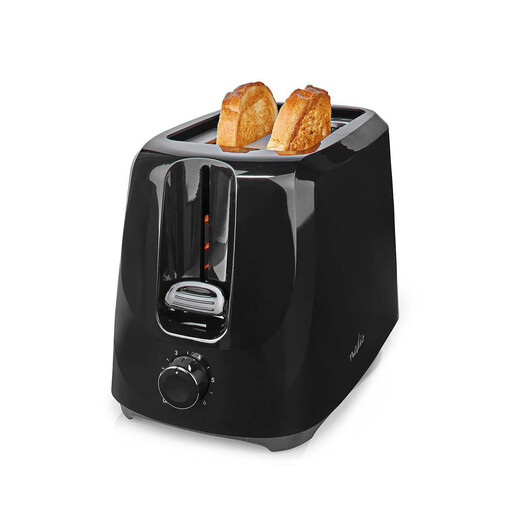
Why it suits this profile: According to the product specifications, this compact 2-slot model takes up little space and has six browning levels for everyday use.
The removable crumb tray and simple controls avoid unnecessary extra features and make regular cleaning straightforward.
Two slots, 700 W, six browning levels, non-slip feet and integrated cable storage.
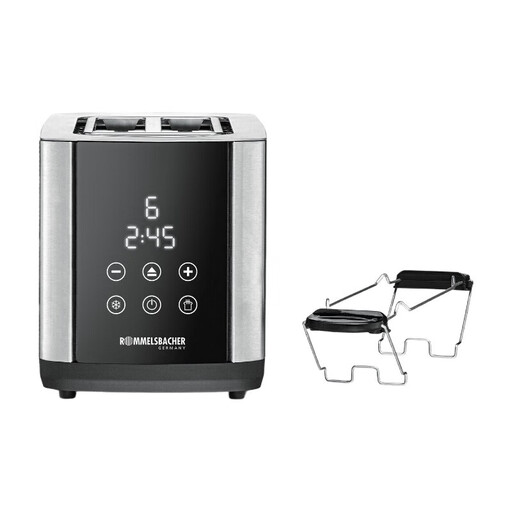
Why it suits this profile: The product description mentions a stainless-steel housing, wide slots and a display with countdown timer for those who want more control at breakfast.
The stated slot size of up to 12 × 12 cm helps prevent thicker or larger bread from not fitting inside the appliance.
850 W, nine browning levels, defrost, reheat, automatic centring and a removable bun warmer.
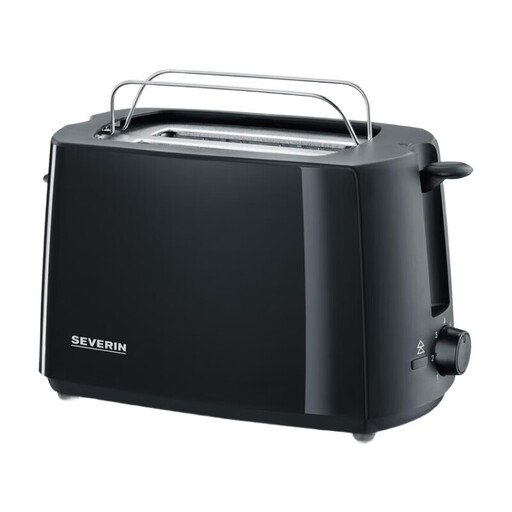
Why it suits this profile: If you want to heat small snacks, mini pizzas or pastries as well as toast, this model comes with a baking tray and lid.
The baking accessory is clearly described and has a lid. This makes it clear what the extra feature is intended for.
Two slots, seven browning levels, high lift, defrost, reheat and a removable crumb tray.
We’ve put together a complete, up-to-date list of products that fully meet these strict selection criteria and the applicable European safety requirements.
Its lifespan depends on usage, maintenance and the quality of its components. Empty the crumb tray regularly, do not leave the appliance unattended and prevent oversized food from becoming stuck. Also check the cable and housing for damage. The statutory warranty and any additional warranty are listed with the product.
Consumption depends on the wattage and how long the appliance is used. An 800 W model running for a few minutes uses less energy per cycle than a 1.400 W model switched on for the same length of time. Actual consumption is also affected by the number of cycles and the selected setting. So do not look at wattage alone; consider the combination of capacity, speed and your usage pattern.
You can with a toaster with a defrost function, provided the instructions allow it. The function generally extends the cycle to defrost the bread first and then toast it. Do not use damaged or unusually large bread, and stay nearby while the appliance is switched on.
