
Vandaag of morgen in huis

Kwaliteit gegarandeerd

Welkomstaanbiedingen ontgrendelen: GRATIS bezorging | Tot 80% korting | Gratis 30 dagen JoyPlus-proefperiode
Download de app
Buying a stand mixer seems straightforward until you start comparing motor power, bowl capacity and attachments. A mixer that’s suitable for cake batter won’t necessarily cope well with heavy bread dough. And a large mixing bowl isn’t always practical if you usually make small batches.
So, keep an eye out for these three common pitfalls:
You’ll generally need less power for batters, whipped cream and egg whites than for firm yeasted dough. So don’t just look at the stated power; also check:
A powerful stand mixer can be useful for families and keen home bakers, but the appliance needs to be suitable for the quantities you make. For example, Honinst recommends kneading heavy yeasted dough for no more than around 10 minutes at a time, then letting the mixer cool down. The Aucma ASM1559 has a stated maximum operating time of 6 minutes without a break.
A stand mixer with a 4 to 7-litre mixing bowl can suit a range of households. Just be sure to distinguish between the bowl’s total capacity and the recommended amount:
The Kenwood Go KZM35 has a 4-litre stainless steel bowl and a stated capacity of up to 1.4 kg of dough. The Kenwood Chef XL KVL4110 has a 6.7-litre bowl. The model is described as suitable not only for kneading and mixing, but also for use with optional attachments for tasks such as blending and slicing.
A stand mixer for baking needs at least three basic attachments:
Planetary mixing helps distribute ingredients around the bowl, but the precise action varies between models. Also check whether the head tilts, whether the bowl locks securely into place and whether the mixer stays firmly on the worktop.
Non-slip feet, suction cups and a splash guard are practical features. They won’t prevent every splash, but they can help keep things tidy on your kitchen worktop. Claims about noise levels, mixing action and motor performance are based on the product specifications and information provided by the relevant manufacturer or seller. If in doubt, always check the latest instruction manual.
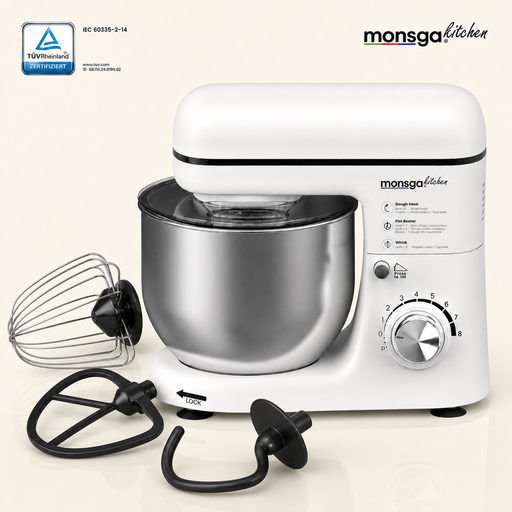
Why it suits this type of user: The recommended working capacity of 5 litres, eight speed settings and included whisk, beater and dough hook provide a versatile foundation for cakes, biscuits and everyday dough-making.
The product information distinguishes between 1000 watts of peak power and 600 watts of rated power. It also gives the recommended capacity of 5 litres alongside the maximum bowl capacity of 6 litres.
Stainless steel bowl, eight speed settings, splash guard and attachments that are listed as dishwasher-safe in the product information.

Why it suits this type of user: This model is designed for people who bake regularly and value a larger bowl, metal construction and added convenience.
The product specifications state a clear power rating of 1200 watts, a 7-litre bowl and automatic speed control. This makes it easier to compare the mixer based on practical details rather than marketing terms alone.
1200 watts of power, integrated scales, stainless steel construction and a 2-year manufacturer’s warranty, according to the product information.

Why it suits this type of user: A good choice for anyone looking for a generous bowl and the option to add attachments for baking, mixing and kneading.
The three basic attachments are clearly specified: a K-beater, whisk and dough hook. The 6.7-litre bowl also offers more room than compact models.
Automatic speed control, metal housing, stainless steel bowl and more than 20 optional attachments, according to the product description.
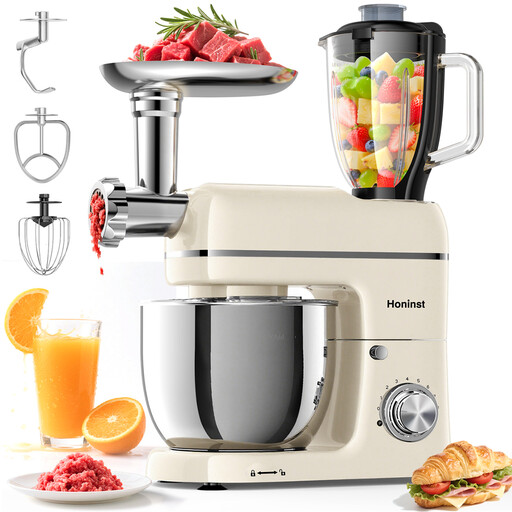
Why it suits this type of user: As well as mixing, whisking and kneading, the product description lists a meat mincer and blender, so one appliance can help with several kitchen tasks.
The extra functions come as separate attachments. Before buying, check whether you’ll actually use them, so you don’t pay for features that end up sitting unused in the cupboard.
6 QT stainless steel bowl, 8 speed settings plus pulse function, and a safety switch that activates when the head is raised, according to the product information.
We’ve put together a full, up-to-date list of products that meet these strict selection criteria and current European safety requirements.
Don’t just look at the highest wattage. For bread dough, rated performance, the recommended maximum dough capacity and the permitted operating time are just as important. Always start at a low speed and follow the instruction manual. If the motor slows down or gets warm while kneading, it needs a break.
Not always. A large bowl is useful for families and bigger batches, but the attachments may not reach smaller quantities as effectively. So check both the total capacity and the recommended minimum and maximum amounts.
Its lifespan depends on how it’s used, the load it handles, and how it’s cleaned and maintained. Never use more dough than recommended, let the motor cool down after heavy kneading and clean the housing only as instructed in the manual. Switch off the appliance and unplug it before changing or cleaning the attachments.
