
Vandaag of morgen in huis

Kwaliteit gegarandeerd

Welkomstaanbiedingen ontgrendelen: GRATIS bezorging | Tot 80% korting | Gratis 30 dagen JoyPlus-proefperiode
Download de app
A pan may look sturdy in the product photo yet prove awkward in everyday use. Think of a base that does not sit properly on your induction zone, a coating that becomes damaged quickly or a pan set containing sizes you hardly ever use. When buying pans, it is therefore wise to look at the specifications and your own cooking habits first.
Not every pan heats equally efficiently on every induction hob. Check whether the product information explicitly mentions induction and pay attention to the diameter of the magnetic base. For example, the Tefal Renewal ceramic frying pan lists a base diameter of 18 cm. This is most likely to fit a similar-sized cooking zone.
Do you use gas, ceramic, electric or halogen? Check whether these heat sources are mentioned too. A pan that the product specifications state is suitable for several types of hob gives you more flexibility if you change your kitchen in the future.
Ceramic pans and pans with a non-stick coating can be practical, but care instructions vary from model to model. Metal utensils, abrasive sponges and sudden changes in temperature can damage the surface. Even dishwasher-safe pans are not automatically resistant to wear.
Pay attention to the difference between:
Always follow the manufacturer's care instructions. Where a brand mentions features such as easy cleaning or even heating, this refers to information from the product description; it is not a guarantee that every dish will cook without sticking.
A large casserole dish takes up space and can become heavy when full. A frying pan that is too small, on the other hand, leaves ingredients overcrowded, so frying starts to resemble stewing. Choose the size based on the number of people you cook for and the dishes you usually prepare.
As a practical guide:
Stainless steel pans are popular thanks to their sturdy construction and the absence of an internal coating in many models. 304 stainless steel is a commonly used grade of steel for contact with food. According to the product information, the Purecook Tri-Ply cooking pan has an interior made from 304 stainless steel, a composite base and a glass lid.
3-ply pans generally consist of several layers of metal. According to the specifications, the Purecook 20 cm frying pan has stainless steel on the outer sides and an aluminium core. Aluminium conducts heat quickly, while stainless steel provides a sturdy outer layer. The exact heat distribution also depends on the base, hob and how the pan is used.
Cast-iron pans retain heat for a long time and are suitable for simmering, roasting and oven cooking. The downside is that they are heavy. According to the product specifications, the 22 cm Le Creuset Signature casserole weighs approximately 3,932 kg and has a capacity of 3,3 litres. This size is suitable for meals for around two to three people.
A coated frying pan is practical for eggs, pancakes and delicate fish. Use wooden, plastic or silicone utensils where the product information specifies this. A stainless steel frying pan often requires more care with preheating and fat, but does not have a traditional non-stick coating on the inside.
Also look at handles, lids and pouring rims. According to the product description, a glass lid helps you monitor the cooking process. A wide pouring rim can help reduce spills. Do check whether the handle is oven-safe and what temperature it can withstand.
If you have little time, look for dishwasher-safe pans. Always check whether this applies to the entire pan or only to certain parts. According to the specifications, the Tefal Duetto pan set is not dishwasher-safe, whereas the WMF Astoria pan set is listed as dishwasher-safe.
Allow cast-iron and enamelled pans to cool down gradually before washing them. Avoid abrasive products and dry unprotected edges carefully. This helps reduce the risk of scratches, stains and rust.
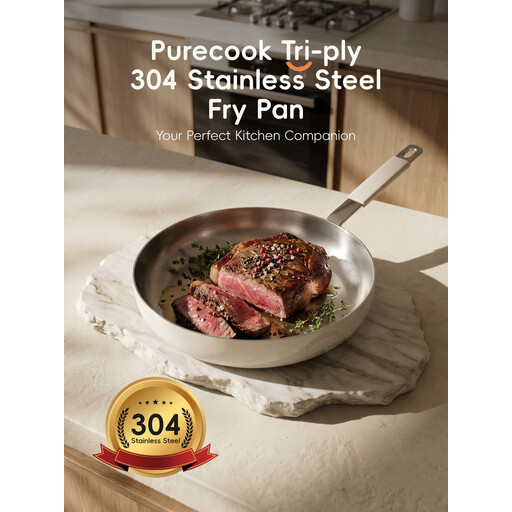
Why it suits this profile: The 22 cm diameter is practical for one or two people. According to the product specifications, the pan is suitable for induction and gas and has an interior without a chemical non-stick coating.
The size helps prevent overcrowding, and the specifications mention several types of hob. Use gentle kitchen utensils and a mild cleaning product to protect the surface.
Tri-ply construction, 304 stainless steel, insulated silicone sleeve and a smoothly finished rim.
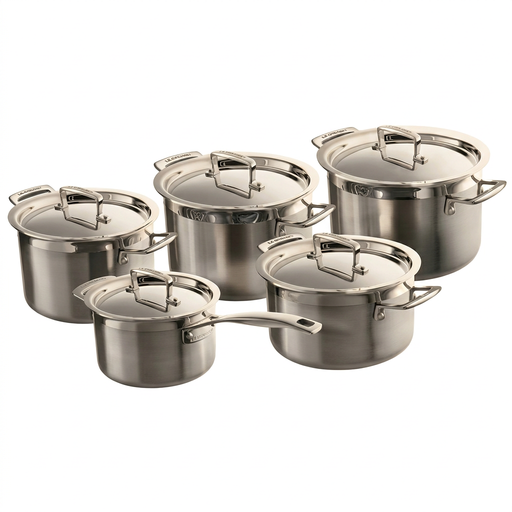
Why it suits this profile: According to the product information, this pan set contains five cooking pots with lids and is suitable for gas, electric, halogen, induction, ceramic cooking and oven use.
The different sizes mean you do not need to find a separate pan for every dish. No non-stick coating is listed, so coating care is less of a concern.
3-ply construction, graduated sizes and dishwasher-safe design according to the product details.
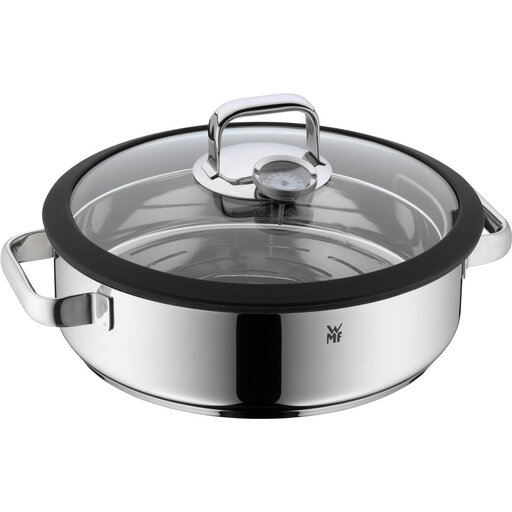
Why it suits this profile: According to the product information, the 28 cm pan has a capacity of approximately 5 litres, a steaming insert and a glass lid with thermometer. This makes it suitable for keen home cooks who regularly steam, roast and stew.
The capacity is clearly stated, and the pan offers more than just frying. Do bear in mind that the thermometer needs to be cleaned separately.
5-litre capacity, steaming insert, thermometer and use on induction and other listed heat sources.
We have put together a complete, up-to-date list of products that fully meet these strict selection criteria and the applicable European safety regulations.
For most households, a 24 or 28 cm frying pan, a 16 to 20 cm cooking pot and a larger cooking pot with a lid will be sufficient. A pan set can offer good value if you genuinely use the different sizes. If you mainly cook for one or two people, you will often get more use out of a few individual pans.
Stainless steel pans are only suitable for induction if the base is magnetic and this is stated in the product information. Also check the base diameter and the size of your cooking zone. The composition of 3-ply pans can vary from model to model, so do not just look for the words “stainless steel”; check the full material and compatibility information.
Lifespan depends on the material, how the pan is used and how it is cared for. Cast-iron pans can be heavy and durable, but require careful handling when it comes to enamel and temperature changes. Pans with a non-stick or ceramic coating are more susceptible to scratches and overheating. Stainless steel pans without an internal coating do not have a coating that can come away, but they can still discolour or become scratched. Use the pan on the correct heat source, avoid abrasive products and store pans with enough space between them.
