
Vandaag of morgen in huis

Kwaliteit gegarandeerd

Welkomstaanbiedingen ontgrendelen: GRATIS bezorging | Tot 80% korting | Gratis 30 dagen JoyPlus-proefperiode
Download de app
Choosing a new pan may seem straightforward, but product pages often use terms that do not tell the whole story. If you focus only on an attractive coating or a low price, you could end up with a pan that is unsuitable for your hob, gets damaged quickly or is difficult to clean.
These points will help you when buying pans for everyday use in a UK household.
A pan may be suitable for gas, electric and ceramic cooking, but not for induction. This is sometimes mentioned only in the technical specifications. For example, the 28 and 32 cm Tefal Easy Cook & Clean frying pans are suitable for gas, electric and ceramic hobs, but explicitly not for induction.
Always check:
A non-stick pan can make cooking and cleaning easier, but the coating usually requires careful handling. Metal utensils, heating an empty pan to a high temperature and suddenly running cold water over a hot pan can all shorten its lifespan.
A ceramic pan and a pan with a traditional non-stick coating also have different properties. Follow the manufacturer’s care instructions rather than relying only on terms such as “durable” or “extra strong”.
These terms do not automatically mean the same thing. PFOA-free refers to one specific substance. PFAS-free is a broader designation. “Teflon-free” generally describes the absence of a branded PTFE coating, but on its own it does not say which other materials have been used.
If this matters to you, look for an explicit product specification such as “PFAS-free” or “without PTFE”. Coating and material claims come from the brand’s or manufacturer’s product information. Treat them as product specifications and check the packaging or manufacturer’s details if you are unsure.
The right size depends on your cooking habits and household:
A frying pan is suitable for frying and searing. A sauté pan often has higher sides and is useful for sauces, stews and larger quantities. A wok is practical for stir-frying, but check that the base makes good contact with your hob. An omelette pan with sections is mainly intended for specific breakfast dishes or portioned cooking.
Aluminium generally heats up quickly and is relatively light. Stainless steel, or RVS, is sturdy and suitable for high temperatures, but food can stick more easily if the pan is not preheated correctly or not enough fat is used.
An RVS pan with a sandwich base or multiple layers can distribute heat more evenly. An induction pan needs a magnetic base. A heavy base stays more stable, while a lightweight aluminium pan may be more comfortable for everyday use.
When choosing a non-stick pan, look out for:
A dishwasher-safe pan is convenient, but hand-washing can help keep the coating in good condition for longer. A saucepan with a lid is useful for simmering and boiling. A glass lid lets you monitor your dish without unnecessarily releasing heat and steam.
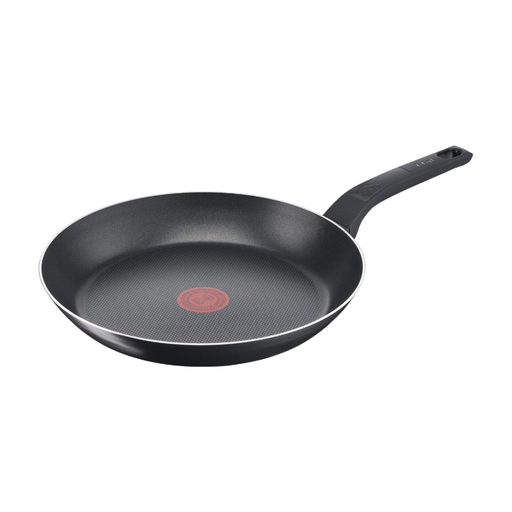
Why it suits this profile: A popular size for everyday frying and larger portions. According to the product information, this pan has an aluminium body and a PFOA-, lead- and cadmium-free titanium non-stick coating, and is suitable for gas, electric and ceramic cooking.
The compatibility and care information are clearly stated. Please note: this pan is not suitable for induction.
28 cm, dishwasher-safe according to the product information and suitable for oven use up to 250 °C.
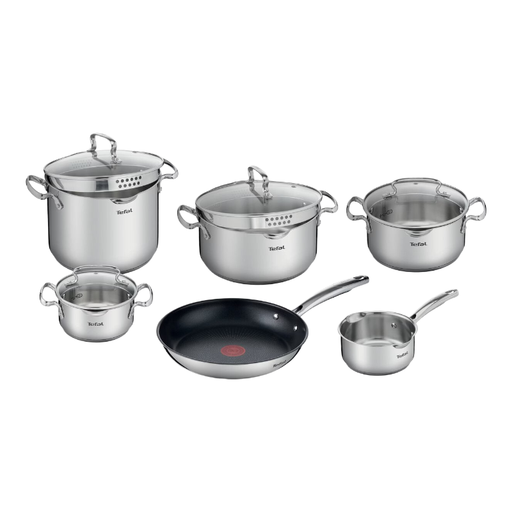
Why it suits this profile: This six-piece pan set contains saucepans, a stockpot, a milk pan and a frying pan. According to the product specifications, the RVS pans are suitable for gas, electric, ceramic, halogen and induction hobs.
The set specifies the individual sizes, included lids and compatible heat sources. It has no non-stick coating, avoiding confusion about coating care.
RVS construction, glass lids, measurement markings and pouring spouts. Not dishwasher-safe according to the product information.
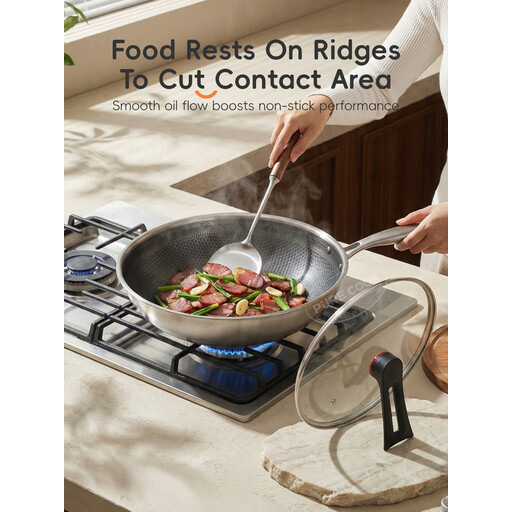
Why it suits this profile: The deep wok shape is designed for stir-frying, frying, braising and stewing. According to the manufacturer, the pan has a three-layer 304 RVS construction and is suitable for gas, induction and electric ceramic hobs.
The product information lists all hob types and recommends hand-washing. This makes it clear in advance that dishwasher convenience is not the priority.
32 cm, glass lid, versatile use and a rolled rim for controlled pouring.

Why it suits this profile: This pan is designed for smaller everyday meals. According to Brabantia, it has a PFAS-free ceramic coating, a recycled aluminium body and an RVS handle. The pan works on induction, gas, electric and ceramic hobs.
The PFAS-free claim is stated explicitly in the manufacturer’s description. Also follow the recommended hand-washing instructions to protect the ceramic coating.
24 cm, oven-safe up to 200 °C, dishwasher-safe according to the product information and suitable for all the heat sources listed.
Check the following before completing your purchase:
We have put together a complete, up-to-date list of products that fully meet these strict selection criteria and the applicable European safety regulations.
Choose a pan with a magnetic base and check that the stated base diameter matches your induction zone. “Suitable for all heat sources” is only meaningful if induction is explicitly mentioned.
This depends on use, temperature and care. Do not use metal utensils, avoid heating the pan empty for extended periods and let it cool down before washing it. Replace the pan when the coating starts to come away or the handle becomes damaged.
A pan set can be good value if you need several sizes. However, check that you will use every item. For a small household, one frying pan, one saucepan with a lid and possibly a wok may be more practical than a large set.
