
Vandaag of morgen in huis

Kwaliteit gegarandeerd

Welkomstaanbiedingen ontgrendelen: GRATIS bezorging | Tot 80% korting | Gratis 30 dagen JoyPlus-proefperiode
Download de app
When you’re buying markers, you’ll quickly come across dozens of sets with different tips, inks and colour counts. A set with lots of colours may look appealing, but it won’t automatically suit your surface or purpose. For school, drawing, journaling, crafting or painting on wood, different features matter.
The three most common mistakes come from:
By checking the ink, tip and age recommendation properly, you can avoid markers that dry out quickly, bleed through or turn out to be unsuitable for your project.
The surface determines which type of marker you need. Look out for these differences before you buy:
So a description like “markers for paper and wood” doesn’t tell you enough. Also look at the stated ink type and the surfaces the manufacturer lists the product for.
The tip directly affects ease of use:
With acrylic markers, a marker with two tip sizes can be practical. The Faber-Castell Acrylic Marker Sets in the product information provided have a tip of 1 mm and 3 mm. The markers are activated by shaking them with the cap closed 20 to 30 times, then pressing the tip repeatedly until the ink flows. That’s not a fault, but part of how they work.
For children aged 4 and over, the Faber-Castell felt-tip pens in the information provided come with an EN 71 quality label and a recommended minimum age of 4 years. According to the product description, the ink is washable from hands and skin and can be washed out of most fabrics at 30 degrees. “Washable” doesn’t mean every stain will disappear completely from every fabric. When using with young children, therefore, use a protected surface and check the packaging.
Also look out for:
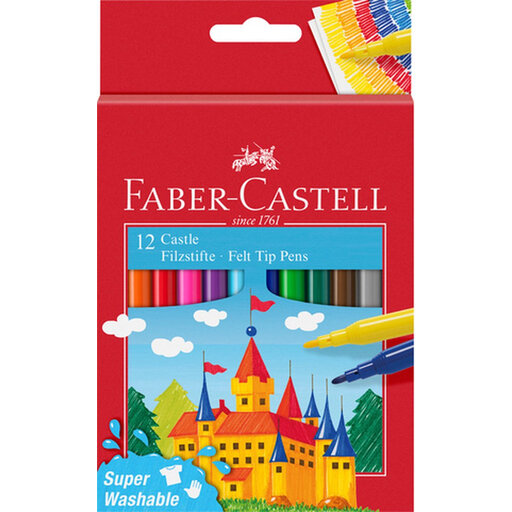
Why this fits the profile: This set contains 12 colourful pens for drawing and colouring on paper, card and wood. The sturdy tip and recommended minimum age of 4 years make it suitable for everyday use by children.
The set opts for a manageable number of colours and a sturdy tip, rather than a large range that could be awkward for young users.
12 colours, sturdy tip, water-washable ink according to the product description and EN 71 listing.

Why this fits the profile: For illustrations, sketches and colour gradients, this set offers 24 alcohol markers with a flexible brush tip from 1 to 5 mm and a fineliner tip of 0.6 mm.
The two tip shapes allow both broad colour areas and fine detail work. Do bear in mind possible bleeding on thin paper.
24 colours, brush tip, 0.6 mm fineliner tip and alcohol ink that dries quickly according to the product description.

Why this fits the profile: These acrylic markers are intended for projects on multiple surfaces, including wood, canvas, glass and ceramic. The six standard colours are useful for basic decoration and clear markings.
The product description lists specific surfaces and two tip sizes. This makes it clearer in advance whether the marker suits your project.
6 colours, water-based acrylic ink, 1 mm and 3 mm tips and an ink level indicator.
For school, study and planners, highlighters with a chisel tip are often more practical than drawing markers. A WRITECH set contains, according to the product information, eight highlighters with a soft chisel tip. The extendable WRITECH version contains six neon colours and a tip for lines from 1 to 4 mm. Check the exact contents of each product, as product titles and images can suggest different quantities.
If you mainly do hand lettering and small texts, you might also look at brush pens. The Faber-Castell Brush Pen Set contains 50 colours, a soft tip and washable ink based on food colourings according to the product description. This set is intended for light paper and not for black paper.
We’ve put together a full, up-to-date list of products that fully meet these strict selection criteria and current European safety regulations.
For children aged 4 and over, felt-tip pens with a sturdy tip and a stated age recommendation are practical. Also check whether the product mentions a relevant safety label, such as EN 71, and whether the ink is washable according to the packaging. Keep permanent markers and paint markers out of reach of young children.
That depends on the ink and the paper thickness. Water-based ink from felt-tip pens and highlighters often bleeds through less than alcohol ink, but this varies by paper. Test a marker first on a page behind. For sketch markers, thick marker paper is usually a safer choice.
Put the cap back on immediately after use and check that it closes fully. Store markers according to the product instructions, away from heat and direct sunlight. With brush pens and felt-tip pens, regular use helps, but a dried-out tip isn’t always recoverable. So don’t just judge a set by its price, but also by the tip, ink type and the surface you need the markers for.
