
Vandaag of morgen in huis

Kwaliteit gegarandeerd

Welkomstaanbiedingen ontgrendelen: GRATIS bezorging | Tot 80% korting | Gratis 30 dagen JoyPlus-proefperiode
Download de app
A dead battery always happens unexpectedly. You turn the key and hear nothing but a disappointing click. In the past, this meant waiting for roadside assistance or hoping for a helpful neighbour with jumper cables. Today, a jump starter or booster pack offers a fast, independent solution.
But when buying a jump starter, it's easy to fall into the trap of marketing promises. Many models look impressive on paper but leave you out in the cold when it really matters. As a Joybuy Product Recommendation Officer, I'll help you make the right choices by exposing the most common pitfalls.
Before you invest in a car jump starter, it's crucial to know what to look for. Manufacturers often use specifications that create more confusion than clarity.
Many jump starters advertise an enormous peak power, like 3000A or 4000A. This number sounds impressive, but it only represents the maximum current the device can deliver for a fraction of a second. For actually starting your car, the continuous starting current (cranking amps) is far more important—a specification that is often less prominently displayed. An excessively high peak current for a small city car is unnecessary and drives up the price.
The capacity, expressed in milliampere-hours (mAh), is another point of confusion. The advertised capacity (e.g., 20,000 mAh) is usually based on the internal 3.7V cells. Because a 12V jump starter starts your car at 12V, the effective capacity you can actually use is significantly lower. This makes it difficult to compare the true performance of a jump starter power bank.
Cheaper models often cut corners on essential safety features. A good car starter must, at a minimum, be protected against reverse polarity (connecting the clamps incorrectly), short circuits, and overheating. Without these protections, you risk not only damaging the jump starter itself but also your car's sensitive electronics.
To avoid a bad purchase, focus on the specifications that truly matter.
The required starting power depends on your engine. A compact petrol car will be fine with a portable jump starter with 800A to 1500A of peak power. For a larger SUV or a jump starter for a diesel engine, a model with 1500A to 3000A is a wiser choice. Diesel engines have higher compression and require significantly more power to start, especially in cold weather.
Think about how you plan to use the jump starter. Is it purely for emergencies, or do you also want to be able to charge your phone or laptop? A model with a higher mAh rating and multiple USB ports can function as a fully-fledged power bank. A jump starter with a compressor is ideal for those who also want to inflate tyres, air mattresses, or balls, but it is often larger and heavier.
Always check if the jump starter is equipped with the following protections:
Below are a few models selected based on their specifications and functionality, tailored to different user profiles.
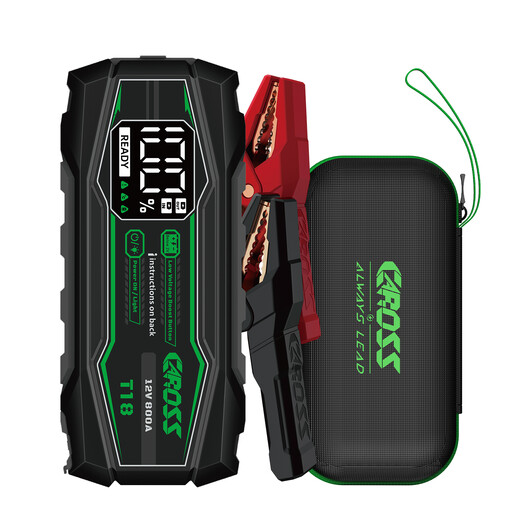
Why This Fits Their Persona: Ideal for drivers of compact to mid-size petrol cars. This model is small enough for the glove compartment and offers enough power for most daily commutes, without unnecessary extras.
This model avoids the peak amp myth by offering a realistic 800A, more than enough for its target audience. It includes crucial spark-proof and reverse-polarity protection, which are often missing in cheaper alternatives.
Very compact and lightweight. It comes with a sturdy storage case, keeping everything neatly together.
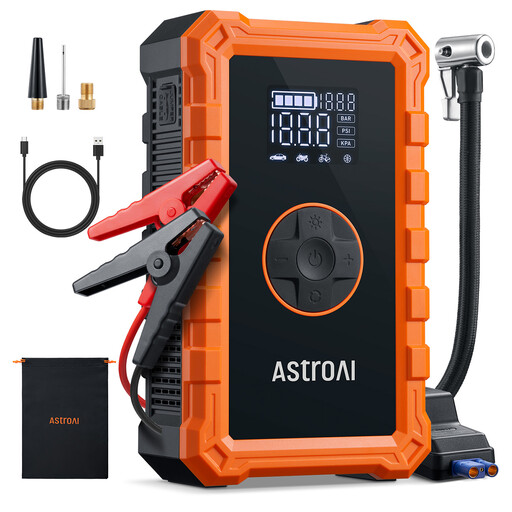
Why This Fits Their Persona: Perfect for owners of an SUV, camper, or boat, and for families who want to be prepared for anything. The built-in compressor is a practical addition for inflating tyres, air mattresses, or toys.
Instead of focusing on a single exaggerated spec, this model combines solid starting power (1500A) with a genuinely useful extra feature. The specifications are clear and focused on practical utility.
All-in-one solution: a reliable jump starter, a 150PSI tyre inflator with auto-stop, and a power bank in one device.
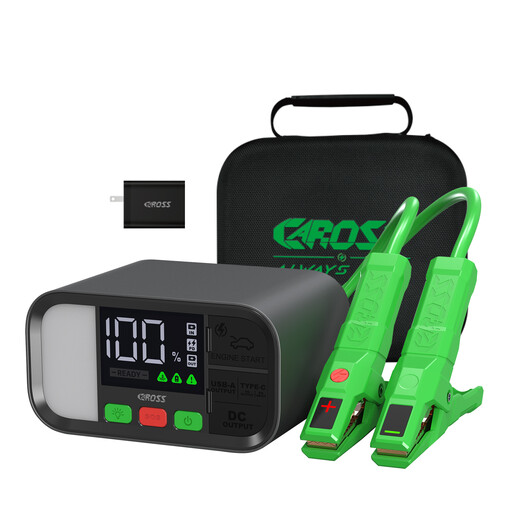
Why This Fits Their Persona: For those looking for the latest technology and maximum convenience. The PD65W output can even charge a laptop, while the unique clamps make connecting it completely foolproof.
This model focuses on tangible innovation rather than empty marketing. The 'Smart Connect' technology is a concrete solution for the fear of connecting clamps incorrectly. The premium materials and large screen justify its positioning.
Unique reverse-polarity-proof clamps make connection foolproof. The PD65W port makes it a powerful power bank for laptops and other large devices.
We have compiled a complete, up-to-date list of products that fully meet these strict selection criteria and safety regulations.
Most manufacturers recommend charging the jump starter every 3 to 6 months, even if you don't use it. Lithium batteries slowly lose their charge over time. By charging it periodically, you ensure the battery remains in good condition and is always ready for use.
Yes, many modern jump starters have a special 'Boost' or 'Force Start' function. This is specifically designed to start batteries that are so depleted they have no residual voltage. Consult your model's manual to see how to activate this feature.
Not necessarily. It's more important to choose a model that matches your vehicle. A jump starter with extremely high amperage is unnecessary and more expensive if you drive a small city car. Match the starting power to your engine size and fuel type (petrol or diesel) for the best price-performance ratio.
