
Vandaag of morgen in huis

Kwaliteit gegarandeerd

Welkomstaanbiedingen ontgrendelen: GRATIS bezorging | Tot 80% korting | Gratis 30 dagen JoyPlus-proefperiode
Download de app
Buying a fridge seems simple, until it won’t fit through the doorway, doesn’t offer enough space or makes more noise than you expected. The differences between models can be significant, especially when choosing a compact fridge, tabletop fridge or mini fridge.
Don’t base your choice on price or appearance alone. Above all, check the dimensions, net capacity, energy rating, noise level and whether it has a freezer compartment. This helps you avoid paying for features you won’t use or choosing a fridge that isn’t practical for your home.
A fridge that’s around 55 cm wide may still offer little usable space inside due to thick insulation, a large motor compartment or an awkward layout. So check the net capacity in litres, not just the external dimensions.
Also measure the entire space:
A 55 cm-wide fridge won’t automatically suit every kitchen. The depth and door-opening direction can be just as important.
A tabletop fridge with a freezer compartment is handy for ice, frozen vegetables or a few meals. Its capacity is often around 13 to 17 litres. That’s not the same as having a full-size freezer.
So check:
In some mini fridges, a small compartment is intended mainly for temporarily storing food that’s already frozen. For example, according to the product specifications for the Salora CFB4300WH, the freezer compartment isn’t designed to freeze food from fresh.
Compare the stated noise level in dB and annual energy consumption in kWh. A difference of a few decibels can matter in a student room, studio flat or office, while energy consumption affects running costs.
Current European energy labels range from A to G. A model with an energy rating of C or D sits differently on the label from one rated E or F. Always check the actual annual energy consumption. It’s a better basis for comparison than simply relying on the words “energy-efficient” in a product title.
For a student room, office or holiday home, 43 to 92 litres may be enough. A tabletop fridge with a capacity of 107 to 133 litres offers more room for everyday groceries, but also takes up more floor space.
A freestanding fridge of around 260 litres is suitable for a small household looking to combine fridge and freezer space. For families or larger grocery shops, a large fridge with over 300 litres is more practical. If you’re considering one, also check that a height of around 180 cm will fit in your kitchen.
A level of around 37 to 39 dB is generally better suited to an open-plan kitchen, bedroom or home office than a model at around 41 dB. The noise level is measured under specified conditions. How loud the fridge seems can vary depending on the floor surface, ventilation clearance and when the compressor switches on.
So if you’re looking for a quiet fridge, compare the official dB specifications rather than relying on product names alone.
A fridge with a reversible door gives you more flexibility when positioning it. Check that the hinges can actually be changed over and that the instructions explain how to do so.
Useful features include:
A fridge without No Frost can still work well, but may need to be defrosted manually from time to time. With a fridge freezer, the difference between automatic and manual defrosting is particularly important.

Why it suits this buyer: At 47.4 cm wide, this model is designed for small kitchens, offices and student rooms. It has a net capacity of 92 litres.
The official product specifications list its external dimensions, 39 dB noise level and annual energy consumption of 85 kWh. This lets you compare its size and energy use in advance.
47.4 cm wide, with adjustable glass shelves, a chill drawer and a reversible door. This model has no freezer compartment.
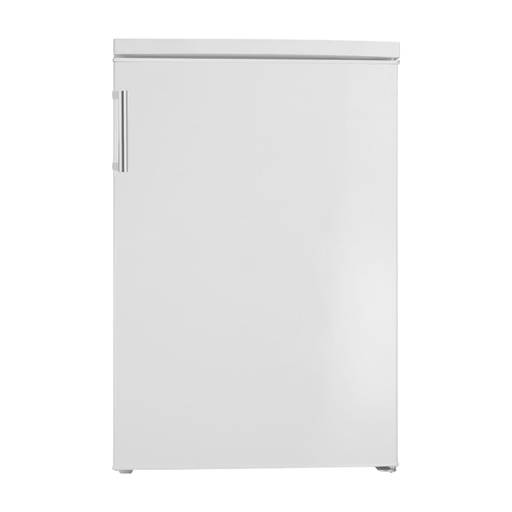
Why it suits this buyer: This tabletop model combines a total capacity of 133 litres with a 95-litre fridge compartment and a 14-litre freezer compartment.
The specifications clearly list the fridge and freezer capacities separately. The stated noise level is 37 dB, and manual defrosting is required.
Energy rating C, 89 kWh per year, three glass shelves and a reversible door.

Why it suits this buyer: With 187 litres of fridge space and 73 litres of freezer space, this model is designed for households looking for one larger appliance.
The product information lists its width of 54.5 cm, 40 dB noise level and manual defrosting. This makes installation and maintenance clear in advance.
260 litres of total capacity, three freezer drawers, LED lighting and a reversible door.
Place a freestanding fridge on a stable, level surface and keep the ventilation openings clear. Don’t position it right next to an oven or radiator, or in direct sunlight. If it has been transported horizontally, leave it upright for the period specified in the instructions before plugging it in.
For a fridge for an office or student room, it’s a good idea to check the noise level and minimum ambient temperature. Not every fridge is suitable for a cold storage room or unheated garage.
We’ve put together a complete, up-to-date list of products that meet these strict selection criteria and the current European safety regulations.
For one person, around 90 to 150 litres may be enough, depending on how often you shop. A household with several people will generally benefit more from a fridge freezer with a capacity of around 250 litres or more. As well as the total capacity, consider the balance between fridge and freezer space.
It depends on the annual energy consumption in kWh and your electricity tariff. Multiply the annual consumption shown on the energy label by your price per kWh. According to the specifications, an appliance using 90 kWh a year consumes less electricity than a comparable model using 170 kWh, under the same conditions.
Lifespan varies depending on the model, how it’s used and how well it’s maintained. Good ventilation, a door that seals properly, defrosting when needed and keeping the condenser clean all help the appliance work as it should. Before ordering, also check the statutory guarantee and any additional manufacturer’s guarantee.
