
Vandaag of morgen in huis

Kwaliteit gegarandeerd

Welkomstaanbiedingen ontgrendelen: GRATIS bezorging | Tot 80% korting | Gratis 30 dagen JoyPlus-proefperiode
Download de app
Buying a food mixer may seem straightforward until you compare the differences between a stand mixer, food processor, blender and mini chopper. Manufacturers often highlight high wattages, multiple speeds and a wide range of accessories. However, these figures don’t always tell you how well an appliance will work in a typical UK kitchen.
Look out for these three common pitfalls:
A stand mixer is best suited to whisking, mixing and kneading. If you regularly make bread, pizza, cakes or biscuits, look for a stable machine with a dough hook, sturdy bowl and a range of speeds.
A food processor works differently. It’s useful for chopping, grating, slicing, mixing and sometimes kneading. A blender is mainly designed for liquid recipes such as smoothies, sauces and soups. A compact mini chopper is handy for herbs, vegetables, nuts or small portions.
If you’re looking for one appliance to handle several tasks, consider a multifunction food mixer. Before you buy, check:
Power is measured in watts. A higher figure may indicate greater motor capacity, but performance also depends on the design, gearing and quantity of food. A food mixer kneading dough will be under more strain than a blender processing soft vegetables.
Also check the instruction manual. Some appliances should only run for short periods at a time and need to cool down afterwards. Never exceed the maximum quantity of dough or ingredients either. For frequent use, overheating protection, a sturdy drive system and a stable base are useful features.
A food mixer with a stainless steel bowl is generally easy to clean and won’t absorb food odours. Check the difference between the maximum capacity and the recommended working capacity. For example, the Monsga SM100 is advertised with a 6-litre bowl, while the product information gives a recommended working capacity of 5 litres.
For smaller households, a food processor with a bowl of around 1.3 to 2.1 litres may be more practical. A compact bowl saves storage space, but is less suitable for large quantities of dough or batch cooking.
Multiple speeds give you more control when whisking, mixing and kneading. A low setting is usually suitable for gently combining ingredients, while a higher setting is used for whisking until light and airy or for processing ingredients finely. A pulse setting is handy for chopping and coarse processing.
Also check whether the machine has a safety lock, splash guard, non-slip feet and automatic shut-off. Blades and grating discs are sharp: always unplug the appliance before changing or cleaning attachments. A CE mark indicates conformity, but doesn’t guarantee that an appliance is suitable for every use.

Why it suits this user: A straightforward food mixer for home bakers who want to get started with cakes, bread, pizza and batters.
The product information lists 400 watts, a 5-litre bowl and 10 speeds. This makes it easier to assess the power than with a model that only gives a peak figure.
Stainless steel bowl, dough hook, whisk, beater, splash guard and pulse function, according to the product description.

Why it suits this user: A good choice for anyone looking for a compact food mixer for baking, with a metal body and straightforward controls.
According to the product information, the recommended maximum dough quantity is 1.4 kg. This gives you a clearer idea of the usage limit than a general claim about large capacity.
4-litre stainless steel bowl, 6 speeds with pulse setting and a connection for optional attachments.

Why it suits this user: Designed for families and home bakers who make larger quantities of batter or dough.
The product description lists both a peak power of 1000 watts and a rated power of 600 watts. It also gives 5 litres as the recommended capacity for the 6-litre bowl.
8 speeds, stainless steel bowl, dough hook, whisk, beater and splash guard, according to the product specifications.
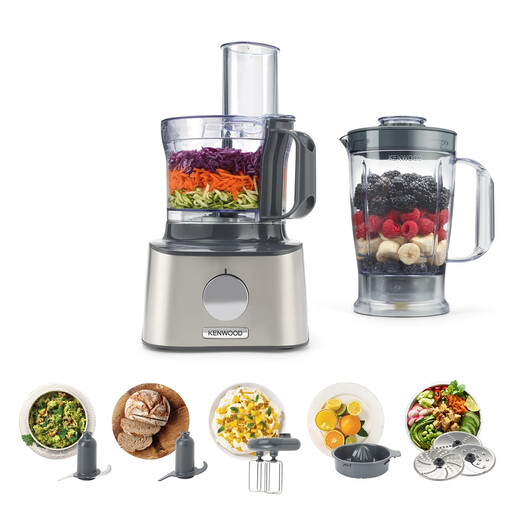
Why it suits this user: A food processor for anyone who mainly wants to chop, grate, slice, mix and make juice with one core appliance.
The product information specifies a 2.1-litre bowl and a 1.2-litre blender capacity. This helps you match the capacity to typical family portions.
800 watts, two speeds, a blender function and attachments for chopping, grating, slicing, kneading and whisking.
We’ve put together a full, up-to-date list of products that meet these strict selection criteria and the applicable European safety requirements.
Yes, a stand mixer with a dough hook can be suitable for bread dough, but always check the maximum dough capacity and recommended running time. A large bowl doesn’t automatically mean you can fill it completely with heavy dough.
It depends on what you’ll use it for. Lower power may be enough for chopping and light preparation. If you regularly knead heavy dough, motor power, the drive system, stability and overheating protection are all more important than the wattage printed on the packaging alone.
Energy use depends on the appliance’s power and how long it runs. An 800-watt appliance running for a few minutes won’t necessarily use more energy than a lower-wattage model that runs for much longer. Use the right speed, avoid processing unnecessarily large portions and follow the rest periods in the manual.
