
Vandaag of morgen in huis

Kwaliteit gegarandeerd

Welkomstaanbiedingen ontgrendelen: GRATIS bezorging | Tot 80% korting | Gratis 30 dagen JoyPlus-proefperiode
Download de app
The right bread knife cuts through a crusty loaf without squashing the soft bread inside. But it can be hard to judge a knife online from photos and marketing copy alone. If you’re looking to buy a bread knife, pay more attention to its construction, blade length and care instructions than to claims such as “extra sharp” or “professional”.
A brand might describe a blade as “extra sharp” or refer to a special cutting technique. Always check the product specifications behind those claims, including the blade material, length, type of serration and care instructions.
According to information from Wüsthof, the Classic blade is made from X50CrMoV15 steel and sharpened using a laser-guided method. Treat the sharpness claim as a statement made by the brand, not as a universal test result that applies to every user.
Fine serrations can work well for soft rolls and cake, while a more robustly serrated knife may be better for a thick, hard crust. The shape of the blade also affects how easily you can slice straight through a large farmhouse loaf or sourdough.
It’s also worth considering how you cut. A bread knife is usually used with a steady sawing motion. Pressing down hard increases the risk of crumbs, uneven slices and damage to the cutting edge.
Some models are listed as dishwasher-safe, including certain 5five and Wüsthof Gourmet models. Other knives, such as the Wüsthof Classic and WMF Grand Gourmet, should be hand-washed.
Even when dishwasher use is permitted, heat, moisture and contact with other items are worth bearing in mind. Hand-washing with mild washing-up liquid and drying the knife straight away is generally the gentler option for the blade and handle.
A 20 cm bread knife is compact and easy to handle for smaller loaves, baguettes and cake. A 23 cm bread knife gives you more reach when cutting tall loaves and thick crusts. Models measuring 32 to 34 cm are suitable if you want to make long, even strokes, but they also need more space in a kitchen drawer or knife block.
Don’t just look at the product’s overall length. The usable cutting length is the blade measurement. The Wüsthof Classic Bread Knife, for example, has a 20 cm blade and an overall length of 31.80 cm.
A bread knife needs a serrated blade to grip the crust. A double-serrated bread knife has serrations along both sides of the cutting edge. WMF says this design is intended to cut more straightly than a single-sided serration.
Also look for terms such as “serrated”, “double serrated” or “serrated edge” in the product description. A smooth-edged chef’s knife isn’t a practical alternative for bread, even if it’s sharp.
Stainless steel bread knives are popular because they resist rust and are relatively easy to care for. X50CrMoV15 steel, for example, is used in several Wüsthof knives. The 58 HRC hardness rating listed for the Wüsthof Classic gives you a technical indication of the steel, but it doesn’t tell you on its own how long the knife will stay sharp. Your chopping board, the pressure you use and how you care for the knife all play a part.
An ergonomic bread knife handle should feel secure in your hand without making you grip it tightly. Check the join between the handle and blade, the balance and whether it’s suitable for left- or right-handed use. Some models are explicitly described as suitable for either hand.
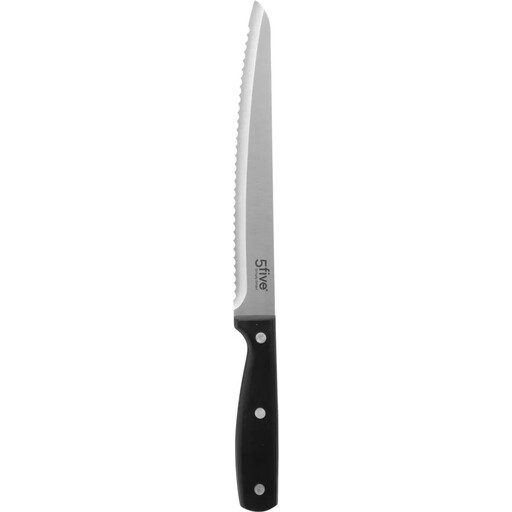
Why it suits this profile: At 33 cm, the blade gives you plenty of reach for different sizes of bread. The stainless steel blade and plastic handle make it a straightforward choice for everyday use.
The product information specifies stainless steel, an ABS plastic handle, a length of 33 cm and dishwasher use, rather than relying on vague sharpness claims.
Long 33 cm blade; stainless steel blade; listed as dishwasher-safe in the product description.
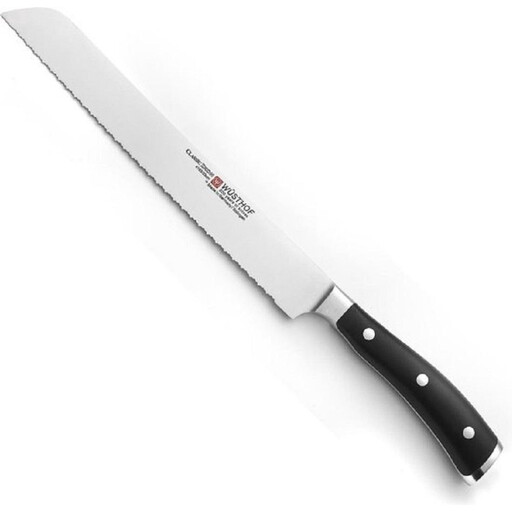
Why it suits this profile: This 23 cm double-serrated knife is designed for people who regularly cut bread, cake and foods with a hard outer layer.
The specifications list the blade length, double-sided serrations, X50CrMoV15 steel and hand-washing instructions. This lets you base your choice on features you can check.
23 cm blade; double-serrated; ergonomic handle; suitable for left- and right-handed use according to the product information.
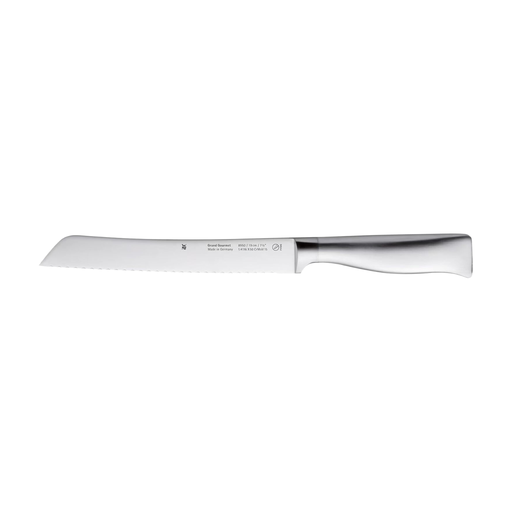
Why it suits this profile: The long, double-serrated design is suited to large loaves, hard crusts and regular use in a busy kitchen.
The 32 cm length and double-sided serrations are clearly stated. The product information also specifies hand-washing, so you can factor care into your choice from the outset.
32 cm long; double-serrated; Cromargan 18/10 handle; forged construction according to the product description.
If you want to prepare vegetables, meat and other ingredients as well as bread, consider a bread knife set. The three-piece Wüsthof Classic set includes a chef’s knife, bread knife and paring knife. A 13-piece 5five set includes a bread knife, chef’s knife, steak knives, scissors, sharpener and knife block, among other items. With any set, check that the other knives suit your everyday cooking routine.
We’ve put together a complete, up-to-date list of products that meet these strict selection criteria and the applicable European safety regulations.
A 20 cm knife is easy to manoeuvre and suitable for smaller loaves. A 23 cm model gives you more reach when cutting tall loaves and hard crusts. Choose based on the bread you usually bake and the storage space you have available.
Wash the knife according to the product instructions, dry it straight away and use a soft chopping board. A serrated blade isn’t sharpened in the same way as a smooth-edged chef’s knife. For models such as the Wüsthof Classic, regular maintenance with a whetstone or honing steel is recommended; follow the manufacturer’s instructions.
It depends on the model. According to the product information, the WMF Grand Gourmet isn’t dishwasher-safe, while some 5five models are. Always check the individual product page. If dishwasher use is permitted, remove the knife from the machine as soon as the cycle has finished.
