
Vandaag of morgen in huis

Kwaliteit gegarandeerd

Welkomstaanbiedingen ontgrendelen: GRATIS bezorging | Tot 80% korting | Gratis 30 dagen JoyPlus-proefperiode
Download de app
Buying a blender sounds simple, until you have to choose between a kitchen blender, hand blender, food chopper or food processor. The difference is not just about wattage. The bowl capacity, blade type, controls and cleaning requirements also determine how well an appliance fits into your kitchen.
Someone who mainly makes smoothies has different requirements from someone preparing mince, herbs, baby food or soup. The points below will help you avoid paying for features you are unlikely to use.
Higher power does not automatically mean that every ingredient will be processed better. The shape of the blades, bowl capacity and recommended operating time also matter. A compact 200 to 350-watt electric food chopper may be suitable for onions, herbs and smaller portions. For ice, frozen fruit or larger quantities, a different design may be more practical.
Also pay attention to the difference between rated power and maximum power. Some models prominently display only the highest marketing figure. Always check the full product specifications and usage limitations.
A large jug is useful for a family, but less efficient when you only want to make a sauce or a small quantity of herbs. Ingredients can remain at the bottom if the blade is not well suited to the amount being prepared. A smoothie blender with a 2-litre jug makes most sense when preparing several portions.
For small quantities, a mini food chopper, hand blender with measuring beaker or manual chopper may be a better fit.
A blender with a food chopper, whisk and extra cups may seem versatile, but accessories take up space and all need to be cleaned. Only choose them if you are genuinely going to use them. A food chopper is useful for nuts, vegetables and herbs, for example, while a meat grinder is designed for more specific tasks and generally cannot be replaced by an ordinary blender.
For smoothies, soft vegetables and sauces, an even blending motion is more important than simply having the highest wattage. For hard vegetables, nuts or ice, a sturdy blade and sufficient motor power are relevant.
Always check the maximum operating time. Some models are designed for short pulses. The IAGREEA electric food chopper, for example, specifies pulsed operation for a maximum of 30 seconds per cycle. The ROUNY hand blender also specifies an operating time of one minute, followed by one minute of rest. This helps prevent overheating and unnecessary wear.
Do not automatically treat the stated capacity as the practical filling quantity. The maximum fill mark in the bowl or jug is the decisive limit. When choosing, think about your usual portions:
Stainless steel blades are standard in blenders and food choppers. A glass bowl is less prone to discolouration and odours than some plastic bowls, but it can be heavier and needs to be handled with care.
Check which parts are dishwasher-safe. This does not automatically apply to the motor base, lid or every accessory. The manufacturer's instructions determine which parts can safely be placed in the dishwasher. Always unplug the appliance before removing parts or cleaning it. Blades are sharp; do not touch them with your bare fingers.
The choices below are linked to specific product specifications, capacities and functions. They are therefore based on different usage scenarios rather than general superlatives.
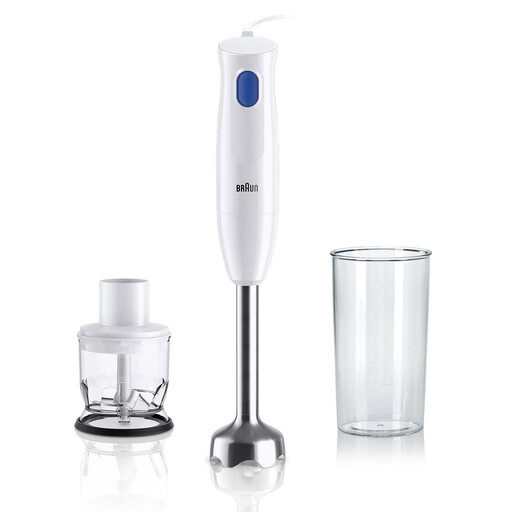
Why it suits this profile: This hand blender is designed for everyday use with smoothies, desserts and sauces. The one-button control is straightforward, and the included measuring beaker has a capacity of 600 ml.
The product specifies 450 watts, a metal blending foot and a separate 350 ml food chopper. This makes it clear what the combination is designed for, without an unnecessary number of settings.
One speed button, EasyTwist system, BPA-free measuring beaker and 350 ml food chopper.

Why it suits this profile: This kitchen blender is suitable for households that prepare larger quantities and a wide range of recipes, such as smoothies, iced drinks and sauces.
The specifications state both the 2.1-litre jug capacity and 14 manual speeds, as well as four automatic programmes. This allows you to compare the capacity and controls with your recipes in advance.
1200 watts, 2.1-litre jug, 700 ml cup and functions including chopping, grinding and pulsing.

Why it suits this profile: A suitable choice for anyone who regularly prepares meat, vegetables, fillings, purée or baby food and needs different portion sizes.
The three separate stainless steel bowls, with capacities of 2.5, 2.2 and 1.8 litres, make the intended use clear. Pulse control and the specified cycle duration help prevent overloading.
350 watts, two speeds, 304 stainless steel bowls and a triple-curved blade system.
We have compiled a complete, up-to-date list of products that fully meet these strict selection criteria and the applicable European safety regulations.
A hand blender is versatile for soup, sauces and small portions. You can work directly in a pan or bowl, but take care to avoid splashing and never immerse the motor base in liquid. A kitchen blender usually has a fixed jug and is more practical for larger quantities, smoothies and iced drinks.
Its lifespan depends on how it is used, maintenance, correct filling and following the maximum operating time. Allow the motor to cool between cycles when instructed to do so in the manual. Also check the cable, blades, locking mechanism and seals regularly. In the Netherlands, many new appliances are covered by at least the statutory conformity protection; additional warranty terms may vary by product.
Energy consumption depends on the power rating and operating time. A 1200-watt appliance running for one minute theoretically uses approximately 0.02 kWh. In practice, a blender often runs for only a short time. So do not look only at the wattage; consider how long and how often you will use the appliance.
