
Vandaag of morgen in huis

Kwaliteit gegarandeerd

Welkomstaanbiedingen ontgrendelen: GRATIS bezorging | Tot 80% korting | Gratis 30 dagen JoyPlus-proefperiode
Download de app
Buying a blender seems simple, until you have to choose between a smoothie blender, personal blender, hand blender or cordless model. Marketing copy often focuses on power, speed or “professional” results. In practice, the right capacity, accessories, cleaning method and ingredients you use are what determine whether you’ll enjoy using your blender.
A higher wattage doesn’t automatically mean every recipe will blend better. A 300 or 350 W blender may be suitable for soft vegetables, fruit and thin smoothies. For hard ingredients, nuts or ice, the blade shape, jug design, pulse function and blending capacity are important too.
Also look out for the difference between rated and maximum power. Some product pages list peak power, while others show the motor’s standard power rating. So don’t compare wattages without checking the full product specifications.
A portable blender, blender to go or cordless blender is handy at the office, when you’re out and about or after a workout. However, its smaller cup and battery are mainly designed for individual portions and cold drinks. Models such as the Xiaomi Portable Blender EU have a capacity of 400 ml. That’s practical for one drink, but less suitable for several people.
Also check whether the appliance is suitable for ice, frozen fruit or thicker mixtures. Don’t use a cordless blender for hot liquids if the product information says not to.
A blender that’s difficult to take apart can end up unused in the cupboard after a few weeks. Before buying, check whether the cup, lid and blade unit can be removed, and which parts are dishwasher-safe. The motor base should never be submerged in water.
Also look for a secure-fitting lid. A travel cup is only practical if its seal is suitable for carrying and you assemble the cup according to the instructions.
Use this guide as a practical starting point:
A powerful blender isn’t always the right choice if you only make a small smoothie. For baby food, hot soup or sauces, a hand blender may be more convenient, as you can blend directly in a pan or bowl. Only use a hand blender in line with the manufacturer’s temperature and safety instructions.
A 400 to 600 ml cup is a good fit for one portion. A blender with a cup or drinking lid saves time if you want to head straight out after blending. For a household or several glasses, a larger jug is more practical.
Check the dimensions too. A compact model should fit under your kitchen cupboards without taking up too much space next to a coffee machine or kettle. For a cordless model, also check the charging port, battery type and charging time.
A BPA-free blender has a cup or jug that the manufacturer states is free from bisphenol A. Tritan is used in various models; check the exact product description rather than relying on the marketing name alone.
Important safety features include:
According to Philips’ own product information, the Eco Conscious Edition has features including a built-in locking mechanism and overheat protection. These are product specifications, not a guarantee that every recipe will turn out perfectly.

Why it suits this user: The 500 ml cup is designed for one portion and, according to the product description, can also be used as a drinking bottle.
The specifications list 250 W, one speed and a safety lock. This makes it clear that it’s a simple model for soft ingredients, not a powerful all-round blender.
500 ml capacity, Tritan cup according to the product information, and removable dishwasher-safe parts.
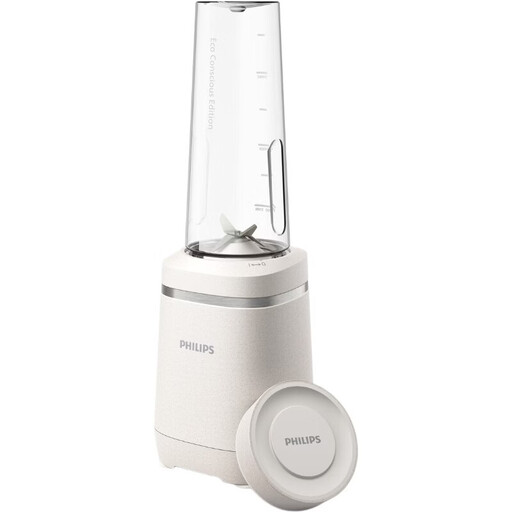
Why it suits this user: This compact model combines a 600 ml capacity with 350 W, a pulse function and, according to the product information, an ice-crushing function.
The instructions specify a maximum blending time of one minute, followed by a rest period. This helps prevent the motor from being overworked by prolonged blending.
600 ml Tritan Renew cup, removable dishwasher-safe parts and non-slip feet according to the product details.

Why it suits this user: With 1000 W, 25 speeds, a turbo function and a chopper, this hand blender is a good fit for anyone who wants to make soups, sauces and dishes with different textures as well as smoothies.
Rather than simply promising high power, the product information lists specific speed settings, accessories and a dishwasher-safe EasyClick system.
25 speeds plus turbo, and a chopper with three texture settings according to the product specifications.
We’ve put together a complete, up-to-date list of products that meet these strict selection criteria and current European safety regulations.
For one person, a personal blender or smoothie maker with a cup of around 400 to 600 ml is often enough. Choose a model with sufficient power for your ingredients and check whether it can handle frozen fruit or ice. If you make several portions, a larger jug is a better choice.
A hand blender is handy when you want to purée soup straight in the pan. A traditional blender may give you a smoother result, but always check the maximum temperature. Some models aren’t suitable for hot liquids. If necessary, let the soup cool before putting it in the blender.
Lifespan depends on how often you use it, how you clean it and whether you stick to the maximum blending time. Let the motor cool down when the instructions say to, don’t overfill the cup, and check the blade unit, seal and cable regularly. A dishwasher-safe blender isn’t necessarily entirely dishwasher-safe: usually, this only applies to removable parts.
