
Vandaag of morgen in huis

Kwaliteit gegarandeerd

Welkomstaanbiedingen ontgrendelen: GRATIS bezorging | Tot 80% korting | Gratis 30 dagen JoyPlus-proefperiode
Download de app
A blender seems easy to choose, until you start comparing product specifications. One model may be marketed as powerful, while its actual power, usable capacity or included accessories are less clear. And a blender with a glass jug isn’t automatically suitable for hot soup or frozen ingredients.
So pay particular attention to these three common pitfalls:
For soft ingredients such as banana, yoghurt and berries, a compact smoothie maker is often enough. For ice, nuts, frozen fruit or fibrous vegetables, power, speed and blade design matter more.
According to its product specifications, a high-speed blender might reach 24.000 or 35.000 revolutions per minute. This is a verifiable technical figure, but it doesn’t guarantee that every recipe will blend smoothly without stopping. A pulse function gives you a short burst of extra power or helps loosen ingredients.
If you mainly make smoothies and shakes, look for:
For soups and sauces, it’s also important to check the instructions. Not every jug is suitable for hot liquids. Allow ingredients to cool if the manufacturer advises you to, and never exceed the indicated fill line.
A tabletop blender with a capacity of around 1 to 1,25 litres is practical for one or two people. Families may be better off looking for a model with a capacity of 1,5 litres or more. Make sure you understand the difference between nominal capacity and usable capacity.
A glass jug is sturdy and generally absorbs fewer odours than some plastics, but it’s heavier and can break if dropped or knocked hard. Tritan and other types of plastic are lighter, which can be useful for everyday use or for a blender with a travel cup.
Also check:
If the information conflicts—for example, the product name says 1,5 litres but the specifications table says 1 litre—it’s best to go by the most specific product information or check the manual.
A blender used for smoothies, baby food or sauces often comes into contact with sticky ingredients. Removable blades and dishwasher-safe parts save time, but the motor base must never be immersed in water.
Look for a safety lock, non-slip feet and overheat protection. Keep the blades out of children’s reach and unplug the blender before removing any parts. Noise levels are also worth considering if you use it frequently. The Fritel BL 3890, for example, lists a noise level of 75 dB, while other models are specified at a higher level.

Why it suits this profile: Its compact design and 0,6-litre capacity make it a good fit for small kitchens, single-person households and everyday smoothies.
The product specifications list two speeds, a pulse function and removable dishwasher-safe parts. This keeps the controls straightforward and cleaning practical.
350 W, 0,6 litres, two speeds and a listed ice-crushing function, all in a compact design.

Why it suits this profile: This model is designed for households looking to combine a glass jug and automatic programmes with manual controls.
The stated usable capacity is 1,5 litres in a 2-litre jug. This makes the difference between total and practical capacity clearer.
1200 W, a glass jug, pulse function, three automatic programmes and a dishwasher-safe jug, according to the product description.
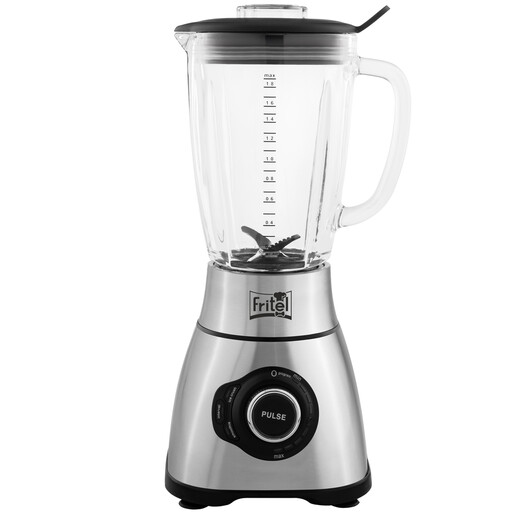
Why it suits this profile: With a 1,8-litre capacity, ice-crushing function, and smoothie and interval programmes, this is an option for larger portions and a variety of recipes.
The product information lists a removable blade unit and dishwasher-safe parts. This means less scrubbing by hand after intensive use.
1,8-litre glass jug, three preset settings, pulse function and a listed noise level of 75 dB.
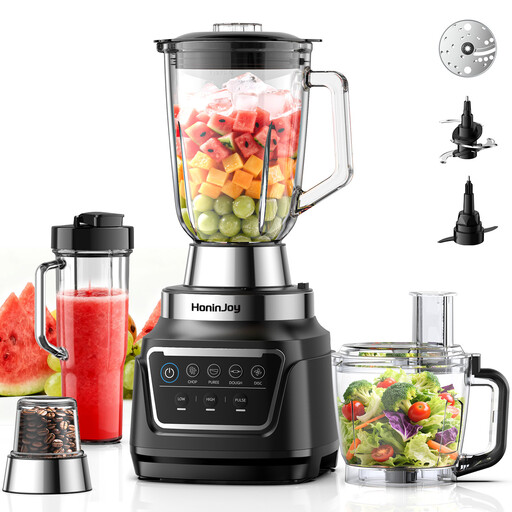
Why it suits this profile: This multifunctional model is designed for households that want to chop, purée, grind, slice and grate as well as make smoothies.
The set includes several bowls and accessories. Check in advance whether you’ll actually use these functions, so you don’t pay for parts that will go unused.
1300 W maximum power, a 1,5-litre glass jug, a 2-litre food processor bowl and an 80-gram grinder.
We’ve put together a complete, up-to-date list of products that meet these strict selection criteria and the applicable European safety regulations.
Lower-powered blenders are often suitable for soft smoothies. If you regularly blend frozen fruit, ice or nuts, it’s worth checking the speed, blade shape, pulse function and recommended operating time too. Wattage alone doesn’t determine the overall blending results.
No. Check the manual and the maximum temperature. Some models are designed for cold preparations, while others only allow hot liquids under certain conditions. Let soup cool if instructed, and don’t overfill the jug. Steam can build up pressure under the lid.
Its lifespan depends on how you use and maintain it, whether you overload it and whether you follow the instructions. Let the motor cool down between heavy blending sessions, don’t use the jug when it’s empty, and clean the blades carefully. A clear manufacturer’s warranty—often two years for the models mentioned—tells you how long the service cover lasts, but it doesn’t predict the blender’s total lifespan.
