
Vandaag of morgen in huis

Kwaliteit gegarandeerd

Welkomstaanbiedingen ontgrendelen: GRATIS bezorging | Tot 80% korting | Gratis 30 dagen JoyPlus-proefperiode
Download de app
Buying a blender seems simple—until you're flooded with terms like 'ultra-powerful,' 'professional performance,' and hundreds of models that all appear to do the same thing. The search for the 'best blender' often leads to confusion and sometimes to a purchase you regret, one that ends up collecting dust in a cupboard after a few months. As a Joybuy Product Recommendation Officer, I'm here to help you see through the marketing hype and make a choice that fits your actual needs.
Before you pull out your wallet, it's important to recognise three common pitfalls that consumers often fall into:
To make a smart purchase, it's better to focus on a few concrete specifications rather than marketing claims. These factors determine whether a blender is right for your kitchen.
Not all blenders are created equal. The type determines what you can most easily use the appliance for.
The jug is where the action happens. Its material directly impacts durability, ease of use, and safety.
A powerful blender is the result of a good balance between motor power and blade design.
Based on these practical criteria, we have selected a few models that suit different user profiles.

Why This Fits Their Persona: Ideal for anyone who wants to quickly make a healthy smoothie or shake on the way to class or work. Its compact, cordless design and rechargeable battery make it perfect for an active lifestyle. The drinking lid seals tightly, so it can be tossed in a bag without leaks.
This model avoids the 'all-in-one' pitfall by specialising as an excellent personal blender. The detachable parts are easy to rinse, which prevents the cleaning hassle.
Cordless and rechargeable via USB-C (over 15 blends per charge). Lightweight and easy to carry.

Why This Fits Their Persona: With a spacious 1.5-litre jug and a powerful motor, this model is perfect for making smoothies, soups, or milkshakes for several people at once. The dedicated ice-crush function makes it ideal for ice-cold drinks in the summer.
This model bypasses the wattage trap by combining its 1300W of power with 4 titanium-coated blades, ensuring effective performance rather than just a high number on paper.
Large 1.5-litre capacity and a dedicated ice-crush function. Two speeds plus a pulse setting for texture control.
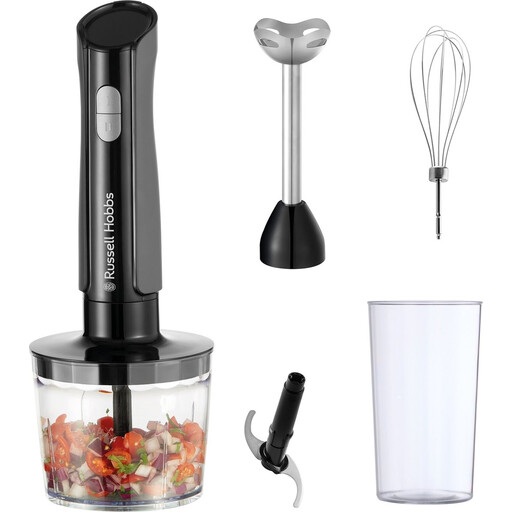
Why This Fits Their Persona: For those who want more than just smoothies. This immersion blender set, complete with a chopper and whisk, is a compact kitchen assistant for puréeing soup directly in the pot, chopping onions or herbs, and whipping cream. It saves space in the kitchen cupboards.
This model is honest about its functionality and avoids the 'all-in-one' pitfall. It masters specific tasks (puréeing, chopping, whisking) rather than being a mediocre jack-of-all-trades. The detachable parts are dishwasher-safe, which makes cleaning simple.
3-in-1 functionality with an included chopper (500 ml) and beaker (600 ml). Dishwasher-safe parts.
We've curated a complete, up-to-date list of products that fully meet these strict selection criteria and safety regulations.
This depends on the ingredients. For soft fruits and vegetables, a blender with 300 to 500 watts is often sufficient. If you regularly want to use frozen fruit, ice cubes, or hard vegetables like carrots, a power rating of 600 watts or more is recommended. Don't forget that the quality of the blades and the shape of the jug are just as important for a smooth result.
No, not every blender is suitable for this. Blenders with a glass jug are generally the safest choice for hot liquids. With a plastic jug, the heat can cause pressure to build up, which can be dangerous. Always let hot liquids cool for a few minutes before blending them in a plastic jug and never fill the jug too full. An immersion blender is often a practical and safe alternative, as you can purée the soup directly in the pot.
Although the terms are often used interchangeably, there is a slight difference. A smoothie maker is typically a compact, personal blender (also known as a portable blender) designed for making one or two servings. The cup often doubles as a drinking cup. A standard blender is larger, usually has more power, and is intended for a wider range of kitchen tasks and larger quantities.
