
Vandaag of morgen in huis

Kwaliteit gegarandeerd

Welkomstaanbiedingen ontgrendelen: GRATIS bezorging | Tot 80% korting | Gratis 30 dagen JoyPlus-proefperiode
Download de app
At first glance, a wok seems simple: a deep pan with high sides. However, models vary considerably in terms of material, base, maintenance and heat distribution. If you only look at a low price or an attractive non-stick coating, you could find yourself with a warped base, rust spots or a worn coating after just a few months.
These three pitfalls are common:
The right wok therefore depends on your hob, the number of people you are cooking for and how much maintenance you are willing to accept.
Carbon steel wok
A carbon steel wok heats up relatively quickly and responds promptly when you raise or lower the heat. This material is widely used for traditional Chinese woks and is suitable for high-temperature stir-frying. An uncoated pan must be seasoned before first use. With regular use and a thin layer of oil, a patina can develop that helps prevent food from sticking.
The trade-off is maintenance: wash the wok by hand, dry it immediately and apply a thin layer of oil if necessary. If you neglect this, carbon steel can rust. Product descriptions for models with a nitrided layer state that they offer increased rust resistance, but these pans still need to be dried and maintained.
Cast iron wok
A cast iron wok retains heat for a long time and distributes it gradually. This is useful for braising, simmering and dishes that continue cooking after searing. The disadvantage is its weight. For example, a 30 cm Staub model is listed as weighing 5.1 kg. This makes lifting, draining and cleaning less practical than with carbon steel.
Enamelled cast iron has an inner layer which, according to the product description, is scratch-resistant and easier to clean. However, use oven gloves: both the pan and the handles can become hot.
Stainless steel with ceramic non-stick coating
A stainless steel wok with a ceramic coating is an appealing option if you want to use less oil and clean up easily. The MAXCOOK Tri-Ply has a 3-layer stainless steel construction, a flat magnetic base and a ceramic inner layer with a honeycomb structure. According to the product description, this wok is suitable for induction, gas, electric and ceramic hobs.
Please note: according to the product specifications, this model is not dishwasher-safe. Sharp metal utensils and harsh cleaning products can damage the finish, even when a manufacturer mentions a scratch-resistant structure.
A wok for induction needs a magnetic, flat base. Do not rely solely on the wording “suitable for all hobs”; check that induction, gas, electric and ceramic are explicitly mentioned.
A flat base is practical in British kitchens because the pan sits securely on the hob. A traditional round base works better on a gas burner with a wok ring, but without a ring it is less suitable for a flat induction or ceramic hob. The School of Wok 13"/33cm Round Bottom Pre-Seasoned Carbon Steel Wok therefore specifies using a wok ring for stability on modern hobs.
A 30 cm wok is a practical medium size for around two to four people, depending on the ingredients and the depth of the pan. For one or two portions, 27 cm may be more convenient. A 36 cm model provides room for four to six portions, but also requires enough hob surface and storage space.
An overfilled wok cools down quickly. As a result, ingredients are more likely to steam or stew rather than stir-fry. So if you are looking for a wok for stir-frying, it is best to match the size to the amount you usually prepare at once.

Why it suits this profile: The 30 cm size and glass lid are practical for everyday cooking. The flat magnetic base supports use on induction and other common hobs.
The product description clearly states hob compatibility. Hand-washing also removes any uncertainty about dishwasher use.
30 cm, 3-layer stainless steel body, ceramic non-stick coating, honeycomb structure and glass lid.
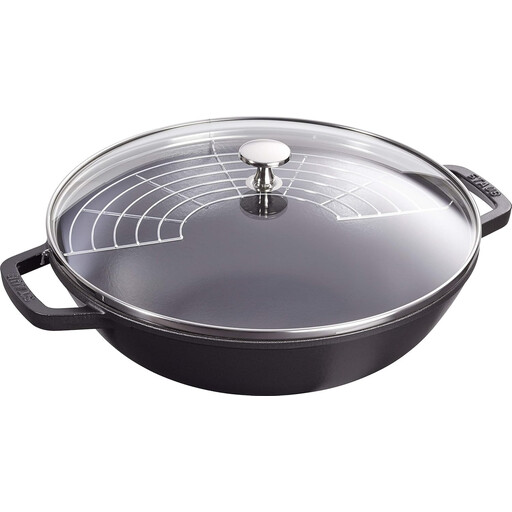
Why it suits this profile: This enamelled cast iron model is designed to retain heat and support versatile cooking, including stir-frying, steaming, deep-frying and braising.
The product specifications state the weight of 5.1 kg and the capacity of 4.4 litres. This allows you to assess in advance whether lifting and storing it will suit your kitchen.
Enamelled cast iron, suitable for induction, gas, electric and ceramic hobs; supplied with a tempura rack, bamboo spatula and chopsticks.
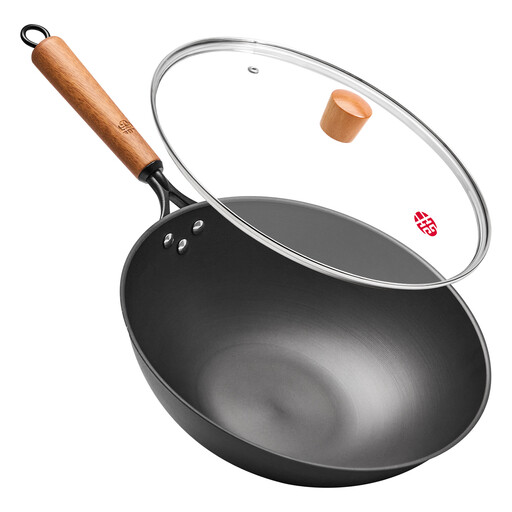
Why it suits this profile: This uncoated carbon steel wok is designed for high temperatures, stir-frying and multiple cooking techniques. According to the product specifications, the flat base is suitable for induction, gas, electric and ceramic hobs.
There is no synthetic coating that can be damaged by high heat. Instead, seasoning, hand-washing, immediate drying and light oiling are essential.
1.5 mm carbon steel, flat base, glass lid, removable wooden handle and included iron spatula.
We have put together a complete, up-to-date list of products that fully meet these strict selection criteria and the applicable European safety regulations.
The lifespan of a wok is strongly influenced by how it is maintained:
Choose a model with a flat magnetic base and check that induction is explicitly stated in the product specifications. A round Chinese wok will usually need a wok ring for stability on a flat hob.
That depends on your preference. Carbon steel is suitable for high heat and, once seasoned, can become less prone to sticking, but it requires consistent maintenance. A non-stick wok is often easier to use, but you need to follow the care instructions and avoid sharp utensils.
For one or two people, a 27 cm wok may be sufficient. A 30 cm wok is often suitable for two to four people. For larger households or meals for four to six people, 33 to 36 cm can provide more space, provided your hob and storage space can accommodate it.
