
Vandaag of morgen in huis

Kwaliteit gegarandeerd

Welkomstaanbiedingen ontgrendelen: GRATIS bezorging | Tot 80% korting | Gratis 30 dagen JoyPlus-proefperiode
Download de app
Buying a suitcase seems simple, until you discover at the airport that the wheels are sticking, it doesn’t meet your airline’s size limits or the interior is awkwardly laid out. Business travellers and frequent flyers in particular often leave it too late to check the details that make a suitcase easy to use.
Three common pitfalls are worth looking out for:
Start by thinking about the purpose of your trip. A cabin suitcase may be enough for a short business trip. For four to six days, a 24-inch medium suitcase is often more practical. Always check your airline’s current requirements, as permitted sizes and weights can vary.
Here’s an example of a clear size breakdown:
The stated measurements are the external dimensions. According to the product information, the internal space may differ by around 1 to 2 cm. Weigh your luggage at home if your airline has a strict weight limit.
A hard-shell suitcase with a TSA lock has a rigid exterior and either a combination lock or a click-lock fastening. ABS is relatively lightweight and commonly used for affordable hard-shell cases. Polycarbonate is another popular hard-shell material. An aluminium-frame suitcase can have a sturdy rim and a zipless fastening, but it’s usually heavier.
Also look out for:
Four 360° spinner wheels let you roll a suitcase alongside you. Check the type of wheels and how the telescopic handle is constructed. A product description may mention “quiet wheels”, but that doesn’t mean they’ll be completely silent on every surface. Tiles, kerbs and cobbles can all affect how much noise they make.
A sturdy top handle, a side handle and a compact shape are useful for business travellers too. A built-in phone holder or cup holder can come in handy while you’re waiting, but check that these features don’t add extra weight or create protruding parts.
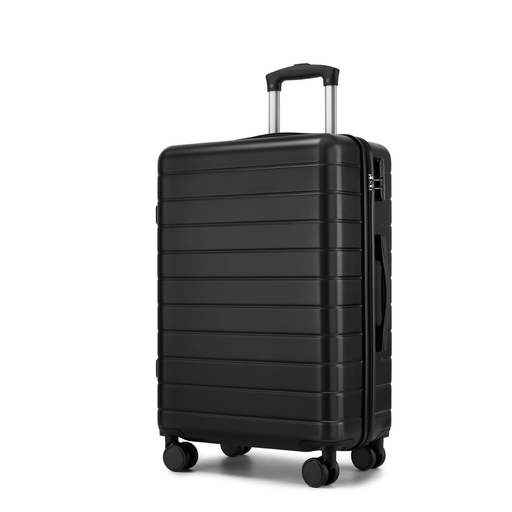
Why it suits this type of traveller: Its 58-litre capacity and 3.2 kg weight make it a good fit for trips of around four to six days, without needing to go straight for a large model.
The dimensions, capacity and weight are listed separately. That makes it easier to compare the suitcase with baggage rules, rather than relying on the word “medium” alone.
ABS hard shell, three handle height settings, 360° spinner wheels, mesh divider and cross-straps.
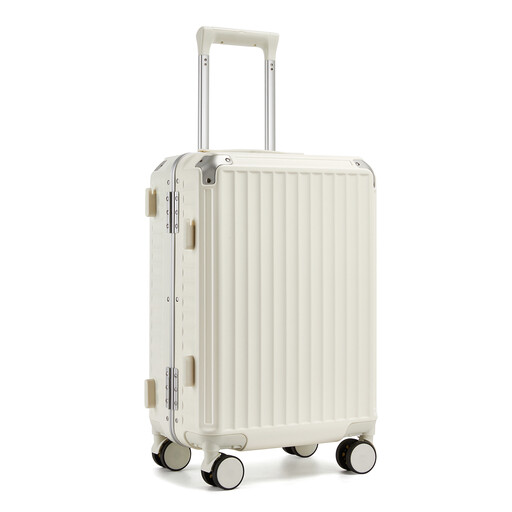
Why it suits this type of traveller: This model is designed for travellers looking for an organised cabin suitcase with a zipless fastening and extra travel features.
The external dimensions of 55 × 37.5 × 23 cm and the weight of 3.45 kg are clearly stated. Be sure to check these against your flight’s baggage rules.
PC hard shell, aluminium frame, zipperless one-click TSA lock, phone holder, cup holder and leak-proof compartment.
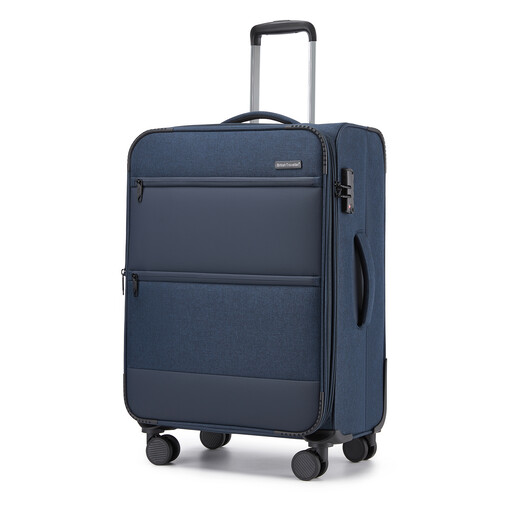
Why it suits this type of traveller: The soft-shell design with an expansion zip is well suited to business trips and short holidays where flexible packing space matters.
According to the product information, the expansion zip increases the depth by up to 3.5 cm. Make use of that extra space thoughtfully, then check the baggage dimensions again.
600D polyester, TSA combination lock, water-repellent front pockets, TPE spinner wheels and internal compression straps.
If you’re taking a business laptop, a protective laptop compartment, a well-organised suitcase and a suitable overall weight are important. According to the product information, the Lenovo V15 G5 IRL has a 15.6-inch Full HD screen, 16 GB DDR5 memory, 512 GB SSD, Wi-Fi 6 and Windows 11 Pro. Take a look at the Lenovo V15 G5 IRL business laptop if you want to combine work and travel.
For a permanent workstation or compact office set-up, a mini PC may be more convenient than a laptop. According to the product listing, the FIREBAT A8 has 24 GB DDR5 RAM, a 1 TB PCIe 4.0 SSD, USB4, dual 2.5G Ethernet and support for four screens. The FIREBAT F1 is a more compact alternative with a Ryzen 5 7640HS, 24 GB LPDDR5 and support for three 4K screens. These devices shouldn’t go in a checked suitcase; if you’re taking them with you, carry them in a protective bag.
We’ve put together a complete, up-to-date list of products that meet these strict selection criteria and the current European safety regulations.
For one to three days, a 20-inch cabin suitcase is often enough, provided its dimensions and weight meet your airline’s rules. If you’re taking extra shoes, documents or equipment, consider a 24-inch medium suitcase too.
Its lifespan depends on the material, how heavily it’s packed, how it’s transported and how well it’s maintained. Avoid overpacking, lift the case by its handles and check the wheels and fastenings regularly. Clean a hard shell with a soft, damp cloth and don’t use abrasive products.
Not completely. According to the product description, spinner wheels may roll more smoothly and quietly, but the surface still makes a difference. The noise may vary on carpet, tarmac and uneven cobbles. Before setting off, also check that all four wheels turn freely.
