
Vandaag of morgen in huis

Kwaliteit gegarandeerd

Welkomstaanbiedingen ontgrendelen: GRATIS bezorging | Tot 80% korting | Gratis 30 dagen JoyPlus-proefperiode
Download de app
Buying a deep fryer may seem straightforward: choose a capacity, compare the power and consider the price. Yet many disappointing purchases are caused by features that sound more impressive in product titles than they are in the kitchen. A large model, for example, takes up a lot of space and uses more oil, while a compact deep fryer can be less practical when preparing several portions in quick succession.
With this buying guide, you can compare an electric deep fryer based on capacity, temperature control, ease of cleaning and safety. That way, you can find a model suited to your household, how often you use it and the space available.
An 8-litre deep fryer sounds spacious, but its capacity is not the same as the amount of food you should fry at one time. You should not overfill the basket, as this causes the oil to cool more quickly and the food to cook less evenly. For one or two people, a 1.2 to 3-litre deep fryer may be more practical. Families may prefer to consider a 4-litre deep fryer or 5-litre deep fryer.
Also pay attention to the external dimensions. A large appliance needs to stand securely on a heat-resistant worktop and be able to cool down safely after use.
A deep fryer with a viewing window lets you see how the food is browning, but colour alone does not tell you whether the food is fully cooked. The window may also steam up. So look for an adjustable thermostat, a clear temperature indicator and a basket that can be lowered smoothly.
An easy-to-clean deep fryer should ideally have a removable inner pan, detachable components and clear cleaning instructions. Check whether only the pan and lid are dishwasher-safe, or whether the housing is too. Electrical components, the power cord and the control panel must not be immersed in water.
A filter lid can help control crumbs and splashes of fat, but it does not replace regular maintenance. Always allow the oil to cool completely before emptying or moving the deep fryer.
Use this guide as a practical starting point:
A double deep fryer with two separate pans can be practical for preparing chips and snacks simultaneously. With models that have a high total power rating, check that your electrical connection is suitable. Some versions require each plug to be connected to a separate circuit, as stated in the instructions.
Power is expressed in watts. A higher wattage can contribute to faster heating and quicker recovery of the oil temperature after you add food. However, it does not, by itself, indicate the appliance’s overall frying performance.
A temperature range of 150 to 190 °C is common for chips, fish, meat and snacks. A thermostat that keeps the temperature reasonably stable is more important than simply having a high wattage. The Fritel Turbo SF 4178, for example, has a power rating of 2300 watts and a manually adjustable temperature of 150 to 190 °C. The product specification also lists a setting for melting solid frying fat.
Not every deep fryer is suitable for both liquid oil and solid frying fat. Check this explicitly before buying. A model for oil and frying fat may have a separate melting setting. Use it according to the instructions; do not simply place solid fat in a basket containing hot oil.
With a deep fryer with a cold zone, crumbs sink to an area beneath the heating element. According to Fritel’s product information, this can prevent food residue from burning immediately. For several models, the manufacturer also states that this can help the oil remain usable for longer. This is a product specification, not a guarantee of a fixed service life: the actual lifespan of the oil depends on factors including the food, temperature and maintenance.
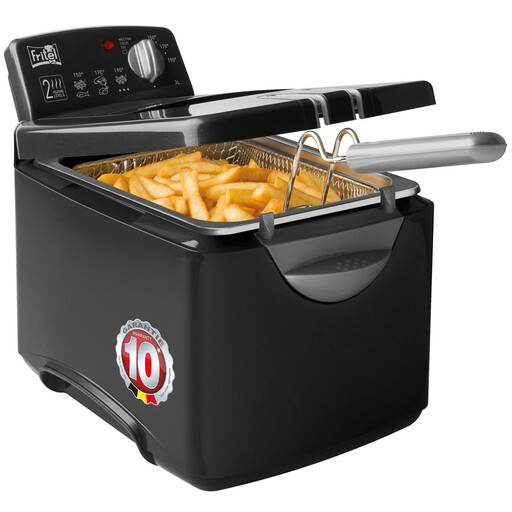
Why it suits this profile: The 3-litre capacity is manageable for a small household, while the viewing window lets you check the food as it cooks.
The product specification lists an adjustable thermostat, filter lid and a separate melting function for solid frying fat. Do check the dimensions of 42 × 31.9 × 29.3 cm.
2300 watts, 3-litre capacity, viewing window and support for oil and solid frying fat.
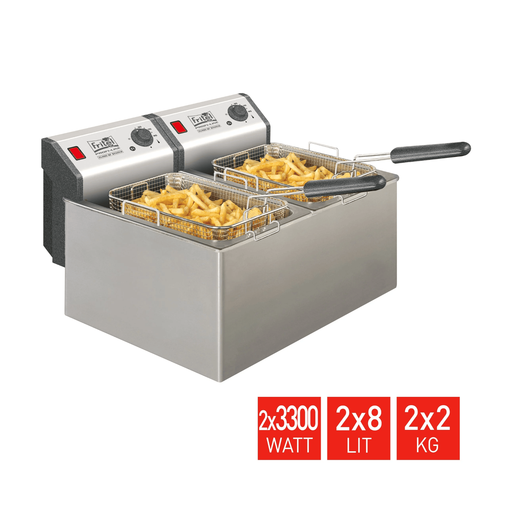
Why it suits this profile: Two 8-litre pans provide plenty of capacity for larger households, parties or frequent use.
The dual-pan design means different foods do not have to share one pan. According to the product information, the components are dishwasher-safe.
2 × 8 litres, 2 × 3300 watts, cold zone and support for oil and solid frying fat.
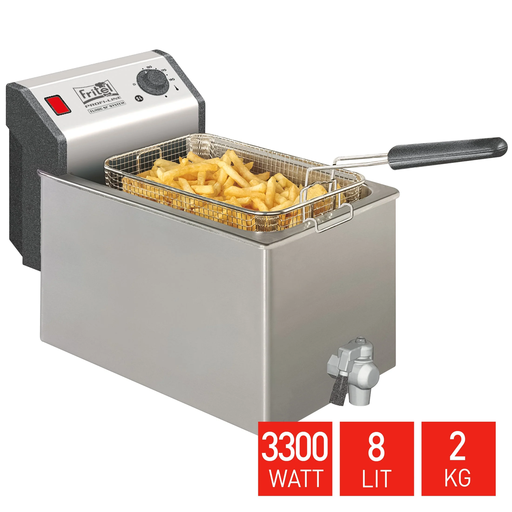
Why it suits this profile: This 8-litre model is designed for large portions and has a drain tap for replacing cooled oil.
The removable components and cold zone address two practical concerns: maintenance and oil becoming dirty quickly. A drain tap makes emptying easier, but only after the oil has cooled completely.
8 litres, 3300 watts, temperature range of 150–190 °C, drain tap and dishwasher-safe components according to the product specification.
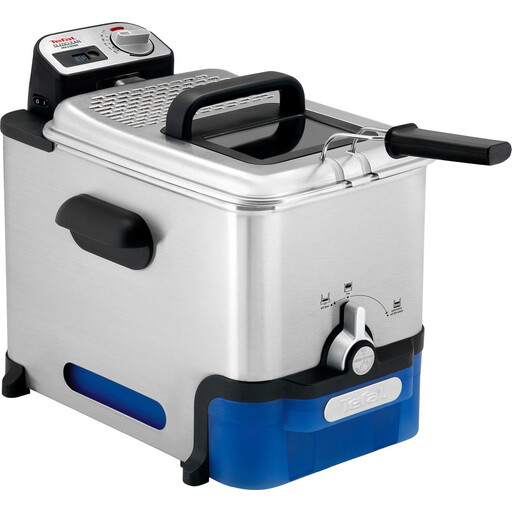
Why it suits this profile: The 3.5-litre capacity and integrated oil filtration system are well suited to home use where easy cleaning is a priority.
According to the product information, the inner pan and detachable components are dishwasher-safe. The control panel is excluded from this.
2300 watts, 3.5 litres, cold zone, viewing window and an oil filtration function.
We have put together a complete, up-to-date list of products that fully meet these strict selection criteria and the applicable European safety regulations.
A traditional deep fryer uses a bath of hot oil or solid frying fat. This is suitable when you are looking for the traditional way to prepare chips, croquettes or snacks. An air fryer uses hot air and, according to the model’s product specification, requires little or no oil, but the result and cooking method differ from deep-frying.
A professional deep fryer or semi-professional model often has a larger capacity, higher power rating, stainless steel housing and a cold zone. This may suit intensive home use, but check the power supply, storage space and cleaning requirements. An appliance with a 16-litre capacity, such as a model with 2 × 8 litres, is not necessarily practical for a small kitchen.
For four people, a model with a capacity of approximately 3 to 5 litres is often a sensible starting point. The capacity you need depends on the portion sizes and the number of frying batches. If you want to prepare large quantities at once, consider a 5-litre model or a double deep fryer.
Consumption depends on the power rating and the heating and frying time. A 2300-watt deep fryer uses more power while heating than a 1400-watt model. A higher wattage may shorten the heating time, but for the total cost, also consider the usage time, number of frying batches and amount of oil.
That depends on how often you deep-fry. A cold zone can allow food residue to sink beneath the heating element, making it less likely to burn. According to the manufacturer’s information, this may help the oil remain usable for longer. If you only prepare small portions occasionally, you may get more benefit from a compact deep fryer that is easy to clean.
