
Vandaag of morgen in huis

Kwaliteit gegarandeerd

Welkomstaanbiedingen ontgrendelen: GRATIS bezorging | Tot 80% korting | Gratis 30 dagen JoyPlus-proefperiode
Download de app
Buying a blender seems simple until you have to choose between a hand blender, smoothie blender, mini blender or portable blender. Marketing copy often focuses on wattage, sharp blades and useful accessories. However, one isolated specification does not always tell you enough about how easy the appliance is to use.
The most common buying mistakes come down to three pitfalls:
By paying attention to power, capacity, controls and maintenance, you can find a model that suits smoothies, soups, sauces, baby food or everyday use more quickly.
A hand blender, also known as an immersion blender, is useful when you want to work directly in a saucepan, bowl or measuring jug. There is no separate jug to fill, and the appliance is easy to store in a drawer. For soup, sauce, purée and small portions, it is often a practical choice.
A standard blender or smoothie blender uses a fixed jug. This type is suitable if you regularly make smoothies, shakes or blended drinks. A mini blender takes up less space and is particularly appealing for smaller households.
A blender to go or cordless blender is designed with portability in mind. The cup can often be used directly as a drinking cup. Do pay attention to the capacity and battery: a compact cup is convenient when you are out and about, but less suitable for several large portions.
The stated power, for example 150 W, 350 W, 450 W or 1,200 W, provides an indication of the motor’s electrical power. It is not a direct guarantee of a particular level of smoothness or speed.
A compact model may be sufficient for soft vegetables, fruit, baby food and sauces. If you want to process frozen fruit, nuts or ice, it is better to check the product specifications for features such as ice crushing, pulse control and suitable ingredients. The Philips 3000 Series HR2510/90, for example, lists 350 W, two speeds and a pulse function. According to the product information, the second speed is intended for harder ingredients and ice.
For a hand blender, the recommended usage time is also important. The ROUNY hand blender states a maximum operating time of one minute, followed by one minute of rest. This is relevant information if you want to prepare large quantities of soup or sauce one after another.
Pay attention to the difference between total capacity and usable capacity. According to the product specifications, the Tefal Minimix BL16GE30 has a total jug capacity of 1 litre and a usable capacity of 0.7 litres. A 0.81-litre Tritan travel cup is also listed.
For one smoothie, 400 to 600 ml may be enough. For two people, 700 ml or more is more practical. A blender with measuring cup helps you measure ingredients, but check that the measuring cup is actually included. According to the product details, the Nedis KAHB100CWT does not include a measuring cup.
Never fill a blender above the indicated mark. You should also follow the instructions when blending hot liquids. Some models are not designed for hot drinks.
A BPA-free Tritan cup is lightweight and is used with various portable models. Also check whether the parts are dishwasher-safe and whether the blade or blending foot can be removed.
The following applies to every model:
Products sold in the EU are subject to applicable European product and safety regulations. In addition, many of the appliances mentioned come with at least the statutory two-year legal guarantee of conformity, depending on the purchase and product terms. Always check the latest information on the product page.
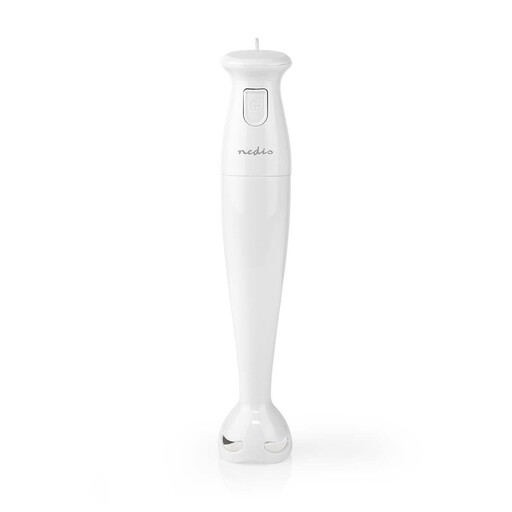
Why it suits this profile: This straightforward model is designed for everyday puréeing and blending, including soup, sauce, milkshakes and fruit. One-button operation keeps it simple to use.
The product specifications clearly state one speed, 150 W and no ice crusher or chopping attachment. This means you do not pay for features you do not need.
Compact design, 1-metre cable and a weight of approximately 519 grams.

Why it suits this profile: If you are looking for one appliance for smoothies, shakes and ice, this countertop model offers several automatic programmes and a travel cup.
The stated power of 1,100 W is combined with three programmes and a pulse function. The product specifications also state that the removable parts are dishwasher-safe.
1100 W motor, 710 ml cup, leak-proof lid and, according to the product information, suitable for ice and frozen ingredients.

Why it suits this profile: The combination of blending foot, whisk, chopper and mixing cup suits users who prepare a wide range of recipes, from soup and sauce to batter and smoothies.
The set clearly lists the included accessories and the maximum operating time of one minute followed by one minute of rest. This allows you to assess its capacity and usage limits in advance.
1000 W rated power, up to 1200 W according to the product details, plus a 700 ml cup and 500 ml chopper.
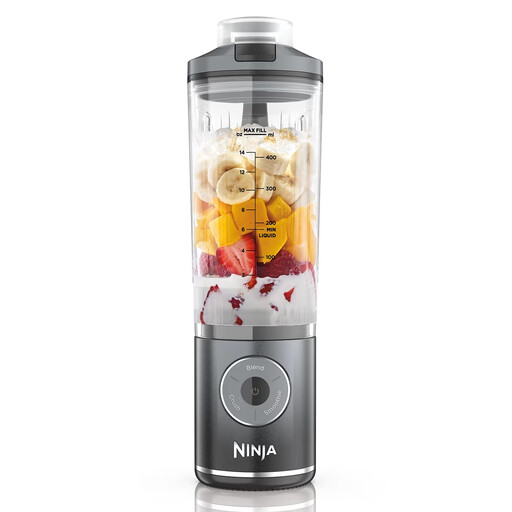
Why it suits this profile: This cordless blender is designed for small portions and use at the office, during a workout or while you are out and about.
The capacity is clearly stated: two 530 ml Tritan cups. USB charging and a leak-proof lid design are also specified.
150 W motor, rechargeable battery, one-button operation and two BPA-free Tritan cups with measurement markings.
We have put together a complete, up-to-date list of products that fully meet these strict selection criteria and the applicable European safety regulations.
Yes, a hand blender can blend soft ingredients and fruit, especially in a tall cup. For frozen fruit, ice or larger quantities, a smoothie blender with a fixed jug is often more practical. Always check whether the manufacturer lists these ingredients as suitable.
That depends on how you intend to use it. For sauces, soft vegetables and small portions, 150 to 450 W may be suitable. For ice, frozen ingredients or more intensive use, also consider the blades, pulse function, maximum operating time and permitted ingredients. Comparing wattage alone gives you an incomplete picture.
Consumption depends on the power rating and usage time. A 400 W appliance running for five minutes theoretically uses around 0.033 kWh. In practice, a blender is usually used for only a short time. A cordless blender also uses electricity while charging, so check the battery and charging information if you use it frequently on the go.
