
Vandaag of morgen in huis

Kwaliteit gegarandeerd

Welkomstaanbiedingen ontgrendelen: GRATIS bezorging | Tot 80% korting | Gratis 30 dagen JoyPlus-proefperiode
Download de app
Buying a blender seems straightforward until you have to choose between a smoothie blender, hand blender, kitchen blender or multifunction blender. Marketing copy often focuses on high wattages, lots of accessories and impressive speeds. However, these figures do not tell you everything about ease of use, capacity or suitability for your recipes.
With this practical buying guide, you can compare blenders using verifiable product specifications. This helps you avoid paying for features you are unlikely to use.
A powerful blender is often associated with a high wattage. That can be useful for hard ingredients and ice, but the wattage does not tell you how large the jug is, how long the appliance can run continuously or how well the blades and drive system are matched.
A 600 W model may be sufficient for smoothies, sauces and soup. If you regularly crush ice or prepare larger quantities, a model with a higher stated wattage may be more practical. Always check the full product description and usage restrictions.
A blender with a 1.5-litre jug provides space for several servings, but the usable capacity may be lower than the total capacity. You should also avoid filling a jug to the brim, especially when preparing hot food. For one person, a mini blender of around 475 to 500 ml may be more convenient, while families are more likely to benefit from a 1.5-litre blender or larger.
A set with a whisk, chopper and several cups sounds versatile. In practice, separate accessories take up space and create extra cleaning work. A hand blender is suitable for puréeing food directly in a pan or bowl. A kitchen blender is generally the more logical choice if you regularly prepare smoothies, cold drinks or larger quantities.
Pay attention to the stated nominal or maximum power, rather than just a marketing term such as “high speed”. A blender with multiple speeds gives you more control when blending soft vegetables, fruit, nuts and sauces. A pulse function operates in short bursts and is useful when you want to chop ingredients coarsely or, according to the product description, crush ice.
For example, the Cecotec 1300 W Countertop Blender states 1300 W maximum power, 20,000 revolutions per minute, two speeds and a pulse function. According to the product description, the appliance is designed for smoothies, juices, purées and crushing ice, among other uses. This makes the specifications relevant if you are looking for a powerful blender for a range of preparations.
A blender with a glass jug is sturdy and less likely to absorb odours or colourants than some plastics. However, glass is heavier and can break if dropped or subjected to a hard impact. Always check the instructions when using hot ingredients: not every blender is suitable for hot liquids.
According to the product details, the Xiaomi Blender has a reinforced 1.75-litre glass jug, six stainless-steel blades, five speeds and a pulse function. The product description also mentions a safety lid and automatic cleaning. The capacity is suitable for several servings, but bear in mind the weight of a filled glass jug.
Removable parts and dishwasher-safe accessories can make everyday use easier. The motor base must not be immersed in water. Blades are sharp, so unplug the appliance before removing or cleaning any parts.
Also check the maximum continuous operating time. Some models need to cool down after around one minute of use. This is particularly important for a multifunction blender used with hard ingredients. A jug or lid locking mechanism helps prevent the appliance from starting when parts are not fitted correctly, but always follow the manufacturer’s safety instructions.
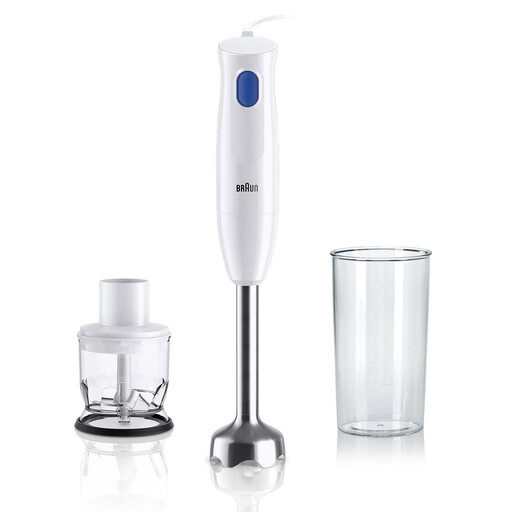
Why it suits this profile: This compact model is suitable for users who mainly want to purée soups, sauces, smoothies or small portions without placing a large jug on the worktop.
The product details clearly state one speed and 450 W. This means you are not paying for a large number of programmes that you may never use.
450 W motor, lightweight design, 600 ml measuring cup and a 350 ml chopper, according to the product description.

Why it suits this profile: Suitable for anyone who values a glass jug, automatic programmes and a wide range of controls for everyday use.
The product description states both the total jug capacity of 2 litres and the usable capacity of 1.5 litres. This makes comparison more transparent.
1200 W, heat-resistant glass jug, touchscreen, pulse function and programmes for smoothies, crushing ice and cleaning, according to the product details.

Why it suits this profile: A logical choice for families and home cooks who prepare several portions and are looking for a blender for crushing ice, making smoothies and preparing purées.
The product listing specifies 1.5 litres, two speeds and a pulse setting. This allows you to assess in advance whether the controls suit your recipes.
1300 W maximum power, four blades, 1.5-litre jug and a specifically stated ice-crushing function.

Why it suits this profile: This mini blender is designed for making a single serving while you are out and about, for example on the way to the office, the gym or while travelling.
The 0.48-litre capacity is clearly stated. This makes it immediately clear that this model is not intended for family-sized portions.
USB-C charging, a weight of 717 grams, drinking lid and, according to the product description, more than 15 blending cycles per charge.
We have put together a complete, up-to-date list of products that fully meet these strict selection criteria and the applicable European safety regulations.
For smoothies, a blender with sufficient jug capacity, stainless-steel blades and multiple speeds is practical. A 600 W smoothie blender may be suitable for soft fruit and liquids. For frozen fruit or ice, it is wise to check whether the manufacturer explicitly states that the appliance can crush ice.
The lifespan depends on how often it is used, the load, maintenance and compliance with the maximum operating time. Allow the motor to cool down when instructed to do so in the manual, avoid overloading the appliance and check that the jug, lid and blades are securely fitted. In the European Union, consumers generally receive a minimum of two years’ legal guarantee; any additional manufacturer’s warranty may vary by brand and product.
Energy consumption depends on the wattage and, above all, on the operating time. A 1200 W blender theoretically uses 0.2 kWh when it runs for ten minutes, but blenders are usually used for much shorter periods. So do not look at wattage alone: a short preparation time and the correct portion size also affect the cost.
By deciding on your recipes, portion size and available storage space first, buying a blender becomes much more straightforward. Only then compare power, materials, speeds, accessories and cleaning options.
