
Vandaag of morgen in huis

Kwaliteit gegarandeerd

Welkomstaanbiedingen ontgrendelen: GRATIS bezorging | Tot 80% korting | Gratis 30 dagen JoyPlus-proefperiode
Download de app
Buying a blender seems simple until you have to choose between a countertop blender, stick blender, hand blender or smoothie blender. Packaging often highlights high wattages, extra programmes and lots of accessories. However, these figures do not tell you everything about everyday use.
The most important question is: what do you want to make, how much do you want to prepare at once and how do you want to clean the appliance? The points below will help you avoid paying for features you will hardly use.
A powerful blender with 1,200 or 1,300 watts sounds appealing, but the result also depends on the blades, jug design, speed control and maximum operating time. A high power rating does not automatically make an appliance suitable for hot soup or prolonged use.
Always check:
A 1.5-litre jug is not always suitable for processing 1.5 litres of ingredients at once. You often need to leave room for movement and to prevent splashing. For a family, a large countertop blender is usually more practical than a 600 ml beaker. For a single smoothie, a compact smoothie blender may be sufficient.
Also pay attention to the difference between total capacity and usable capacity. For example, Tefal lists the PerfectMix+ with a 2-litre glass jug and a usable capacity of 1.5 litres.
A blender with a chopper, whisk and several beakers can be useful, but only if you actually use those functions. A stick blender with a whisk is handy for whipped cream, batter or sauces. A blender with a chopper is better suited to herbs, nuts, onions and small portions.
Check in advance whether the accessories are included with the delivery and whether each one is dishwasher-safe separately. “Dishwasher-safe” does not always apply to the motor unit or to every component.
For soups, sauces and soft vegetables, a power rating of around 300 to 650 watts is often sufficient. For hard ingredients, frozen fruit and ice, a powerful blender with a suitable blade design is more practical. Do not look only at the wattage; also check:
A model with many settings gives you more control, but two clearly defined speeds may be easier to use every day. For example, the ROUNY hand blender has a stated maximum operating time of one minute, followed by a one-minute rest period. This is important information if you want to prepare larger quantities.
A glass jug is sturdy and less likely to absorb smells or colourants, but it is heavier than plastic. Check whether the jug can withstand changes in temperature and whether it is suitable for hot preparations. Only use hot liquids when the instructions explicitly allow it.
A plastic beaker is generally lighter and suitable for smoothies or baby food. The Braun MQ10.201MWH is listed with a BPA-free 600 ml measuring beaker. The Philips HR2534/00 set consists of a measuring beaker and a metal blending foot.
A detachable blending foot makes a hand blender easier to clean. Check whether the components can go in the dishwasher and at what temperature. The ROUNY product information lists dishwasher-safe accessories below 60 °C. For other models, the manufacturer refers you to the instructions for details of which components are dishwasher-safe.
Also look out for:
The blades are sharp. Always unplug the appliance before removing or cleaning accessories.
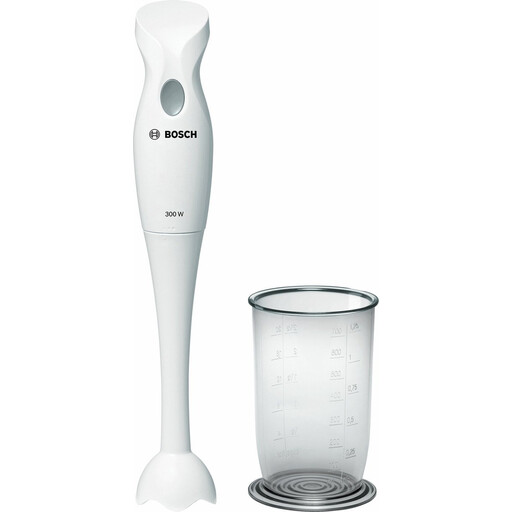
Why it suits this profile: A straightforward choice for soups, sauces and small everyday preparations without a large accessory bundle.
You do not pay for features you do not need: the set is compact and includes a measuring beaker.
300 watts, turbo function, one speed and detachable dishwasher-safe components according to the product information.

Why it suits this profile: Suitable for households that regularly make smoothies, cold drinks and hot preparations, and value programmes and a glass jug.
The product information states both the total jug capacity and the usable capacity, helping you estimate portions more accurately.
1200 watts, a glass heat-resistant jug, three automatic programmes, pulse function and a dishwasher-safe jug according to the product description.

Why it suits this profile: A practical hand blender for anyone who needs several textures and preparation techniques, from sauces to chopping.
The 25 speeds allow you to start gently instead of processing every ingredient at a fixed high speed.
1000 watts, 25 speeds plus turbo, 3-in-1 chopper and dishwasher-safe components according to the product information.

Why it suits this profile: The 1.5-litre jug is practical for making several glasses of smoothie or juice, or a larger portion of a cold preparation.
The product information lists a pulse function and a separate ice-crushing function; check the instructions for the correct quantities.
1300 watts maximum power, 1.5-litre jug, two speeds, pulse function and four blades according to the product description.
We have put together a complete, up-to-date list of products that fully meet these strict selection criteria and the applicable European safety regulations.
A stick blender is flexible: you can blend directly in a pan or bowl and store the appliance compactly. This is useful for soup, sauces and baby food. A countertop blender usually has a larger jug and is better suited to making several portions of smoothies, crushing ice and preparing cold drinks.
Its lifespan depends on how it is used, cleaned and loaded. Do not overfill the jug, follow the recommended rest periods and do not process ingredients for which the model is not intended. Also check the statutory guarantee and service information before placing your order.
Energy consumption depends on the power rating and operating time. An appliance rated at 1,200 watts theoretically uses 1.2 kWh per hour at full power, but blenders usually run for only short periods. A lower wattage may be sufficient if you mainly process soft ingredients and small portions.
