
Vandaag of morgen in huis

Kwaliteit gegarandeerd

Welkomstaanbiedingen ontgrendelen: GRATIS bezorging | Tot 80% korting | Gratis 30 dagen JoyPlus-proefperiode
Download de app
Buying a blender seems simple until you start comparing different power ratings, programmes, jugs and accessories. A compact smoothie blender is handy for one person, while a countertop blender or multifunctional blender is better suited to families and keen home cooks. The right choice depends mainly on what you want to make and how often you’ll use the appliance.
When comparing models, don’t focus only on a high wattage or words such as ‘professional’. Check the capacity, materials, maximum running time and included accessories. That way, you can avoid leaving your blender unused at the back of a kitchen cupboard after a few months.
A high wattage doesn’t tell you everything about performance. The blade design, jug shape, speed settings and maximum running time also play a part. A 600W blender may be suitable for soft vegetables, fruit and simple smoothies, but less suited to regularly crushing ice or blending hard nuts.
Also check whether the stated power refers to the motor’s maximum power or its rated power. Product information can vary.
A 1.5- or 2-litre jug may look appealing, but you mustn’t fill it past the maximum fill line. Hot liquids often come with additional safety instructions. For example, according to the Blaupunkt TBG801’s safety information, a jug containing hot liquid must not be filled more than halfway. The centre cap should also be removed to let steam escape.
For one person, a blender with a travel cup of around 600 to 700 ml is often more practical. For several people, a countertop blender with a larger jug is a better fit.
A food processor with a blender, food processor attachment, citrus juicer and meat grinder can combine lots of functions. This may save space, but the appliance often takes up more room than a standalone smoothie maker. Check whether you really need the extra attachments and whether they’re easy to store and clean.
A compact blender with a limited number of speeds is often enough for smoothies and soft ingredients. For ice, frozen fruit, hummus or nut butter, a powerful blender with a pulse or turbo setting is more practical. As well as the wattage, look at:
Don’t treat a manufacturer’s claim about achieving a smooth blend as a guarantee. According to Ninja’s product description, BlendSense technology adjusts the blender’s performance to suit the ingredients and portion size. In practice, the amount of liquid, how you chop the ingredients and the order in which you add them still matter.
A glass jug can be heat- and scratch-resistant in certain applications, but it may be heavier. Plastic or Tritan is often lighter and suitable for taking with you. Check whether a cup is described as BPA-free, whether the parts are dishwasher-safe and whether the blades can be removed.
Also check the lid on a travel cup. A smoothie blender that blends directly into a travel cup is especially handy for commuting, school or sports. A large jug makes more sense if you’re preparing soup, sauce or several portions at once.
Always take care around sharp blades. Unplug the appliance before removing any parts, and never immerse the motor base in water. Also check:
For a blender for baby food, an even blend is important, but let food cool first and check the temperature yourself. Don’t use hot liquids unless the manual expressly says it’s safe to do so.
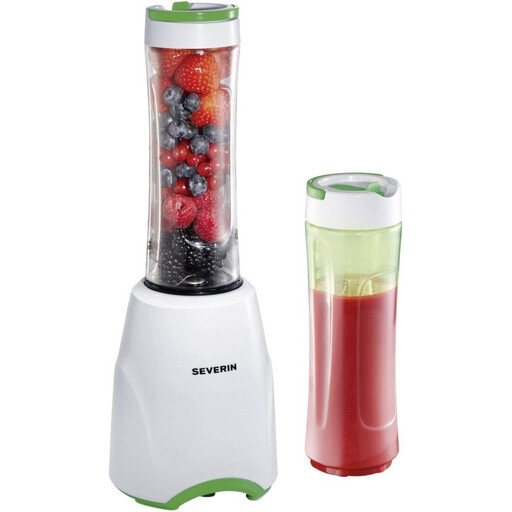
Why it suits this type of user: This compact model is designed for smoothies, milkshakes and sports drinks. The two 0.6-litre travel cups are handy for use at home or on the go.
It keeps things simple, with two speeds, pulse action and a 0.6-litre capacity. So you’re not automatically paying for accessories you don’t need.
300W power, two Tritan cups, dishwasher-safe parts and a travel cup you can take with you straight away.

Why it suits this type of user: With a 2.1-litre jug, a 700 ml cup and a range of automatic and manual settings, this model is well suited to households that regularly prepare a variety of dishes and drinks.
The specifications list both manual speeds and programmes, so you don’t have to rely solely on an automatic setting.
1200W motor, 14 manual speeds, 2.1-litre jug, 700 ml cup and an ice-crushing function described as such in the product information.

Why it suits this type of user: According to the product information, this food processor combines a blender, citrus juicer, food processor and meat grinder with a 3.9-litre mixing bowl. It’s a good fit for keen home cooks who prepare a variety of dishes.
You’re deliberately choosing several functions in one appliance. Before buying, check which attachments are included and confirm the power rating: the product information lists both 900W and 450W.
3.9-litre stainless steel bowl, blender, citrus juicer, vegetable slicer and meat grinder, according to the listed product specifications.
We’ve put together a complete, up-to-date list of products that meet these strict selection criteria and the applicable European safety requirements.
A model with around 300 to 600W may be enough for soft ingredients and everyday smoothies. If you regularly want to blend frozen fruit, ice, nuts or thick mixtures, also look for a pulse function, suitable blades and the recommended running time. Wattage alone isn’t a reliable guide to the end result.
Its lifespan depends on how often you use it, how you clean it, whether you overload it and whether you follow the instructions in the manual. Let the motor cool down when instructed, and don’t run the appliance continuously for longer than permitted. Many consumer purchases in the Netherlands are covered by a legal guarantee; check the terms and conditions provided by the retailer and manufacturer.
A blender usually runs for just a few minutes at a time. Its electricity use therefore depends mainly on its power rating and how long it’s used for. A 1200W model will theoretically use more electricity than a 300W model during one minute of use, but actual consumption depends on how long and how often you use the appliance.
