
Vandaag of morgen in huis

Kwaliteit gegarandeerd

Welkomstaanbiedingen ontgrendelen: GRATIS bezorging | Tot 80% korting | Gratis 30 dagen JoyPlus-proefperiode
Download de app
Buying a blender seems straightforward until you have to choose between a hand blender, smoothie blender, mini blender or powerful blender with multiple attachments. Marketing terms such as “extra powerful”, “professional” and “suitable for everything” don’t always tell you what you’ll actually need.
The most important question, then, isn’t which appliance has the most features, but which type of blender suits your recipes, portion sizes and cleaning routine. The tips below will help you avoid a costly mistake.
A higher wattage sounds appealing, but it doesn’t tell you everything about performance. The blade design, jug capacity and the way ingredients circulate also affect the results. A powerful blender is particularly useful if you regularly process hard or frozen ingredients. For soup, sauces and soft vegetables, a simple hand blender may be enough.
Also check how long the appliance can be used for at a time. According to the product instructions, some models can only run for short periods before needing a break. For example, the ROUNY hand blender specifies a cycle of one minute’s use followed by one minute of rest. This matters when preparing larger quantities.
A jug of around 400 to 600 ml is handy for one smoothie or a portion to take with you. For several people, a countertop blender with a capacity of, say, 1.2 or 1.5 litres is more convenient. However, a large jug takes up more space and may be less practical for small quantities.
Check whether it comes with a drinking lid, measurement markings or a separate chopper. A blender with a travel cup can save time if you want to head out straight after blending.
A blender with a chopper, whisk and measuring jug can combine several kitchen tasks in one appliance. That’s useful if you often make pesto, whipped cream, batter, chop herbs or prepare chopped vegetables. If you mainly use your appliance for soup and smoothies, unused attachments may simply take up extra storage space and create more washing up.
A hand blender is designed for use directly in a saucepan, bowl or measuring jug. It takes up little space and works well for soups, sauces and baby food. Check the length and material of the blending shaft, as well as whether it has a splash guard.
A countertop model is more convenient for smoothies, larger quantities and ingredients you want to blend in a lidded jug. A model such as the Bear LLJ-B12K1 has a capacity of 1.2 litres, four stainless steel blades and a pulse function. According to the product information, the included grinding or chopping cup is designed for quantities of up to 100 grams.
Don’t just look at the wattage; check the controls too. A blender with multiple speeds gives you more control over the texture. According to its specifications, the Royalty Line hand blender has 800 watts, 20 speeds and a turbo setting. This can be handy if you switch between whisking ingredients until light and airy, blending until smooth and mixing thicker preparations.
A pulse function works in short bursts. It’s useful for combining ingredients in a controlled way or briefly processing ice, for example. Always check the manual before using hard or frozen ingredients; not every appliance is designed for them.
Check which parts are dishwasher-safe. With a dishwasher-safe blender, this usually applies only to removable attachments, not the motor housing. The motor unit must not be submerged.
A BPA-free blender may be a preference if the product details clearly state that the jug or parts that come into contact with food are BPA-free. This is specified for the white/beige Nutribullet Portable 475 ml. Check exactly which parts are covered by that claim for each model.
Also look out for:
Claims about quieter operation, durability or extra-smooth results, for example, should be treated as claims made by the brand unless they’re backed up by a verifiable specification. A brand may claim that a product performs in a certain way based on its own research; that doesn’t automatically guarantee the same results for every user.
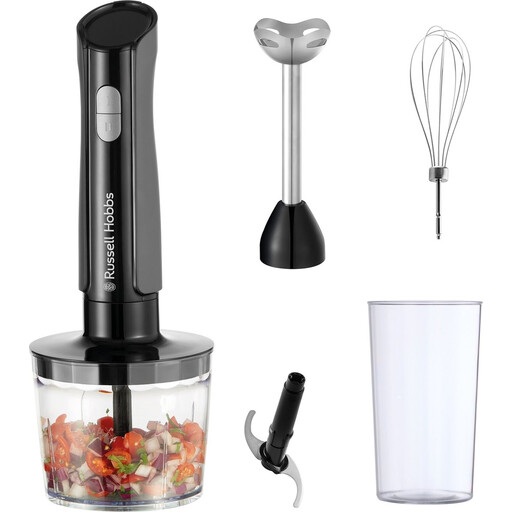
Why it suits this type of user: This hand blender combines blending, chopping and whisking in one compact appliance. With 500 watts, two speeds and a 600 ml blending beaker, it’s designed for everyday use with smaller portions.
Choosing a hand blender means you won’t end up buying a large countertop jug for small preparations. According to the product information, the removable parts are dishwasher-safe.
3-in-1 attachments, two speeds, a 500 ml chopper bowl and a 600 ml blending beaker.
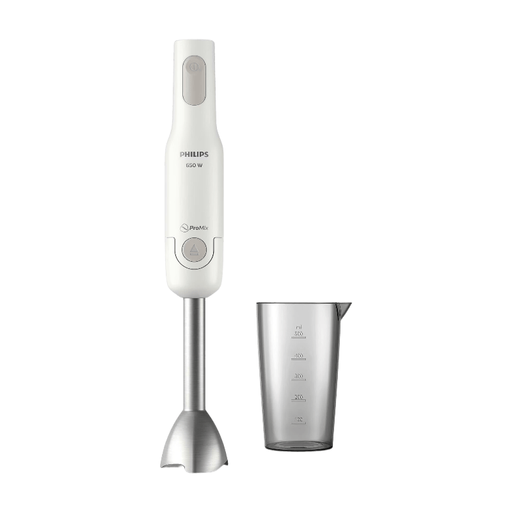
Why it suits this type of user: This 650-watt hand blender is designed for everyday blending, including soups and sauces. The metal blending shaft, 1.2-metre cord and one-button release are practical details for regular use.
The product information specifies a splash guard and a maximum continuous operating time of one minute. This makes its practical limits clearer than a general claim about power.
650 watts, a metal blending shaft, splash guard and quick-release attachments.

Why it suits this type of user: With 800 watts, 20 speeds, a turbo setting and whisk and chopper attachments, this blender offers a range of settings for different preparations.
The variable controls let you adjust the speed to suit what you’re making. The product details also specify dishwasher-safe parts and a splash guard.
20 speeds, turbo function, whisk, chopper and product parts specified as BPA-free.
We’ve put together a complete, up-to-date list of products that meet these strict selection criteria and the applicable European safety regulations.
For a single portion, a smoothie blender or portable blender with a capacity of around 400 to 600 ml is handy. If you make several portions at once, a countertop blender with a larger jug is a better choice. Check whether the model is suitable for ice or frozen ingredients; a high rotation speed alone is no guarantee.
A hand blender can be handy for soup because you can blend it directly in a saucepan. However, check the manual first. A cordless or portable blender is often not designed for hot liquids. If in doubt, let the soup cool first and always use a suitable bowl or pan.
Its lifespan depends on how often you use it, how well you maintain it, whether you overload it and how you clean the blades. Use the appliance within its specified operating time, let the motor cool down and clean removable parts straight away. Before you buy, also check the warranty terms and whether accessories are available.
