
Vandaag of morgen in huis

Kwaliteit gegarandeerd

Welkomstaanbiedingen ontgrendelen: GRATIS bezorging | Tot 80% korting | Gratis 30 dagen JoyPlus-proefperiode
Download de app
Buying a bike sounds simple until you have to choose between city bikes, mountain bikes, road bikes, children's bikes and electric models. Marketing copy often highlights the number of gears, wide tyres or a lightweight frame. That does not automatically mean a bike is right for your route or riding style.
The most common poor purchases result from three mistakes:
Comparing bikes carefully helps you avoid finding that a bike becomes uncomfortable after just a few rides or ends up unused in the shed.
Your intended use largely determines which type of bike makes sense.
A bike for women or men does not necessarily need a specific frame design. The correct frame size, step-over height, saddle position and handlebar reach are more important.
The size shown on a product page may refer to the frame size or the wheel size. These are not the same thing. Adult bikes, for example, may have 26-inch, 27.5-inch or 700C wheels. 700C wheels are often used on road bikes and some trekking bikes, while mountain bikes frequently have 26- or 27.5-inch wheels.
Always check:
The product descriptions for the BAMCBASE Sprague, for example, list a 24-inch version for riders approximately 4’3” to 5’2” tall and a 26-inch version for approximately 5’ to 5’8”. Treat this as a guideline and compare it with your own measurements.
An aluminium bike is generally lighter than a comparable steel model, but the material alone does not tell you enough about comfort or durability. A steel frame can be sturdy, while aluminium is practical if you often need to carry the bike up stairs.
Tyres determine how the bike feels:
Also check the stated bike weight and maximum load. A heavy model is not necessarily a problem, but it can be inconvenient if you need to carry it every day or manoeuvre it frequently.
A 21-speed bike can be useful on routes with changes in elevation or when you frequently switch between relaxed and fast riding. On flat Dutch cycle paths, a simpler system may be more practical and require less adjustment.
When considering brakes, pay attention to the differences between:
According to the product description, the BAMCBASE Sprague has V-brakes and 21 gears. The Oyama Freedom 2.1 has an aluminium frame, front suspension and hydraulic disc brakes. The Hiland Alliance road bike uses dual caliper brakes and 14 gears. These differences show why one bike cannot be suitable for every route.
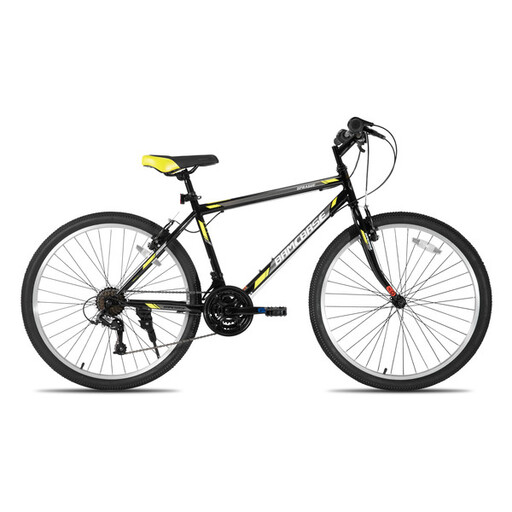
Why it suits this profile: The combination of a steel frame, 21 gears and V-brakes is straightforward for beginner cyclists and suitable for everyday use on paved and lightly unpaved routes.
The product page states the recommended rider height for each wheel size, so you do not have to choose based solely on the number of gears. According to the description, the V-brakes are easy to adjust.
Hi-ten steel, 21 gears, adjustable saddle and high-volume XC tyres.
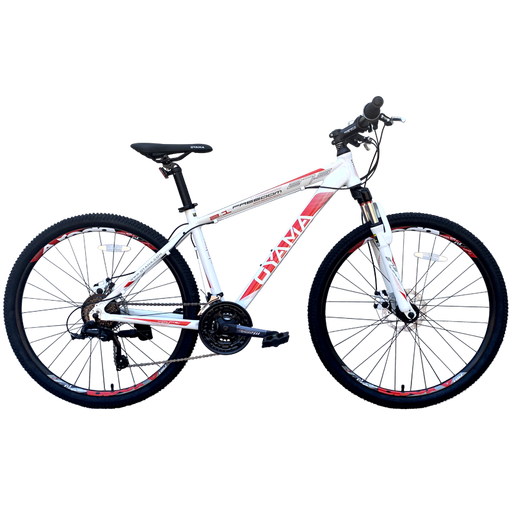
Why it suits this profile: This model is aimed at cyclists who regularly ride trails and value an aluminium frame, front suspension and hydraulic disc brakes.
The 19-inch frame size and 27.5-inch wheel size are listed separately. This allows you to check the fit rather than relying solely on the wheel size.
Aluminium frame, front suspension, hydraulic disc brakes and 27.5-inch tyres.
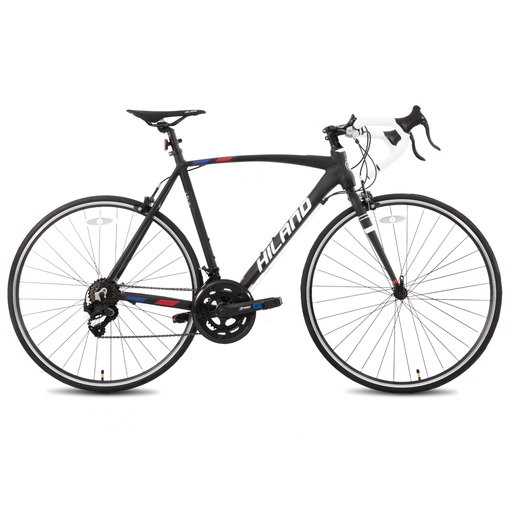
Why it suits this profile: According to the product description, this model is intended for road use, city rides and longer recreational distances. It is suitable for cyclists looking for a relatively lightweight road bike.
The description explicitly states that the bike is not intended for off-road or extreme terrain. This helps prevent unrealistic expectations about how it should be used.
Aluminium frame, 700C wheels, 14 gears and a stated weight of approximately 12.53 kg.
If you want to buy a children's bike, consider rider height, saddle adjustment and brake operation. A bike with stabilisers can help during the early balancing stage, but check that the stabilisers are securely fitted and are not used as a substitute for supervision.
The RoyalBaby EZ Freestyle is available in 14- and 16-inch versions. According to the product description, the 14-inch version is intended for children aged approximately 3 to 5, while the 16-inch version is for approximately ages 4 to 7. The aluminium frame, low step-through design and adjustable components can be practical as a child grows quickly.
A children's BMX bike is mainly designed for freestyle riding, jumps and tricks. According to the product information, the Hiland Redeem has a 20-inch wheel, wide 20 x 2.35-inch tyres, a 360-degree rotor and stunt pegs. Use this type of model in a suitable location and check the brakes, rotor and bolts before every ride. Young children should always be supervised by an adult.
Many bikes are supplied partially assembled. Before your first ride, check:
Clean the frame with a damp cloth, lubricate the chain regularly and keep the bike as dry as possible when storing it. With an electric trekking bike, charging costs, battery care and possible replacement parts are added to routine maintenance. So do not compare only the purchase price; also consider the warranty, parts and maintenance instructions.
We have put together a complete, up-to-date list of products that fully meet these strict selection criteria and the applicable European safety regulations.
For mainly tarmac routes, a city bike or trekking bike is usually practical. Choose a mountain bike only if you also regularly ride on unpaved routes. With any model, pay attention to the frame size, riding position, lights and whether mudguards can be fitted.
Its lifespan depends on how it is used, stored and maintained. Check the brake pads, chain, tyres, bolts and gears regularly. A bike left outside in damp conditions will generally need maintenance sooner than one stored somewhere dry.
Allow for a well-fitting lock, lights, a helmet, maintenance and potentially new tyres or brake pads. With electric models, charging, battery care and possible battery replacement also need to be taken into account. Compare the total cost of ownership before making your decision.
