
Vandaag of morgen in huis

Kwaliteit gegarandeerd

Welkomstaanbiedingen ontgrendelen: GRATIS bezorging | Tot 80% korting | Gratis 30 dagen JoyPlus-proefperiode
Download de app
A good kitchen knife should suit your cooking habits, your hand and your chopping board. However, it can be difficult to compare product titles and marketing claims. Terms such as ‘ultra-sharp’, ‘professional’ and ‘rust-resistant’ don’t mean much on their own if details about size, care and handle are missing.
Pay particular attention to these three common pitfalls:
Many kitchen knives are made from stainless steel. This material is suitable for everyday use and is less prone to stains and corrosion than ordinary steel. However, ‘rust-resistant’ doesn’t mean a knife can never discolour. Prolonged soaking, damp storage and harsh cleaning can shorten its lifespan.
Some models specify high-carbon stainless steel. This can contribute to hardness and help the blade stay sharp for longer, but the exact type of steel and its hardness matter more than the marketing term alone. Also check whether hand-washing is recommended. For example, the Wüsthof Classic Ikon Santoku is listed as being made from X50CrMoV15 high-carbon stainless steel, and hand-washing is recommended.
The right shape depends on the task:
A longer knife isn’t automatically more convenient. In a smaller Dutch kitchen, a knife measuring 12 to 18 cm may be easier to use on a standard chopping board.
An ergonomic handle should sit securely in your hand without you needing to grip it tightly. Consider the material, shape and grip, especially when your hands are damp. A wooden handle has a warm appearance, but check whether hand-washing and drying immediately are recommended.
Also look at the connection between the blade and handle. A fully forged knife or a full-tang construction can offer extra stability, but this should be clearly stated in the product information. Check the weight too: a heavier knife can feel comfortable when chopping, while a lighter knife may feel less tiring during fine cutting.
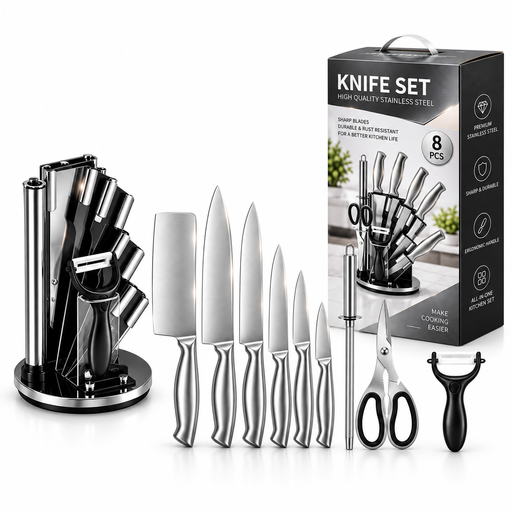
Why it suits this profile: The set combines several everyday kitchen functions with a sharpener, kitchen scissors and a peeler. It’s a practical choice if you’re putting together a kitchen from scratch.
The contents are clearly listed, including a chef’s knife, cleaver, carving knife, fruit knife, sharpener, scissors and peeler. This makes it easier to compare the number of pieces with what you’ll actually use.
According to the product description: food-grade stainless steel, a V-shaped edge and hollow, non-slip handles.

Why it suits this profile: This individual santoku knife is aimed at shoppers who prefer to choose one specific knife, with clear information about its steel, dimensions and care.
The product information specifies the type of stainless steel, a 17 cm blade, a weight of around 170 grams and hand-washing as the recommended care method.
According to the product description: X50CrMoV15 high-carbon stainless steel, a double-sided edge and a polyoxymethylene handle.
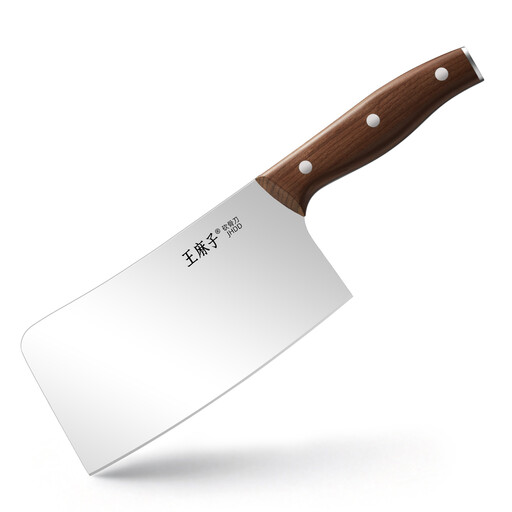
Why it suits this profile: This cleaver is designed for tougher preparation involving bones, ribs and poultry. It’s a useful addition if you regularly tackle heavier chopping tasks.
Its purpose is clearly specified. Don’t use this type of cleaver as a substitute for a fine paring or fruit knife.
According to the product description: a forged construction and a solid wooden handle with a non-slip profile.
We’ve put together a complete, up-to-date list of products that meet these strict selection criteria and comply with the applicable European safety regulations.
For most households, a chef’s knife or santoku knife, a small paring or fruit knife and a bread knife are enough. If you often prepare meat, you could add a carving knife. A complete kitchen knife set is especially practical if you want to buy several types of knife at once.
It depends on the product. Some models are marketed as dishwasher-safe, but hand-washing and drying immediately can help reduce discolouration, handle damage and premature blunting. Always follow the care instructions on the product page.
It depends on how often you use it, the type of steel, the chopping board and how you care for it. If a knife no longer cuts through ingredients smoothly, it may need some attention. Sharpen it carefully and don’t use a damaged knife. An included sharpener is handy, but check that it’s suitable for your knife’s edge.
