
Vandaag of morgen in huis

Kwaliteit gegarandeerd

Welkomstaanbiedingen ontgrendelen: GRATIS bezorging | Tot 80% korting | Gratis 30 dagen JoyPlus-proefperiode
Download de app
If you’re looking to buy felt-tip pens, you’ll soon come across sets with dozens of colours, special tips and promising terms like “extra strong” or “super washable”. But the number of pens isn’t everything. A large set can be impractical for young children, while a smaller set is perfectly adequate for school or simple colouring.
Pay attention to the type of ink, the tip, the age recommendation and the intended use. That way, you can avoid pens that dry out quickly, bleed through clothing or don’t suit the drawing style you’re buying them for.
A colouring pen set with 30 or 40 colours may look appealing, but young children often benefit more from a clear, manageable set with basic colours. For adults and hobby artists, colour gradations are far more useful. So check which colours are actually included and whether the set comes with a storage box.
With washable felt-tip pens, the claim doesn’t mean every stain will disappear under all circumstances. The result depends on the fabric, how long the ink has been left and how you treat the stain. According to the product descriptions of various brands, certain inks can be removed from hands with water and stains can be washed out of most fabrics. However, treat a stain as quickly as possible and follow the garment’s washing instructions.
A thick tip is handy for quickly colouring large areas, but less suitable for small details. A fine drawing pen works the opposite way. Brush markers and dual-tip pens offer more variety, but also require more control and aren’t necessary for every child.
For children, water-based inks are often practical for drawing on paper and card. Look for terms like water-based, washability and any warnings on the packaging. A product description might state that the ink is alcohol-free, odourless or water-based. Treat this as the manufacturer’s product specification and always check the age limit and safety information.
Alcohol markers are a different category. The alcohol base usually dries quickly and can be suitable for illustrations, sketches and colour gradients. However, the ink is generally not designed to be washed out of fabric and can bleed through thin paper. So use marker paper or place a protective sheet underneath your drawing.
When choosing a set, look at the line width and shape:
A strong or pressure-resistant tip can be useful for children who press firmly on the paper. Check whether the manufacturer actually describes the tip as blocked, spring-loaded or pressure-resistant.
For felt-tip pens for children, the recommended minimum age is more important than just the look of the packaging. Some sets are suitable from age 3, others from age 4, 6 or 12. Small parts, loose caps or accessories may carry a warning. A CE mark or EN 71 reference is relevant product information, but doesn’t replace supervision and appropriate use.
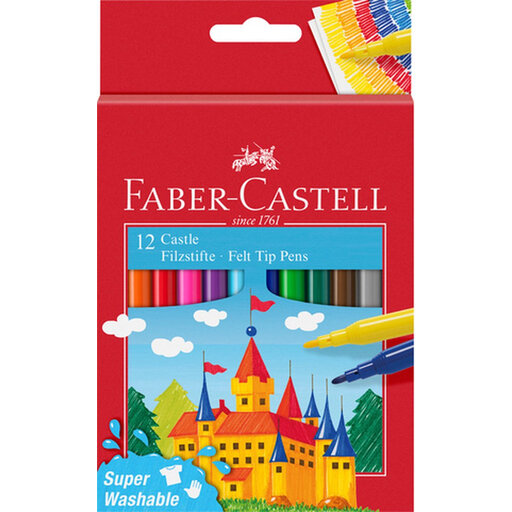
Why this fits the profile: The set contains 12 basic colours and, according to the product information, is intended for children aged 4 and over. That makes it clear and manageable for home, schoolwork and simple craft projects.
You’re not paying for an unnecessarily large colour range. The sturdy tip is described as suitable for children, and the ink is stated by the manufacturer to be washable from hands and most fabrics at 30 degrees.
12 colours, sturdy tip, cardboard packaging and EN 71 reference according to the product details.
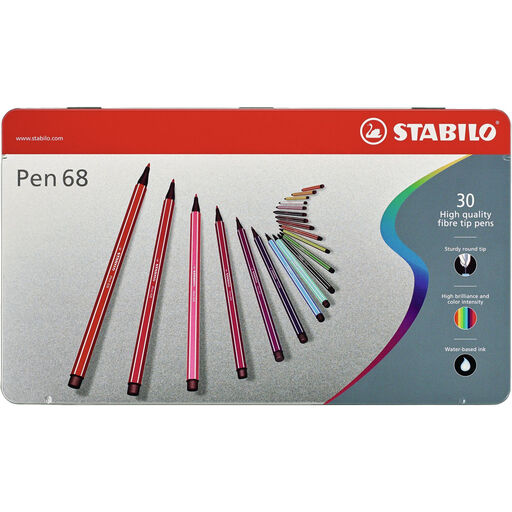
Why this fits the profile: These colouring pens are aimed at users who want a wider colour selection and a consistent line width for colouring, hand lettering and creative projects.
The product information mentions a water-based, odourless ink and a pressure-resistant tip of approximately 1 mm. That makes the set more suitable for controlled lines than an extra-thick children’s pen.
Set of 30 colours, approximately 1 mm line width and, according to the product description, blendable with water for watercolour effects.

Why this fits the profile: This set is designed for sketching and illustrations where a brush tip and fine line are desirable. The stated minimum age is 12 years.
The product description clearly states that these are alcohol markers. That means you can anticipate bleeding on thin paper and the fact that alcohol ink doesn’t have the same washability as children’s ink.
24 colours, flexible brush tip of approximately 1 to 5 mm and a metal fineliner tip of 0.6 mm according to the product details.
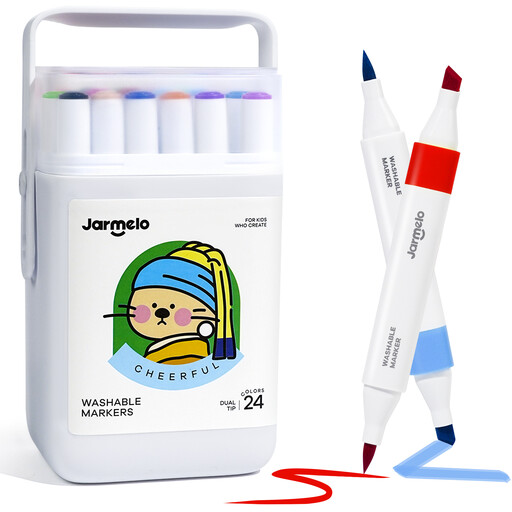
Why this fits the profile: The dual tip combines a brush tip with a chisel tip. That’s practical for children and beginners who want to switch between details, broad strokes and simple lettering.
The two tip shapes are clearly described in the product information. 90% washability from skin and most fabrics is also stated; nevertheless, treat stains immediately with water.
24 colours, brush and chisel tip, water-based ink and a storage case with handle according to the product description.
We’ve put together a full, up-to-date list of products that fully meet these strict selection criteria and comply with current European safety regulations.
Choose a set with a clear minimum age, a sturdy or thick tip and, ideally, water-based, washable ink. For children from around age 3, sets with a wider grip are often easier to hold. Always check the safety warnings and supervise when small parts are present.
Ordinary colouring pens usually have a fixed tip and give a predictable line. Brush markers have a flexible tip that changes line width depending on the pressure you apply. They’re suitable for lettering and illustrations, but young children can deform the tip more easily if they press hard.
Close each pen immediately after use and check that the cap is on properly. Store metallic pens and other special inks according to the instructions on the packaging. For heavy use, a storage case is handy because it helps you see which cap belongs to which pen.
