
Vandaag of morgen in huis

Kwaliteit gegarandeerd

Welkomstaanbiedingen ontgrendelen: GRATIS bezorging | Tot 80% korting | Gratis 30 dagen JoyPlus-proefperiode
Download de app
Want to buy dumbbells for home, but finding it hard to tell the difference between individual weights, barbell sets and adjustable models? The right choice depends on more than just the maximum weight. Grip, storage, adjustability and stability all affect how practical the set will be to use over time.
Marketing copy often uses terms such as “professional”, “ergonomic” or “for a complete workout”. So check the product specifications first. A 10 kg set, for example, might consist of two dumbbells weighing up to 5 kg each, while a set with several pairs may be lighter but offer more training options.
The weight given for a dumbbell set usually refers to the complete set. Two 3 kg dumbbells have a total weight of 6 kg. With adjustable dumbbells, the stated total weight may also include the bars, collars and plates.
When comparing sets, check:
This helps you avoid choosing a set that looks heavy on paper but doesn’t offer enough resistance in practice.
Cast iron dumbbells are sturdy, but they can damage floors and make more noise when put down. A neoprene coating usually feels softer and is practical for lighter weights used for home fitness. Check that the coating covers the entire weight and that the handle has enough room for your hand.
A rubber or neoprene finish is no substitute for safe use. Always put weights down in a controlled way, and consider using a protective exercise mat with heavier sets.
Adjustable dumbbells save space, but the collars need more attention. Make sure loose plates are firmly secured before you start. An adjustable set with connectors for a barbell or kettlebell can be versatile, but converting it takes extra time.
If you mainly want to train quickly, fixed hex dumbbells may be a better choice. Their hexagonal shape helps stop them rolling away and makes exercises such as renegade rows more practical.
Weights of 1 to 3 kg are often practical for light cardio, mobility exercises and general fitness. Squats, lunges, rows and chest presses may require more resistance. Beginners can start with a light weight that allows them to maintain good form.
If you want to build strength, don’t just look for one heavy pair. A set with several weights lets you adjust the load for each exercise. For strength training with dumbbells, gradually increasing the load is more useful than buying an extremely heavy weight straight away.
Check the diameter and length of the handle. A grip that’s too thick can be uncomfortable, while a short handle may not leave enough room for larger hands. Specifications such as “grip: 10 x 3,2 cm” tell you more than a general term such as ergonomic.
Product descriptions for various models say that neoprene coatings provide a soft, non-slip grip. This describes the product and doesn’t guarantee that the dumbbell won’t slip in all conditions. Keep the handles clean and dry.
Round cast iron dumbbells can roll away when you put them down. Hex dumbbells stay in place more easily thanks to their flat sides. In a small home or flat, dumbbells with a rack are handy: they keep the floor clear and make it easy to see which weight you need.
Check the dimensions too. A set with a rack takes up more room than individual hand weights, but can be easier to keep organised. Heavier models need a stable, level surface.

Why it suits this type of user: The set includes six dumbbells weighing 1, 2 and 3 kg, plus a plastic rack. It gives beginners the chance to try different exercises without having to buy several items separately.
The weight is listed per pair, and the hexagonal heads are less likely to roll away. The rack also helps keep everything neatly stored.
Three fixed weights, a cast iron core with a neoprene coating and an included PP rack.
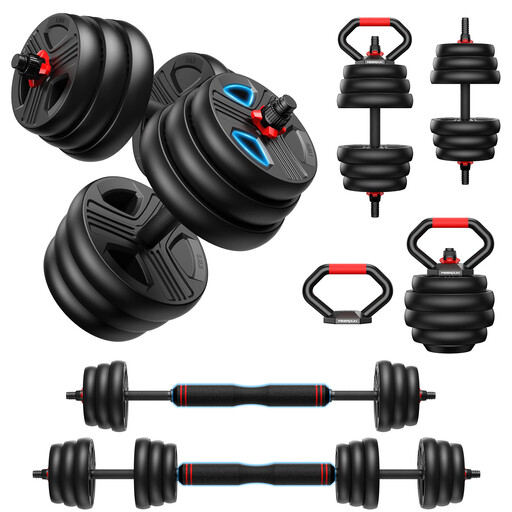
Why it suits this type of user: This model is designed for anyone who wants to set up different types of training with one compact set. According to the product description, it can be used as a dumbbell, barbell, kettlebell and push-up stand.
The weight plates are adjustable, so you’re not limited to just one fixed weight. Before each exercise, check that the collars and connectors are tightened securely.
Total weight of 10 kg, cast iron with a non-slip coating and several configurations for full-body training.
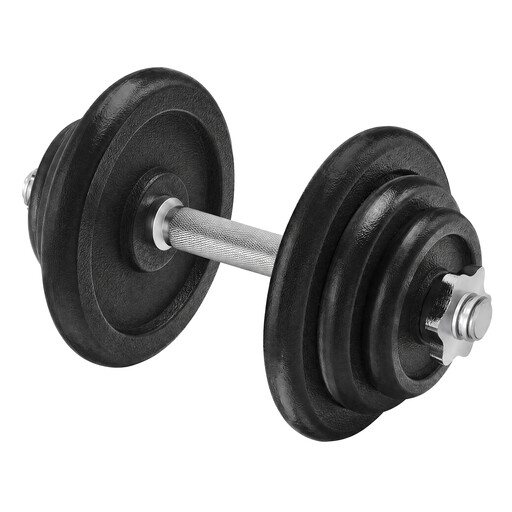
Why it suits this type of user: The adjustable plates are suitable for users who do a range of exercises and want to adjust the load for each movement.
The set lists two 5 kg plates, two 2.5 kg plates and two 1.25 kg plates separately, so you can check exactly what’s included in advance.
Total weight of 20 kg, steel bars, cast iron plates and four spinlock collars.
We’ve put together a complete, up-to-date list of products that meet these strict selection criteria and current European safety regulations.
Read the instructions supplied before using your dumbbells for the first time. With adjustable models, check that all the plates and collars are secure. Use the weights on a stable, level surface and put them down gently.
Also bear these points in mind:
Some models’ product information states that the weight may vary by around 3%. If you need to train with great precision, check the stated weight and product details carefully before buying.
A set with 1, 2 and 3 kg weights gives you several starting points for light strength training, cardio exercises and full-body workouts. As you get stronger, you can move on to heavier fixed or adjustable weights. Choose a weight that lets you perform each movement with control.
Yes, especially if you have limited storage space. One set can replace several different weights. Bear in mind that changing the plates takes time, and check the collars before each exercise. For fast circuit training, several fixed pairs are often more practical.
Their lifespan depends on the material, how they’re used and how well they’re maintained. Cast iron stands up to regular use, but paint and neoprene can be damaged if weights are dropped heavily. Put dumbbells down carefully, store them in a dry place and check the collars and handles periodically.
