
Vandaag of morgen in huis

Kwaliteit gegarandeerd

Welkomstaanbiedingen ontgrendelen: GRATIS bezorging | Tot 80% korting | Gratis 30 dagen JoyPlus-proefperiode
Download de app
Anyone looking to buy dog food online will soon find hundreds of bags, trays and tins. Dry dog food, wet dog food, grain-free dog food, puppy food and senior food are often promoted with terms such as “natural”, “premium” or “high in meat”. Such descriptions do not always tell you whether the food is suitable for your dog.
The right choice mainly depends on age, size, activity level, ingredients and nutritional value. By checking the following points, you can avoid paying for a product that does not meet your dog’s everyday needs.
“Dog food with chicken”, “dog food with lamb” or “dog food with beef” may sound clear, but always check the full composition. See whether the named ingredient appears near the top of the ingredients list and whether the recipe also contains sufficient vitamins, minerals, fats and fibre.
A product with one appealing flavour is not automatically complete and balanced dog food. Check the legally required description on the packaging, such as “complete pet food” or “complementary pet food”.
Grain-free dog food may be suitable for a dog whose diet needs to avoid grains, but it is not necessarily needed for every dog. In grain-free recipes, grains are often replaced with ingredients such as peas, lentils, chickpeas or sweet potato. So look at the whole recipe, not just the front of the bag.
Does your dog have a known food sensitivity? Discuss an adjusted diet with a vet. Marketing claims about digestibility or allergies should not be treated as medical advice.
An 11.4 or 12 kg bag can be practical for a large dog, an active animal or a household with several dogs. However, the bag may remain open for a long time if you have a small dog. This can affect the food’s smell, taste and quality if the packaging is not properly sealed.
Wet dog food in 150-gram portions is easy to measure, while a bag or tin weighing more than 1 kg may result in less packaging waste. So compare the price per kilogram as well as the shelf life after opening.
Puppies have different nutritional needs from adult dogs. Puppy food is formulated for growth and should be given according to the instructions on the packaging. With large breeds, it is especially important to pay attention to the daily amount, as overfeeding during growth can be undesirable.
For adult dogs, choose adult dog food based on weight and activity level. Senior dog food is often formulated for older animals, but the appropriate age varies by product and size. For example, according to the product description, Eukanuba Life Care Senior Small is intended for small senior dogs aged 11 and over.
Dry dog food is easy to store, simple to weigh out and suitable as a daily meal when it is labelled as complete food. For dry food, check the crude protein, crude fat, crude fibre and moisture content.
Wet dog food contains a lot of moisture and is available as pâté, chunks in gravy, jelly or trays. After opening, leftovers should be stored in the fridge according to the product information and usually used within two days. Serve wet food at room temperature when advised on the packaging.
Pay attention to the following:
A high protein percentage is not, in itself, a reason to choose a product. For example, Orijen Original Prey lists 38% crude protein and 18% crude fat, while Acana Classics Grasslands lists 27% crude protein and 16% crude fat. The most suitable ratio depends on your dog and its overall diet.
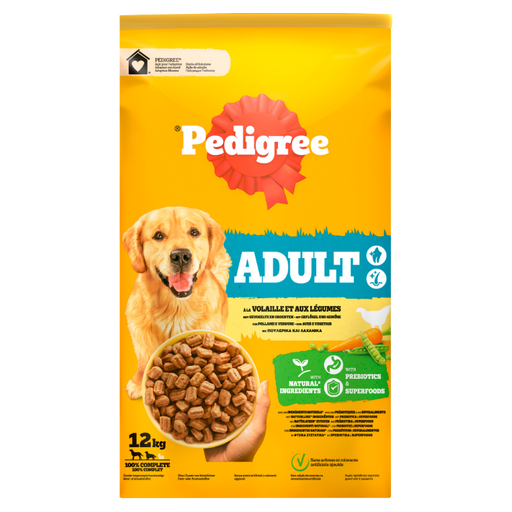
Why it suits this profile: A large bag of dry food for adult dogs that need an easy-to-measure main food every day.
The product description states that it is a complete meal for adult dogs. However, check the individual feeding amount on the packaging.
12 kg of dry food; recipe with chicken and vegetables; suitable for adult dogs.
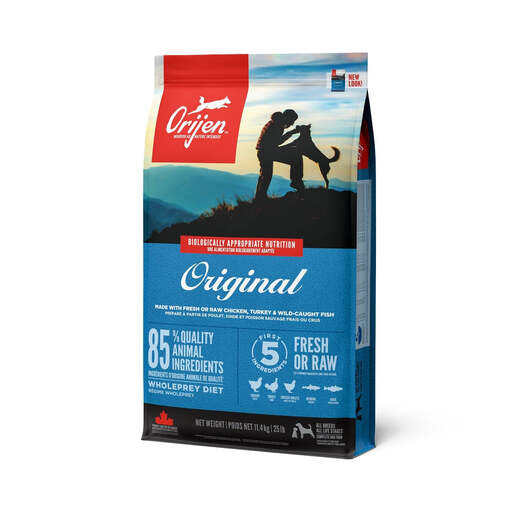
Why it suits this profile: For anyone considering premium dog food with several animal-based ingredients and detailed analytical information.
The product information lists ingredient percentages, analytical constituents and a gradual transition over seven to ten days.
38% crude protein; chicken, turkey, fish and egg in the recipe; suitable as complete food for dogs at all life stages, with an exception stated on the packaging.
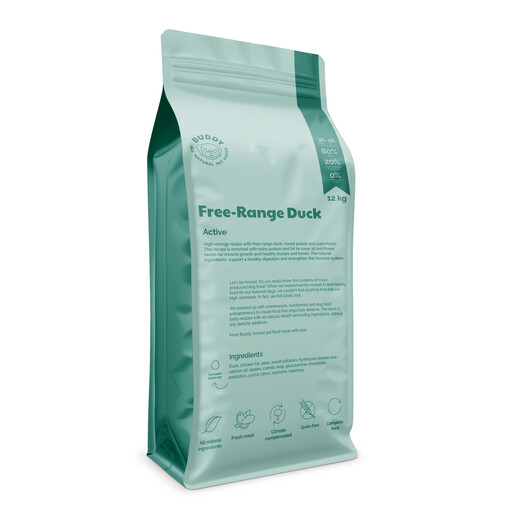
Why it suits this profile: An option for large, active or working dogs where energy intake and portion size require extra attention.
The product information identifies the target group and lists a recipe with duck and vegetables. Always adjust the amount to the dog’s actual activity level.
12 kg pack; 80% animal-based ingredients according to the product information; grain-free and gluten-free according to the product description.
For a puppy, you could consider Orijen Puppy Formula 11.4 kg or Farmina N&D Pumpkin Lamb Puppy Medi/Maxi 12 kg. According to the product information, both are intended for growing dogs and include guidelines based on age, weight and activity level.
For adult medium-sized and large dogs, Farmina N&D Pumpkin Lamb Adult Medi/Maxi and Farmina N&D Pumpkin Chicken Adult Medium to Large are relevant options to compare. Both list a grain-free recipe containing pumpkin. If your dog has a sensitivity, always check the full ingredients list: a lamb or chicken recipe may also contain other animal protein sources.
For older small dogs, Eukanuba Life Care Dog Senior Small Chicken 3 kg is aimed at small senior dogs. The smaller pack may be useful when freshness after opening is important to you.
We have put together a complete, up-to-date list of products that fully meet these strict selection criteria and the applicable European safety regulations.
Use the feeding table on the packaging as a starting point. The correct number of grams depends on body weight, age, activity level and body condition. An active dog may need more than a calm dog of the same weight. Weigh out portions and adjust them gradually if your dog’s weight changes.
Neither is automatically more suitable for every dog. Dry food is practical and has a long shelf life after opening. Wet food contains more moisture and may appeal to dogs that prefer softer food. With both types, check that they are complete food if you want to serve them as a main meal.
Gradually mix the new food with the current food, usually over seven to ten days. Follow the instructions on the packaging and monitor your dog’s stools, appetite and body condition. If problems persist or your dog has a known medical condition, it is advisable to consult a vet.
