
People who regularly eat porridge while working from home
If you make porridge for lunch several times a week, a larger bag may suit your needs. Before you buy, consider where you’ll store an opened pack so it stays dry and airtight.


Choose a 1 kg bag of regular porridge oats if you eat porridge at home regularly and can store the contents in a dry, airtight container. If you have a short lunch break, finer oats or individual portions may suit your routine better. If you have coeliac disease, check for the official Crossed Grain mark on the packaging, as advised by the Netherlands Nutrition Centre; regular porridge oats are not automatically suitable.
If you make porridge for lunch several times a week, a larger bag may suit your needs. Before you buy, consider where you’ll store an opened pack so it stays dry and airtight.
If you want to spend less time preparing and measuring, check the cooking instructions for finer oats or consider individual portions. A regular bag is still an option if you prepare your lunch in advance.
If you have coeliac disease, you’ll need to check the oats carefully: the Netherlands Nutrition Centre advises choosing only oat products with the official Crossed Grain mark on the packaging.
First, consider how often you eat porridge at home, how much time you have around lunchtime, and whether you need to check the ingredients or gluten status carefully.
| What to consider | What to check | Who it matters to |
|---|---|---|
| Pack size and how much you keep in stock | Compare the net weight and check whether you can store an opened pack somewhere dry and airtight. | If I often eat porridge at home, I don’t want to keep opening new packs, but I also don’t want to leave unused supplies in the cupboard. Around 46% of consumers put this stock choice first. |
| Preparing lunch during your break | Read the instructions for hot or cold preparation and consider whether individual portions would be convenient for you. | When my lunch break is short, I want to know how much preparation my porridge needs before I can eat. For around 36% of consumers, preparation time is the most important factor. |
| Ingredients and gluten status | Check the ingredients and allergens; if you have coeliac disease, look for the official Crossed Grain mark. | If I need gluten-free oats or have to check ingredients carefully, a familiar product name isn’t enough. Checking the label is the top priority for around 18% of consumers. |
A pack of individual portions and a large bag of porridge oats don’t solve the same lunch problem: one makes portioning easier, while the other gives you more oats in a single pack.
Check the net weight and product format before deciding which pack suits your lunch routine.
A 1 kg bag is less practical if you rarely eat porridge or can’t seal an opened pack properly.
Store opened porridge oats somewhere dry and airtight. Choose a smaller pack if that better suits how much you use.
According to the Netherlands Nutrition Centre, oat products can be contaminated with gluten. This means a regular pack isn’t automatically suitable if you have coeliac disease.
If you have coeliac disease, check for the official Crossed Grain mark and read the latest allergen information on the packaging.
Jumbo offers fine and coarse wholegrain porridge oats in 500 g packs, as well as a 1 kg pack of fine wholegrain oats.
Albert Heijn stocks regular fine wholegrain porridge oats in a 1 kg pack, as well as a separate 450 g gluten-free option.
Quaker offers a 600 g pack of porridge oats and individual Oats Express portions.
Brinta Porridge Oats come in a 450 g pack of extra-fine oats.
ALDI offers fine or coarse wholegrain porridge oats under the Golden Bridge brand in 1 kg packs, as well as a fine 500 g option.
Lidl offers coarse porridge oats in a 500 g pack.
These products may suit a working-from-home lunch if you’re considering a medium-sized pack, individual portions or a porridge mix. Above all, compare the product format with how much time you have to prepare lunch and whether you need plain porridge oats.
 Image unavailable
This Express option may suit you if you want to spend less time portioning out oats around lunchtime. Check the cooking instructions and, if you need to eat gluten-free, look for the mark and allergen information on the packaging.
 Image unavailable
The 600 g pack may suit you if you make porridge regularly but don’t want to buy a 1 kg bag straight away. Check the pack to see which preparation method suits your lunch break, and check the allergen information if needed.
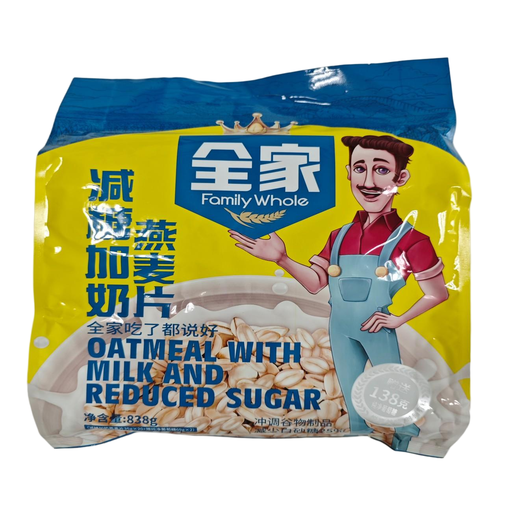 Image unavailable
This mix is different from a bag of plain porridge oats and may suit you if you want to prepare individual portions. Check the ingredients and allergen information before buying, and decide whether the included glucose sachets are right for your lunch.
Yes, the Netherlands Nutrition Centre lists porridge oats as an option for lunch. The most convenient pack for you depends on how often you eat porridge and whether you prepare it during your break or in advance.
Store the oats somewhere dry and airtight. The Netherlands Nutrition Centre advises that opened porridge oats can be kept in a kitchen cupboard for up to a year; follow the instructions on your pack too.
Yes, you can cover cold porridge and put it in the fridge, following the preparation instructions. For unsweetened porridge made with whole milk, the Netherlands Nutrition Centre recommends keeping it in the fridge for three to five days. Don’t assume this applies to lunches made with other ingredients.
Not automatically. According to the Netherlands Nutrition Centre, oat products can be contaminated with gluten. If you have coeliac disease, choose only a pack with the official Crossed Grain mark and check the latest label information.