
Households that eat muesli every day
A 1 kg bag may suit regular breakfasts with yoghurt, milk, quark or a plant-based alternative. Before buying, consider whether you’ll use it all as part of your usual routine.


Choose plain muesli if you’re looking for a versatile base for your daily breakfast, or a fruity or crunchy variety if flavour and texture matter more. Match the pack size to how often you eat muesli, and compare the ingredients, nutritional values per 100 g and allergens for each variety; a large bag alone tells you nothing about what’s inside.
A 1 kg bag may suit regular breakfasts with yoghurt, milk, quark or a plant-based alternative. Before buying, consider whether you’ll use it all as part of your usual routine.
If you eat muesli often, the ingredients and nutritional values per 100 g matter more than the size of the bag alone. The Netherlands Nutrition Centre recommends comparing breakfast cereals on this basis.
A fruity or crunchy variety can be appealing if its flavour or texture makes it easier to enjoy breakfast as part of your routine. Be sure to compare the nutritional information for each variety: similar product names don’t mean the ingredients are the same.
First, decide which muesli you’ll enjoy eating regularly and what pack size suits you. Then compare the ingredients and nutritional information for each variety.
| What to consider | What to check before buying | Who is this most important for? |
|---|---|---|
| Pack size and how quickly you’ll use it | Check the net weight and consider how long an opened bag will last in your household. | If I eat muesli almost every morning, I want to have enough at home without leaving a bag open for too long. That’s why around 36% of consumers prioritise pack size. |
| Ingredients and nutritional values | Compare the ingredients list and the sugar, fibre, salt and fat values per 100 g. | When I eat the same breakfast regularly, I want to know what’s in my usual muesli, even if two bags look similar. For around 36% of consumers, ingredients are their main concern. |
| Flavour and texture | Check whether the variety is plain, fruity or crunchy, and whether the pack size suits your routine. | On a busy morning, I’m mainly looking for a flavour and texture I’ll enjoy with breakfast straight away. Crunch and convenience are top priorities for around 21% of consumers. |
| Allergens | Read the current ingredients list, the allergens highlighted on the pack and any warnings about possible traces. | If I need to avoid certain ingredients, the packaging should give me clear information before I eat the muesli. For around 7% of consumers, checking this is their main concern when buying. |
Varieties in the same range can differ noticeably. Jumbo lists 7,8 g of sugar per 100 g for Muesli Naturel and 19,4 g per 100 g for Muesli Fruit.
Compare the nutritional information per 100 g and check which ingredients are in the variety you’re choosing.
Text on the packaging doesn’t tell you everything about the ingredients. The Netherlands Nutrition Centre recommends comparing breakfast cereals using the nutritional information per 100 g.
Compare the ingredients lists and nutrition tables for the varieties you’re considering.
Ingredients and any warnings about traces may vary between muesli varieties. The Netherlands Food and Consumer Product Safety Authority explains how allergens are listed on labels.
Check the current packaging every time you choose a new variety, including the information about allergens and possible traces.
Jumbo offers plain muesli as well as varieties with fruit, nuts or seeds, including 1 kg packs.
Albert Heijn’s range includes plain, fruit and nut muesli, as well as crunchy muesli in a range of pack sizes.
Quaker Cruesli is a crunchy option for anyone who prioritises flavour and texture. Albert Heijn lists options including an 850 g Chocolate Value Pack.
Golden Bridge is an ALDI range that includes wholegrain muesli with oat flakes, wheat flakes and raisins.
Lidl’s in-store range includes fruit muesli and crunchy varieties with nuts or chocolate.
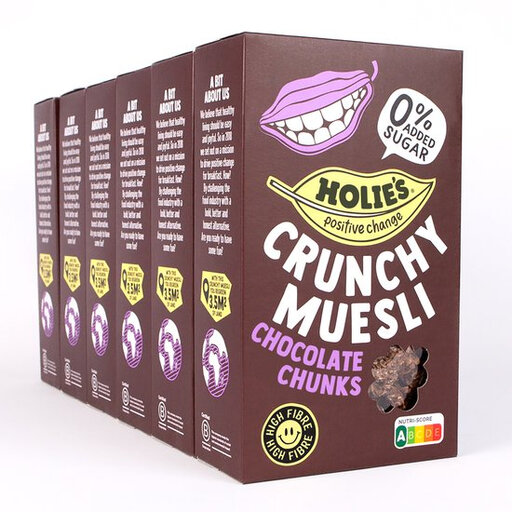
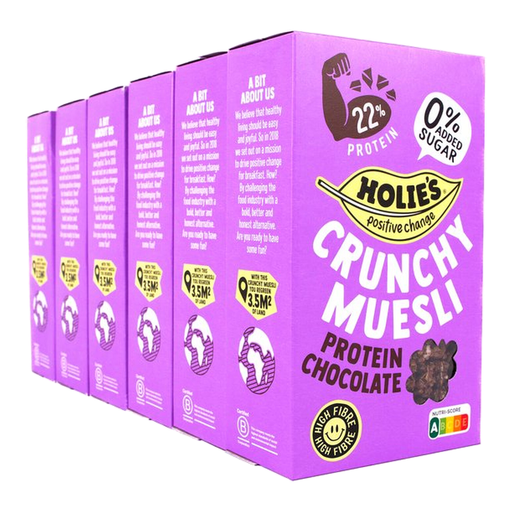
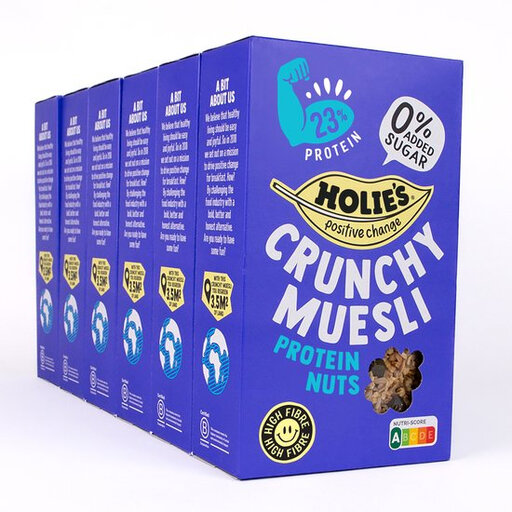
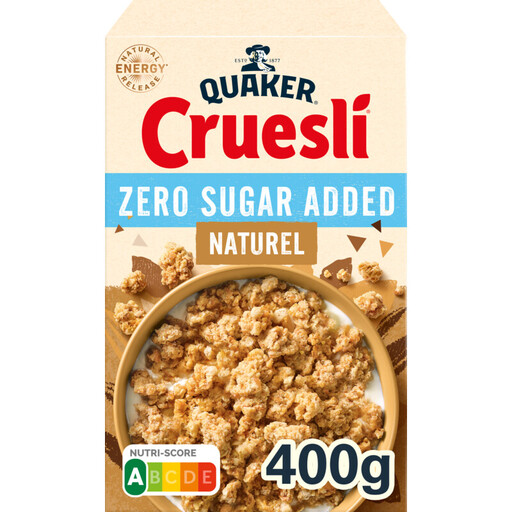
These products suit anyone looking for a crunchy breakfast: each of the three Holie's varieties comes in six 400 g bags, while the Quaker Cruesli is a single 400 g bag. Choose a pack format based on how often you’ll eat that variety, and check the nutritional information and allergens for the specific flavour.
 No image available
A crunchy chocolate variety in six individual bags, ideal if you eat this flavour regularly.
Check the ingredients, nutritional information and allergens for this variety before buying.
 No image available
A crunchy chocolate variety for anyone who can make use of a pack containing six individual bags.
Check the ingredients and nutritional information per 100 g; the product name alone doesn’t give you the full picture.
 No image available
A crunchy nut variety in six individual bags, suitable for regular breakfasts.
Check the nutrition table on the current packaging before choosing this variety for its ingredients, and check for allergens and possible traces.
 No image available
A plain crunchy variety in a single 400 g bag, ideal if you’re not looking for a multipack.
Compare the ingredients and nutritional information for this variety with other crunchy muesli before making your choice.
Compare the nutritional information per 100 g and read the ingredients list too. The Netherlands Nutrition Centre uses values per 100 g as the basis for comparing breakfast cereals; also consider which pack size suits how much you use.
No, a 1 kg bag is best suited to people who eat their chosen muesli regularly and can store the opened pack properly. If you only eat muesli occasionally, a smaller bag may be more practical.
Yes, muesli can be part of a breakfast with a plant-based alternative to milk or yoghurt. If you want to avoid certain ingredients, check the ingredients in both the muesli and the alternative.
Yes, check the current packaging for every different muesli variety, as ingredients and warnings about possible traces may vary. The Netherlands Food and Consumer Product Safety Authority explains how allergens are listed on food labels.