
Vandaag of morgen in huis

Kwaliteit gegarandeerd

Welkomstaanbiedingen ontgrendelen: GRATIS bezorging | Tot 80% korting | Gratis 30 dagen JoyPlus-proefperiode
Download de app
Choosing a new built-in oven can seem straightforward on paper. Almost every model has fan-assisted cooking, a grill and a digital timer. Yet problems often only come to light after you buy: the oven doesn’t fit the housing unit, the connection isn’t suitable or a promising cleaning function turns out to be less practical than expected.
So pay particular attention to these three common pitfalls:
Most full-size models come under the 60 cm built-in oven category. The actual product is often around 59.4 to 59.5 cm wide, while the housing unit usually needs to be around 56 cm wide. Always check the technical drawing for the specific model and compare it with your kitchen cabinet.
As well as the width, check:
Don’t just measure the visible front. Check that the back panel, cable and ventilation space won’t get in the way either.
A fan-assisted oven uses a fan to circulate hot air around the oven cavity. This is handy when cooking on several shelves and for even results. A multifunction oven typically combines fan-assisted cooking with conventional top and bottom heat, a grill, defrosting and sometimes pizza functions.
Don’t just look at the number of programmes. Check which functions are actually listed on the specification sheet and whether accessories such as a baking tray or air-fry rack are included.
An oven with a steam function can add extra moisture while baking or cooking. This can be useful for bread, vegetables and dishes that shouldn’t dry out too quickly. There are some clear differences:
For example, the Siemens CS736G1B1 is listed as having a 1-litre water reservoir. If your oven has a water reservoir, you’ll need to fill, empty and maintain the tank in line with the manual.
An oven with pyrolytic self-cleaning heats the cavity to a high temperature, reducing residue to ash, according to the product description. Remove loose food debris and accessories before use if the manual instructs you to. High temperatures and odours may occur during the cycle.
Hydrolytic or steam cleaning loosens dirt using water and heat. You’ll usually still need to wipe the inside with a cloth afterwards. Catalytic liners absorb grease particles during use, according to the product description, but regular cleaning is still needed.
An oven with an air-fry function uses intense air circulation, often with a special rack or baking tray. Check whether this accessory is included. A smart oven with Wi-Fi may support control, notifications or automatic programmes through an app. You’ll usually need a Wi-Fi network, an account and a compatible app.
According to the product descriptions, selected Bosch models offer Home Connect, while Samsung models offer SmartThings functionality. These features depend on the software, network and compatible devices. Think of them as extra convenience, not a replacement for manual controls.
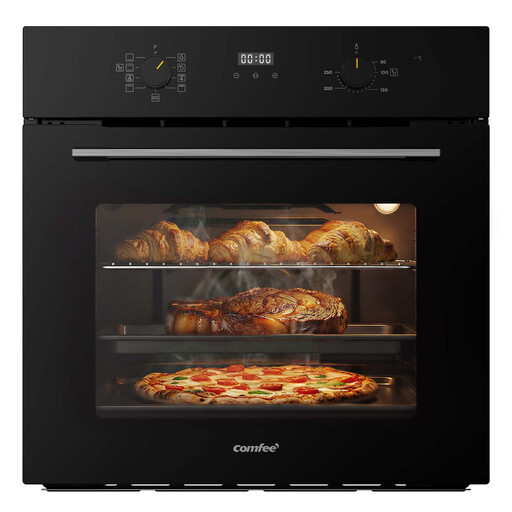
Why it suits this profile: A straightforward choice if you’re looking for a spacious electric built-in oven without Wi-Fi or complicated controls.
The specifications list 10 functions, a timer and AquaClean steam cleaning. Be sure to check the housing dimensions and the stated A energy rating before ordering.
70-litre capacity, fan-assisted cooking, grill, pizza function and a black finish.
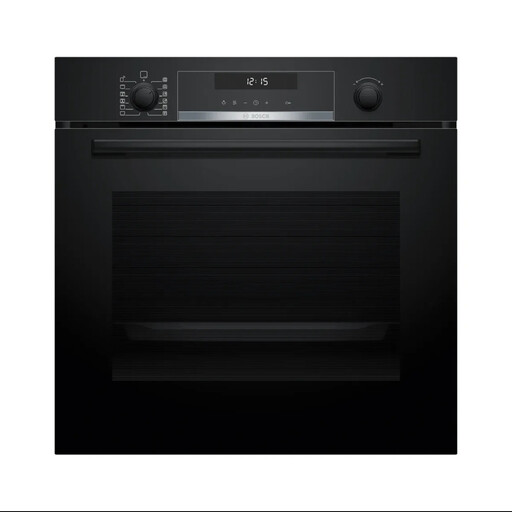
Why it suits this profile: Designed for households that bake regularly, want to cook on several levels and would like to spend less time cleaning by hand.
It has a 71-litre capacity, and the housing dimensions are clearly stated. Pyrolytic cleaning reduces residue, but accessories must be removed as instructed in the manual.
71 litres, A+, Air Fry, 3D fan-assisted cooking, pyrolytic cleaning and Home Connect, according to the product specifications.
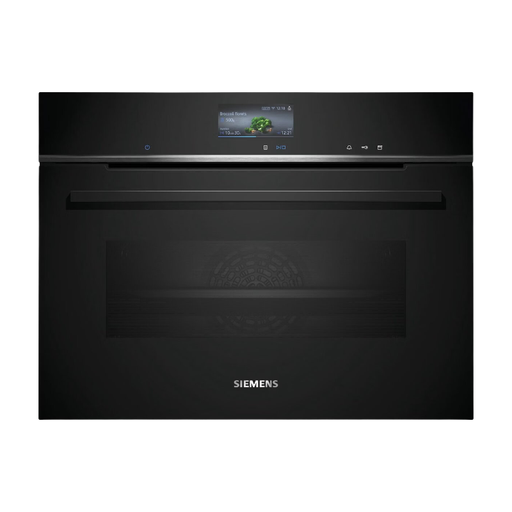
Why it suits this profile: A good choice if you’re looking for fan-assisted cooking alongside an integrated steam function, automatic programmes and app control.
The 1-litre water reservoir and compact height of around 45.5 cm are listed. This helps with installation planning and day-to-day maintenance.
47-litre capacity, fullSteam Plus, 4D fan-assisted cooking, pyrolytic cleaning and Home Connect.
We’ve put together a complete, up-to-date list of products that meet these strict selection criteria and the applicable European safety regulations.
An A+ energy-efficient oven may be a good choice, but the label doesn’t tell the whole story. Also compare the stated energy use for each cooking method, the capacity and how often you use the oven. A large oven can be practical for a family, but a compact cavity may make more sense for a small meal.
According to the product specifications, the Samsung NQ50T8939BK has a 50-litre capacity, an A+ energy rating and stated fan-assisted energy use of 0.61 kWh. The Samsung NV7B6675CCK/U1 has a 76-litre capacity, two oven cavities and a stated fan-assisted energy use of 1.05 kWh, among other figures. Use these figures only to compare models measured using the same method. Actual energy use depends on the temperature, programme, preheating and cooking time.
No. The front width is similar, but housing height, housing depth, ventilation space and connected load can vary. Measure the housing unit and always check the installation details for your chosen model.
Its lifespan depends on use, maintenance, installation and components. Cleaning it regularly, not leaning on the door and keeping the ventilation clear can help prevent unnecessary wear. Keep the receipt and manual in case you need to ask about a warranty or service.
A combi oven saves space and combines several functions in one appliance. According to the product information, a model such as the Bosch CMG7241B1 has a 45-litre capacity, a microwave function and 900 watts of microwave power. Be sure to compare the capacity, heating time, controls and connected load with your needs.
