
Vandaag of morgen in huis

Kwaliteit gegarandeerd

Welkomstaanbiedingen ontgrendelen: GRATIS bezorging | Tot 80% korting | Gratis 30 dagen JoyPlus-proefperiode
Download de app
A new built-in hob may seem straightforward to choose at first glance. Yet many disappointing purchases are caused by the wrong cut-out size, an electrical connection that is not powerful enough, or features that add little in everyday use. If you only look at a black glass surface or a low price, you may only discover during installation that the hob does not fit or is unsuitable for your existing consumer unit.
This buying guide helps you compare ceramic, electric and induction hobs based on verifiable specifications.
A 60 cm hob is not automatically suitable for every kitchen. Always check the dimensions of the cut-out, even when replacing an existing hob. Many models require a cut-out of approximately 56 cm wide and 49 cm deep, while compact models use different dimensions.
A 30 cm hob often requires a cut-out around 26 to 27 cm wide and approximately 49 cm deep. The Wiggo WH-E312G(B), for example, is a 2-zone hob measuring 30 cm wide. The overall dimensions and the cut-out dimensions are therefore not the same.
A hob with four zones may have a connected load of 6,000 to 7,200 watts. This does not automatically mean you can simply plug it into a standard socket. Some models are suitable for one or two phases, while others require a fixed connection.
Therefore, check:
For models supplied with a cable but no plug, the connection must be carried out by a qualified installer in accordance with the instructions.
A timer, boost function or flexible zone can be useful, but check exactly how it works. For example, a timer may operate separately for each zone or simply function as a general kitchen timer. On an induction hob, automatic pan detection is different from a flex-induction hob, where several zones can be combined.
Also look out for contradictions in the product information. If in doubt, check the technical specifications and the supplied manual before ordering.
An induction hob heats a suitable magnetic pan directly. You need pans with a magnetic base, such as cast iron, enamelled iron or suitable stainless steel. A magnet test on the underside of the pan provides an initial indication.
A ceramic hob uses heating elements beneath a glass-ceramic surface. The surface remains hot for some time after use. A residual heat indicator is therefore a useful safety feature. Ceramic models generally work with a wider range of pans than induction hobs.
A freestanding electric hob or portable induction hob is practical for a student room, temporary kitchen or as an additional cooking surface. You place it on the worktop and generally connect it differently from a fixed built-in model.
For one person or a small kitchen, a 2-zone hob may be sufficient. Check whether the two zones have different power ratings. According to the product specifications, the Wiggo WH-E372GC(B) has zones rated at 1.2 and 1.8 kW. Ciarra’s 2-zone ceramic and induction models have a total power output of 3,000 watts and nine power levels.
A 4-zone hob provides more space for using several pans at once. In a household that often prepares multiple courses, the zone layout and pan sizes are more important than the number of zones alone. An extendable zone can be useful for a roasting pan or oval dish.
Touch controls create a sleek surface that is easy to wipe clean, but the control panel must be kept dry and clean. Knobs are often preferred by users who want immediate physical feedback.
Useful features include:
None of these features makes supervision while cooking unnecessary. Do not leave an active hob unattended, and do not use a glass surface with cracks.
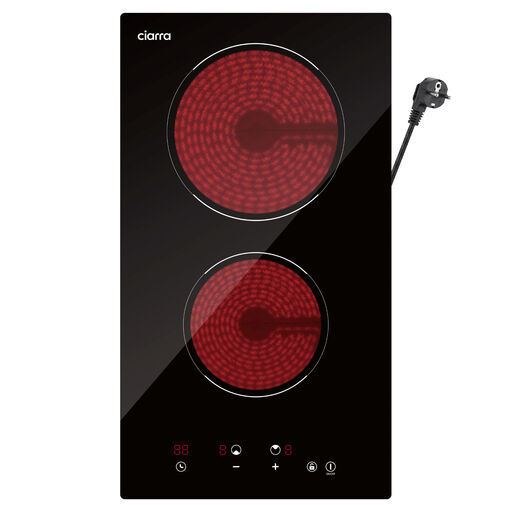
Why it suits this profile: This compact built-in hob offers two zones and straightforward touch controls for everyday meals in a small kitchen.
The specified cut-out size is 260 x 490 mm. The product information also states that it has a timer of up to 99 minutes and automatic switch-off.
3,000 watts, nine power levels, child lock and residual heat indicator.
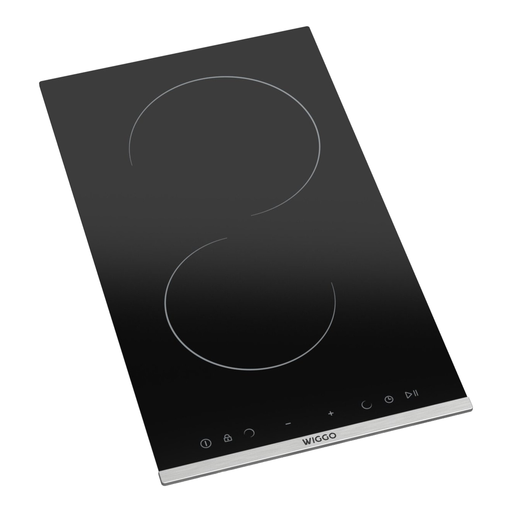
Why it suits this profile: Its 30 cm width leaves room for additional worktop space or combination with another module.
The product information lists the overall dimensions, power per zone and single-phase connection. However, check the installation manual and your existing cookware.
Two zones rated at 1,400 and 1,800 watts, touch controls, timer, boost function and black glass surface.
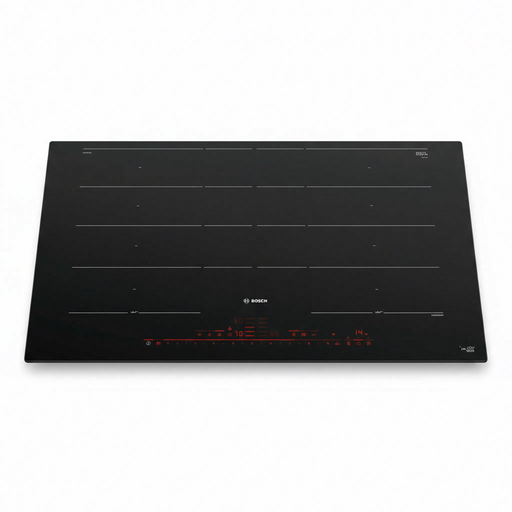
Why it suits this profile: This wide flex-induction hob is designed for users who want to combine different pan sizes, including larger pans.
The flexible zone is designed for variable pan positions. Beforehand, check that the available worktop width and electrical connection are suitable for this 80 cm model.
FlexInduction, pan detection and PowerBoost according to Bosch’s product description.
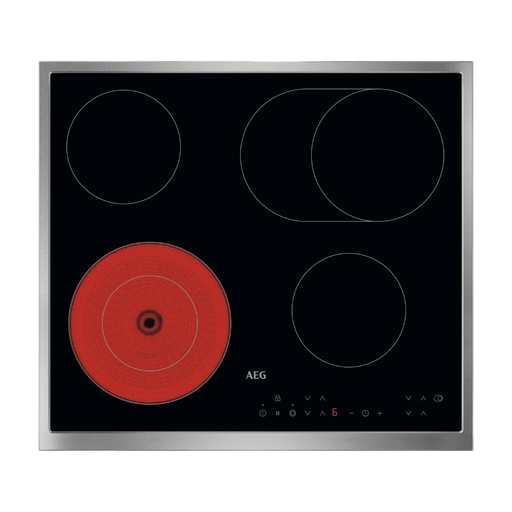
Why it suits this profile: The four electric zones and variable zone layout are well suited to households that regularly use several pans.
The specified cut-out is 56 x 49 cm. The hob has an extendable zone and automatic switch-off; connection must be carried out by a qualified installer.
Four zones, 7,000 watts total, touch controls, 99-minute timer and child lock.
We have put together a complete, up-to-date list of products that fully meet these strict selection criteria and the applicable European safety regulations.
Before buying, measure the cut-out in the worktop and compare it with the official cut-out dimensions. Also check the ventilation space beneath the hob. A built-in model supplied with a cable but no plug is not a plug-and-play solution. Have the electrical connection installed in accordance with local regulations.
With induction, you need to consider your cookware. Aluminium or ceramic pans without a magnetic base will not work properly. With ceramic hobs, pans with a flat base are important for even heat transfer.
Clean the glass surface with a soft, damp cloth once it has cooled down. Do not slide heavy cast-iron pans across the surface and do not use abrasive products. For every hob, check the manual for the exact cleaning and safety instructions.
Many 60 cm models use a cut-out of approximately 56 x 49 cm, but this is not a fixed rule. Always check the specified cut-out dimensions. A 30 cm hob generally requires a smaller cut-out and is suitable when worktop space is limited.
Consumption depends on the power rating, cooking time and selected setting. A higher wattage means that the hob can use more energy per hour when operating at full power. Therefore, do not look only at the maximum power output. Also consider the power controls, timer and your cooking habits.
No. Induction works with magnetic pans. Hold a magnet against the base of the pan to check, and choose pans with a flat underside. Ceramic and traditional electric hobs are generally less dependent on the pan material, but the pan size must still match the cooking zone.
