What should you look for when choosing?
First, decide whether you want to serve the rolls straight away or bake them first. Then consider which types of bread and allergens are suitable for your guests, and how many rolls you’ll need.
| What to consider |
What to check when buying |
Who is this important for? |
| A base for different fillings |
Choose between fresh and bake-at-home rolls, and decide whether to serve them whole or sliced. |
If I’m putting out a range of fillings, I want rolls I can portion as needed. This flexibility is a priority for around 40% of consumers. |
| Wholemeal and fibre |
If you’re looking for wholemeal, check that it’s stated explicitly; compare fibre per 100 g. |
I want to offer a clearly identifiable wholemeal option alongside white bread. This is the most important consideration for around 30% of consumers. |
| Serving gluten-free food |
Check the allergen information and keep utensils and crumbs separate. |
When a guest needs to eat gluten-free, I want to prevent regular rolls coming into contact with their roll. This is the highest priority for around 20% of consumers. |
| Quantity and preparation |
Compare the number of rolls in each pack and follow the oven instructions for bake-at-home rolls. |
When I’m shopping for a group, I want to know how many rolls I can prepare and when I’ll need oven space. This matters most to around 10% of consumers. |
Rolls for this buffet
These white rolls are a good fit for a buffet where you want a base for a range of fillings. The pack contains four rolls; decide whether you’d like to serve them whole or slice them before serving.
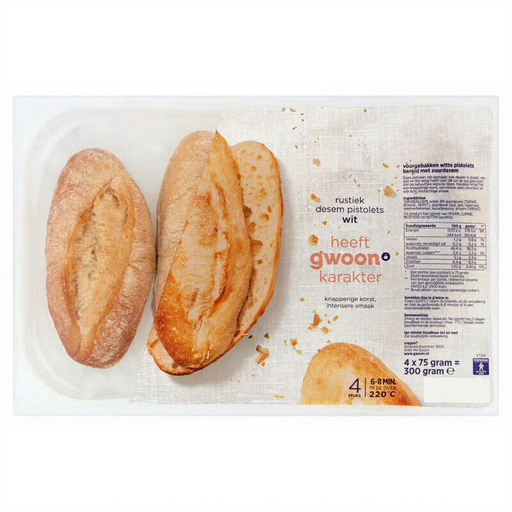 Image unavailable
g'woon White Rustic Pistolet, 4 pieces
A white roll to serve with a range of fillings; the pack contains 4 pieces. If you’d like to serve smaller portions, check whether the rolls are suitable for slicing. Check the packaging for preparation instructions and, if you have allergies, for ingredient and allergen information.
View at Joybuy
Frequently asked questions
Where can I find allergen information for rolls?
For pre-packed rolls, check the label: according to the Netherlands Food and Consumer Product Safety Authority, allergen information must be provided. For unpackaged bakery rolls, ask a member of staff for this information before choosing, especially if you’re buying for someone with an allergy.
How should I serve gluten-free rolls alongside regular ones?
Prepare and present them separately, using clean utensils and keeping them away from crumbs from regular rolls. The Netherlands Nutrition Centre points out that even a small amount of gluten can cause symptoms in people with coeliac disease, so a gluten-free product needs careful handling when it’s served too.
How should I store an opened pack of bake-at-home rolls?
First, follow the storage instructions on the packaging for your product. As a general guideline, the Netherlands Nutrition Centre recommends keeping an opened bake-at-home bread product in the fridge for 2–4 days or in the freezer for 1–3 months; check whether the product instructions differ.
Does organic mean a roll doesn’t contain iodised salt?
No, you can’t tell from the ‘organic’ label. Albert Heijn’s organic multigrain rolls list iodised salt among the ingredients, so check the label of the variety you’re buying.


