
Families looking to get the portions right
You want enough rolls for everyone, without automatically buying a larger pack than you need. So count the rolls in each pack and decide in advance how many you want to serve.


Choose individual rolls if you only need a few; a pack of part-baked rolls is a better fit if you can plan the portions in advance and want to serve warm bread. If you’re looking for a wholemeal base, check the ingredients rather than relying on the name ‘multigrain’, and check the current label for allergens and iodised salt.
You want enough rolls for everyone, without automatically buying a larger pack than you need. So count the rolls in each pack and decide in advance how many you want to serve.
You can plan to bake part-baked rolls if the cooking instructions suit your appliances and the timing of your dinner. Also check the storage advice if you won’t be using all the rolls at once.
Check the ingredients, allergens and any mention of iodised salt for each product. Don’t rely on the type of bread alone: this information can vary from pack to pack.
First, decide how many rolls you want to serve and whether you want to bake them before serving. Then check which type of bread and ingredients will suit your guests.
| What to consider | What to check | Who it matters to |
|---|---|---|
| Number of rolls | Count the rolls in each pack and work out how many you need for dinner. A single roll and a multipack suit different numbers of diners. | If I’m serving bread to several people, I want enough rolls without unnecessary leftovers. Around 36% of consumers say getting the right number of rolls is their top priority. |
| Type of bread and fibre | Read the product description, ingredients and nutritional information per 100 g. ‘Multigrain’ doesn’t automatically mean a roll is made entirely from wholemeal flour. | For a family meal, I want to be able to see whether a roll has a wholemeal base. Around 29% of consumers give this choice of bread top priority. |
| Preparation and storage | Check the cooking instructions and make sure they suit your oven or air fryer. Follow the storage advice on the pack for any leftover rolls. | If I want to serve warm bread, baking it needs to fit into my plans. This is the main consideration for around 21% of consumers. |
| Ingredients and allergens | Read the current ingredients and allergen information, including any ‘may contain’ statement. Check separately whether iodised salt or baker’s salt is listed. | If someone at the table needs to avoid certain ingredients, I want to know what’s in the bread before I buy it. Around 14% of consumers put this check first. |
The name ‘multigrain’ doesn’t tell you what proportion of the flour is wholemeal. For example, PLUS states that its multigrain rolls contain 56% wholemeal wheat flour.
If a wholemeal base matters to you, check the product description and ingredients list.
According to the Netherlands Nutrition Centre, using baker’s salt when baking bread is not compulsory. So the type of bread alone won’t tell you which salt a particular product contains.
Check the pack to see whether iodised salt or baker’s salt is listed in the ingredients.
According to Jumbo, Jumbo Pistolet Wit contains wheat; its product information also mentions possible traces of milk and sesame. Information may differ for other rolls.
Read the current label before buying, even if you’ve bought the product before.
An individual roll for anyone who only wants to pick up a few.
Packs of part-baked rolls, available in white and multigrain.
Part-baked white rolls in a pack of four.
Part-baked rolls with a choice of white or multigrain.
Rolls to choose alongside your other groceries.
A white roll for anyone choosing bread in store.
This pack of four rolls is an option if that quantity suits your family dinner. Check the cooking instructions on the pack if you want to serve the rolls warm.
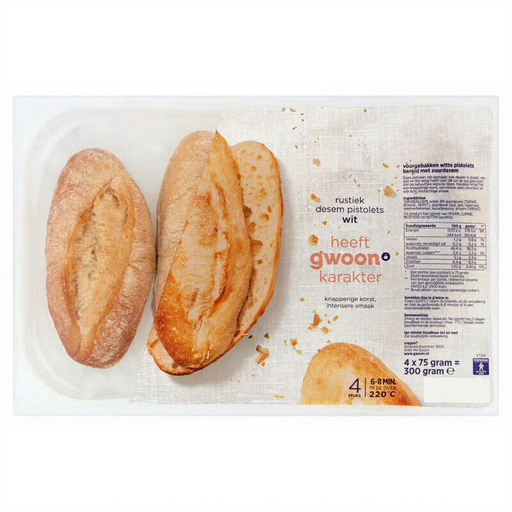 Image unavailable
A pack for a dinner where four rolls are just right. Before buying, check the current ingredients and allergen information, and read the cooking instructions if you want to serve the rolls warm.
Count how many rolls you want to serve and compare that number with the quantity in each pack. An individual roll may suit you if you only need a few; with a pack of four, consider whether you can use any leftovers.
No. The term ‘multigrain’ doesn’t automatically mean a roll is made entirely from wholemeal flour. Read the product description and ingredients; for example, PLUS states that its multigrain rolls contain 56% wholemeal wheat flour.
Yes, if the instructions on the pack allow it. The Netherlands Nutrition Centre generally recommends keeping part-baked rolls in the freezer for 1–3 months; their quality may deteriorate if stored for longer. Once opened, follow the storage advice for the specific product.
Before buying, read the current ingredients list and any ‘may contain’ statement. The Netherlands Food and Consumer Product Safety Authority explains the rules for allergen labelling; base your choice on the information for the specific roll, not a general product name.
No. The Netherlands Nutrition Centre says that using baker’s salt in bread is not compulsory. Check the ingredients for the roll you want to buy: for example, PLUS lists iodised salt in its white and multigrain rolls.