
Harbour walker who wants one camera
You want to capture both a panoramic view of the harbour and distant details without changing lenses. Compare the wide-angle setting, optical zoom range and the size of the camera you’re actually willing to carry.


Start with the photo you take most often: for a wide view of the harbour, the wide-angle setting matters, while details on the opposite bank call for optical telephoto reach. Then consider the sensor, lens speed and the weight of the complete camera. The longest zoom isn’t automatically the most comfortable choice at dusk or on a walk. The models mentioned are examples to help you weigh up your options; they don’t confirm availability at Joybuy.
You want to capture both a panoramic view of the harbour and distant details without changing lenses. Compare the wide-angle setting, optical zoom range and the size of the camera you’re actually willing to carry.
You stay on the quay and photograph subjects you can’t get closer to. Telephoto reach and ease of handling at high zoom levels are important considerations.
You also take photos as the light fades and want to weigh up sensor size and lens speed against zoom range and carrying weight.
Start with the field of view you need, then compare the optical telephoto reach. Next, consider the lighting conditions and how much the camera weighs. The Consumers’ Association (Consumentenbond) lists your subject, camera size, zoom range and image quality among the things to consider when choosing.
| Consideration | What to look for | Who should pay particular attention? |
|---|---|---|
| From a view of the quay to a close-up | Compare the wide-angle and telephoto focal lengths in 35mm-equivalent terms; distinguish optical zoom from digital zoom. | If I want to photograph both the whole quay and something on the opposite bank from the same spot, I’m looking for one lens that covers both fields of view. Around 33% of consumers put versatile framing first. |
| Framing distant subjects | Compare the maximum optical telephoto focal length and see how easily you can find a subject in the viewfinder at high zoom levels. | When I can’t get any closer from the quay, I want to frame distant details well. Around 27% of consumers prioritise reach for subjects like these. |
| Taking photos as the light fades | Compare sensor dimensions and the maximum aperture, separately for wide-angle and telephoto. | If I also take photos later in the day, I want to consider the sensor and lens speed, even if that means less telephoto reach. Around 20% of consumers prioritise use in low light. |
| Taking the camera with you | Check the weight, including the battery and memory card if these are included in the stated figure. Also consider how it will work with your bag or camera strap. | For a longer walk, I want a kit that remains comfortable to carry, even if I have to give up some optical reach. Around 20% of consumers put carrying weight first. |
A higher digital zoom figure doesn’t mean the lens can zoom in further optically. So the number on its own may not give you a clear idea of what the lens can achieve.
Compare the stated optical range to gauge how large a subject on the opposite bank will appear in your photo.
At extreme telephoto range, it can be harder to find a subject again and keep the camera steady. A fixed-lens camera can also still be quite heavy.
Try out the maximum telephoto setting and compare weights on the same basis before choosing a camera for a lightweight walking kit.
A similar-looking model name doesn’t necessarily mean it’s the same camera or version. FZ82 and FZ82D, P1000 and P1100, and RX10 IV and RX10 V are different model names.
Check the full model name and version on the product page, even if the description gives the same zoom range.
The LUMIX DC-FZ82D is an example of a camera offering a wide field of view and a broad optical zoom range with a single fixed lens.
The PowerShot SX70 HS is an example of a camera with a wide-angle-to-telephoto range for a walk.
The RX10 IV is an example of a camera that involves weighing up sensor size, lens speed and telephoto reach.
The P1100 is worth considering if very long optical zoom is an essential requirement.
The AZ528 is another superzoom option to consider if you want to compare a less far-reaching range.
These Joybuy products are digital cameras whose product names mention optical zoom. Before buying, check the full version and whether the stated zoom range suits your harbour photography.
 No image available
An option to consider if you want to use optical zoom for subjects at different distances.
The product name mentions 12X optical zoom, 4K and Wi-Fi.
 No image available
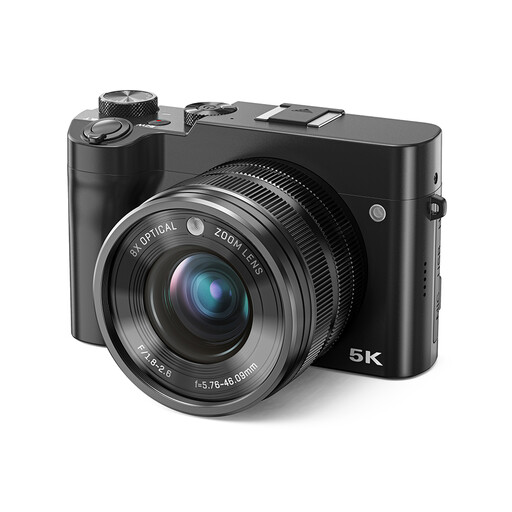
An option to consider if you want to use optical zoom to adjust the framing of harbour scenes.
The product name mentions 8X optical zoom, 5K, 64MP and two lenses.
 No image available
An option to consider if you’re looking for a camera with optical zoom for changing your framing around the harbour.
The product name mentions 10X optical zoom, 5K and 56MP.
No. Also compare the minimum and maximum focal lengths in 35mm-equivalent terms, and check whether the zoom is optical. The Consumers’ Association (Consumentenbond) points out that it can be harder to keep your subject in the frame at high zoom levels.
Start with a less zoomed-in view, then zoom in further. Check whether your chosen model has a viewfinder and image stabilisation; these features don’t guarantee protection against camera shake.
Before paying, check what’s included with the specific offer, such as the battery, charger and memory card, and what additional costs the seller lists. In the Netherlands, if a product is faulty, the seller must provide a solution. The Dutch Government describes the statutory guarantee as a right you have when you buy something.
Not without considering how you’re sharing the photo. The Dutch Data Protection Authority distinguishes between photos kept private or shared with a very limited group and wider publication. Consider the specific use before posting identifiable people online.