
Photographing entire rows of façades
If you’re on a narrow canal-side path and want to capture buildings, gables and part of the canal in one shot, compare the widest optical setting first.


If you’re standing on a narrow canal-side path, compare the shortest optical focal length first: a wide angle of view may matter more than maximum telephoto zoom. For changing light, sensor size, aperture and exposure settings are also important, but no single specification guarantees a successful shot. Extra telephoto reach is most useful if you often want to photograph architectural details on the opposite bank.
If you’re on a narrow canal-side path and want to capture buildings, gables and part of the canal in one shot, compare the widest optical setting first.
If the sun and shade keep shifting, with bright sky alongside dark brickwork, compare the sensor and lens specifications and check which exposure settings you can use.
If you want to capture ornaments, windows or brickwork from across the canal, look at the optical telephoto range and bear light and stability in mind too.
A good fit if: you want to try to frame an entire façade and its surroundings in one shot from a narrow canal-side path. Panasonic lists a 20 mm full-frame equivalent wide-angle setting for the DC-FZ82D.
Trade-off: that angle of view doesn’t tell you how well shadow areas will be rendered; Panasonic’s Dutch product page lists versions of the DC-FZ82D as unavailable.
A good fit if: you often shoot in fading or high-contrast daylight and a 24 mm wide-angle setting is wide enough for your framing. Sony specifies a 1.0-type sensor and a 24–600 mm equivalent lens with a maximum aperture of f/2.4–4.0 for the DSC-RX10M4.
Trade-off: 24 mm is less wide than the 20 mm listed by Panasonic for the DC-FZ82D; these specifications don’t guarantee results in every lighting condition.
A good fit if: ornaments or brickwork across the canal are your main subject. Canon lists a 21–1365 mm equivalent range for the PowerShot SX70 HS, while Nikon lists a 24–3000 mm equivalent optical range for the COOLPIX P1100.
Trade-off: maximum telephoto reach is no substitute for a useful wide-angle setting or enough light; Canon says the SX70 HS has been discontinued.
| What to consider | What to check before buying | Best suited to |
|---|---|---|
| Fitting an entire façade in the frame | Compare the shortest optical focal length in full-frame equivalent terms: Panasonic lists 20 mm, Canon 21 mm, and Sony and Nikon 24 mm for the models mentioned. | If I want to frame a complete row of façades from a narrow canal-side path, the widest angle of view comes first; around 36% of consumers say capturing entire rows of façades is their top buying priority. |
| Brickwork in changing light | Compare the sensor size, maximum aperture and available exposure settings for the exact model. Sony specifies a 1.0-type sensor and a maximum aperture of f/2.4–4.0 for the DSC-RX10M4. | If I want to capture bright sky and dark brickwork together as the sunlight changes, I look at the exposure controls; around 29% of consumers prioritise changing light. |
| Details across the canal | Check the optical telephoto range separately from any digital zoom, and compare the maximum aperture at the telephoto end too. Nikon lists a 24–3000 mm equivalent optical range for the P1100. | If I want to isolate windows or ornaments from where I’m standing, optical telephoto reach matters most; around 21% of consumers make distant architectural details their main priority. |
| Taking it with you without changing lenses | Compare the weight including the battery and card, and check that the grip and portability suit your walk. Canon lists the SX70 HS at approximately 610 g including the battery and card. | If I want to walk along the canal without changing lenses, portability is a factor; around 14% of consumers say being able to do so is their main need. |
When you’re trying to fit an entire façade into the frame from a narrow canal-side path, the lens’s starting setting determines how wide you can frame. Digital zoom is also not the same as optical range.
First compare the shortest optical focal length in full-frame equivalent terms, then work out how much telephoto reach you need.
A wide-angle lens can help you fit a façade into the frame, but lines near the edge of the image may appear distorted. Nikon also highlights the importance of light and shade in architectural photography, as well as correcting lines in post-processing.
Check your composition and consider perspective or lens correction if straight lines matter.
Post-processing can take extra time if you want to correct lines.
Canon says the PowerShot SX70 HS has been discontinued. Panasonic’s Dutch product page lists versions of the DC-FZ82D as unavailable; this doesn’t tell you what other retailers have in stock.
Before buying, check the exact model code, what’s included in the box, the seller and current availability.
The DC-FZ82D is a useful point of comparison if you’re looking for a wide angle of view and plenty of telephoto reach in one camera.
The DSC-RX10M4 is worth considering if you want to compare a 1.0-type sensor and a fixed zoom lens.
The PowerShot SX70 HS is a useful point of comparison if you’re looking for a combination of wide angle and telephoto reach.
The COOLPIX P1100 is most relevant if distant architectural details are your main focus.
The Joybuy products below are digital cameras whose product names mention optical zoom. Check that the form factor, controls and angle of view suit your needs for a bridge camera for photographing canal houses.
 No image available
The listed 12× optical zoom gives you a starting point for comparing range; also check the shortest focal length to see whether it can fit an entire façade in the frame.
The product name mentions 4K, Wi-Fi and 64 MP.
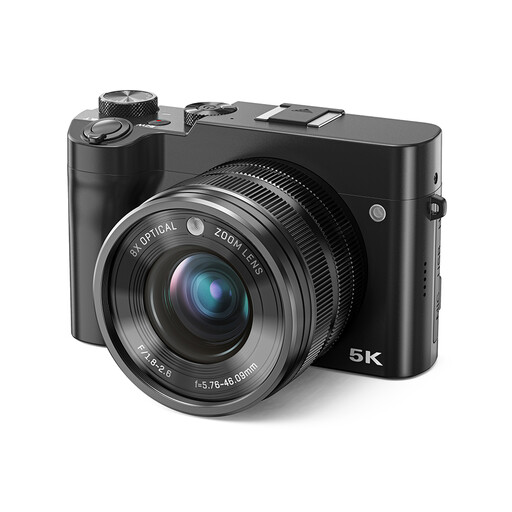 No image available
The listed 8× optical zoom is a starting point for comparing range; also check whether the wide-angle setting suits your shooting position by the canal.
The product name mentions a dual lens, 5K and 64 MP.
First compare the shortest optical focal length in full-frame equivalent terms. Panasonic lists 20 mm for the DC-FZ82D, Canon lists 21 mm for the SX70 HS, and Sony lists 24 mm for the DSC-RX10M4. Try changing your shooting position too: the zoom factor alone doesn’t tell you how wide the lens starts.
Reassess the exposure and use exposure compensation if your camera offers that setting. Canon, for example, specifies ±3 EV for the SX70 HS. For architectural photography, Nikon also recommends paying attention to the interplay of light and shade. This doesn’t guarantee that all the bright and dark details will be preserved in one photo.
Before you head out, check that the battery and memory card are present and working, take a test shot at wide angle and telephoto, and consult the manual for your model’s settings and cleaning instructions. Canon lists a battery and charger among the items included with the SX70 HS; don’t assume another model or a second-hand camera comes with the same accessories.
If a product is faulty, the seller in the Netherlands must provide a solution. According to the Dutch government, the legal guarantee has no fixed time limit. An additional warranty is most relevant if its terms give you more rights than you already have.
Check the privacy rules first: according to the Dutch Data Protection Authority, identifiable people in photographs are personal data. Private use within a very limited circle is exempt, but public or commercial sharing requires an applicable legal basis under the GDPR. Don’t assume that one person’s consent applies to every publication.