Which trade-offs matter to you?

Photographing birds on the far side

You’re staying on the path and want to get a distant bird large in the frame. Optical telephoto reach and a usable viewfinder matter more to you than the widest angle. Also consider how easy it is to keep tracking a moving subject.

Shooting in changing light

You also take photos when clouds pass in front of the sun or later in the day. Compare sensor size and lens aperture at the focal length you actually use, rather than looking only at the maximum zoom setting.

Walking around the pond with one camera

You want to switch between the whole pond landscape and close-up details without changing lenses. The wide-angle setting, zoom range, weight and controls all play a part in your decision.

What should you look for when choosing?

Superzoom for distant birds

A good fit if: in good light, you mainly want to frame birds or distant details from the path. Panasonic lists a 20–1200 mm equivalent range for the DC-FZ82D; Nikon lists 24–3000 mm equivalent for the COOLPIX P1100.

The trade-off: a long telephoto reach can make it harder to track your subject and keep the camera steady while framing. The Consumentenbond warns that cameras with a high zoom range often have a small sensor, which can be a disadvantage in low light.

Shorter telephoto reach for fading light

A good fit if: you often take photos as the light fades and 600 mm equivalent is enough. Sony specifies a 1.0-type sensor and a 24–600 mm f/2.4–4 lens for the RX10 IV and RX10 V.

The trade-off: you get less maximum telephoto reach than with models such as the DC-FZ82D and COOLPIX P1100. These specifications don’t guarantee a sharp photo of a moving bird in low light.

Wide shots and details on one walk

A good fit if: you want to photograph both the pond and subjects on the far side. Panasonic lists 20–1200 mm equivalent for the DC-FZ82D; Canon specifies 21–1365 mm for the PowerShot SX70 HS.

The trade-off: compare the wide-angle and telephoto ends separately. Canon Netherlands marks the SX70 HS as discontinued and no longer available in its own shop; this doesn’t determine its availability from other retailers.

What to consider What should you check? Who is this important for?
Getting distant birds in the frame Compare the optical telephoto reach in millimetres equivalent, the viewfinder and the aperture at the telephoto end. I want to frame a bird on the far side of the pond large enough from the path; around 31% of consumers make distant birds their top purchase priority.
Shooting in changing daylight Check the sensor size and f-number at the zoom setting you use. Stabilisation won’t freeze a moving bird. As the light around the pond fades, I want to take sensor size and lens aperture at my usual telephoto setting into account; around 31% of consumers prioritise changing light.
Capturing both the wider scene and details Compare both ends of the optical range in millimetres equivalent; don’t count digital zoom as optical reach. I want to take wide shots of the pond and capture details on the same walk without changing lenses; around 23% of consumers give this flexibility their top priority.
Carrying and using the camera Compare the weight including the battery, grip, screen and viewfinder of the exact models. For a walk, I want a camera that’s comfortable to carry and quick to use; around 15% of consumers put portability and ease of use first.

Things to watch out for when buying

  • Assuming the highest zoom figure means the best pond photo

    At high magnification, it can be harder to keep a bird in the frame. The Consumentenbond also points out that cameras with a high zoom range often have a small sensor, which is a particular consideration in low light.

    Compare optical range, sensor size and aperture at the telephoto end. First, work out how far away your subject usually is.

  • Confusing digital zoom with extra optical reach

    Nikon distinguishes between the COOLPIX P1100’s optical zoom up to 3000 mm equivalent and its digitally extended zoom range. Digital magnification doesn’t add optical reach.

    Compare the optical telephoto end of the exact models and treat digital magnification separately.

  • Taking a manufacturer’s page as proof of current stock

    A manufacturer’s product page doesn’t automatically tell you what a retailer is currently offering. A status shown by the manufacturer doesn’t tell you whether other retailers have the product in stock, either.

    Before you order, check the exact model code, version and box contents on the retailer’s product page.

Camera brands to compare

Panasonic

The LUMIX DC-FZ82D is worth considering if you’re looking for a wide starting view and plenty of telephoto reach in one bridge camera.

  • Panasonic specifies a 20–1200 mm equivalent range and a maximum aperture of f/2.8–5.9.
  • The manufacturer lists the versions shown as unavailable on its Dutch product page. Check the retailer for the current offer and exact version.

Sony

The RX10 IV and RX10 V are worth considering if 600 mm equivalent is enough and you want to take sensor size and lens aperture into account.

  • Sony specifies a 1.0-type sensor and a 24–600 mm f/2.4–4 lens for both models.
  • These model specifications don’t prove that the RX10 range as a whole performs better in all lighting conditions.

Nikon

The COOLPIX P1100 is worth considering if extra optical reach for distant subjects is the main reason for your choice.

  • Nikon lists 24–3000 mm equivalent, RAW shooting and an electronic viewfinder.
  • Nikon gives its weight as approximately 1.4 kg. You may not need the maximum telephoto setting at a city park pond.

Canon

According to Canon, the PowerShot SX70 HS combines a wide starting view with a long telephoto reach and an adjustable screen.

  • Canon specifies 21–1365 mm equivalent and a weight of around 610 g including the battery and memory card.
  • Canon Netherlands marks the model as discontinued and no longer available in its own shop; this doesn’t tell you whether other retailers offer it.

KODAK PIXPRO

The AZ528 is a bridge camera to compare if you’re looking for optical reach but don’t want the longest telephoto setting to be your main deciding factor.

  • KODAK PIXPRO specifies 24–1248 mm equivalent for the AZ528.
  • Compare the range with the sensor and lens specifications that matter for your lighting conditions; the maximum telephoto figure alone doesn’t tell you which camera is suited to low light.

Cameras at Joybuy

The Joybuy cameras below list optical zoom in their product names. Before you buy, check the focal-length range in millimetres equivalent and the sensor size: the stated zoom factor alone doesn’t tell you how suitable the range is for photographing birds on the far side of a pond.

Komery W6 digital camera with 12X optical zoom

Komery W6 12X Optical Zoom 4K Digital Camera, 64MP, WiFi

The stated optical zoom factor is useful if you want to try different framings on a walk; check the focal lengths in millimetres equivalent for your pond scene.

The product name lists 12X optical zoom, 4K, 64MP and WiFi.

Joybuy
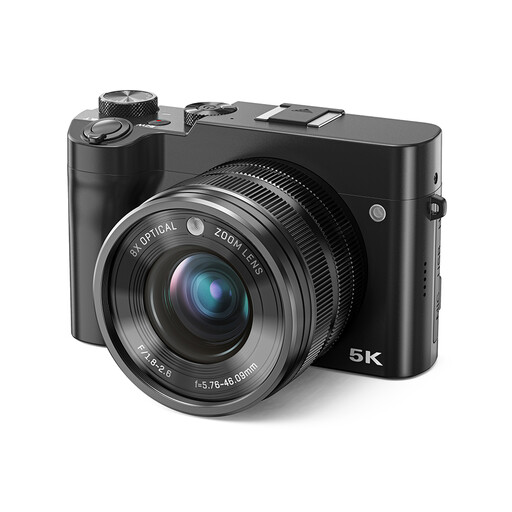
Songdian digital camera with 8X optical zoom and dual lenses

Songdian 8X Optical Zoom 5K Digital Camera, Dual Lens, Black

The stated zoom factor can help you adjust your framing; check the range in millimetres equivalent before comparing this camera with a bridge camera.

The product name lists 8X optical zoom, 5K video, dual lenses and the colour Black.

Joybuy
Songdian digital camera with 10X optical zoom and front and rear cameras

Songdian 5K Digital Camera, 10X Optical Zoom, 56MP, Black

The stated optical zoom factor gives you a starting point for different framings; check the focal lengths in millimetres equivalent for distant subjects.

The product name lists 10X optical zoom, 5K, 56MP and a front and rear camera.

Joybuy

Frequently asked questions

Which feature helps when a bird is moving and the light is fading?

When choosing, look at the lens aperture at the zoom setting you use, along with the focusing and control options. When taking photos, choose a shutter speed suited to the movement; stabilisation can’t replace a shutter speed that freezes a moving animal.

Do I need an interchangeable lens for a bridge camera?

No, a bridge camera has a fixed zoom lens. So, check in advance that both the wide-angle view and the reach for distant subjects suit the way you use the camera; you can’t swap the lens for one with a different range.

Which accessories and service terms should I check?

Check whether the battery, charger and memory card are included or need to be bought separately; Canon, for example, lists a battery and charger among the SX70 HS box contents. According to ACM ConsuWijzer, the retailer must put a faulty product right free of charge under the legal guarantee; this is separate from any manufacturer’s warranty. For online purchases, the Authority for Consumers & Markets says you usually have 14 days to change your mind.

Can I photograph identifiable people by the pond and share the pictures publicly?

According to the Dutch Data Protection Authority, private photos that stay private or are shared only with a very limited group are treated differently from photos shared publicly or for business purposes. The exception for personal or household use doesn’t apply to public or business use, so check the relevant privacy rules in those cases. This doesn’t mean that every park photo can automatically be posted publicly.

Can I get closer to a nest to take a bird photo?

According to the Environmental Information Point, deliberately disturbing birds or damaging the nests of wild birds that naturally occur in the Netherlands may require a permit; the conditions and any possible exemptions matter. Keep your distance and check the specific activity and any local park rules before approaching a bird or nest.
