For a town square, a wide-angle setting is important if you want to capture the whole scene from one spot; for façades and towers across the square, optical telephoto reach matters more. The sensor, lens aperture and exposure controls are also relevant in changing light, but listed specifications are no substitute for real-world testing. A bridge camera keeps lens choices simple, but you can’t replace its fixed lens later.
Who is a bridge camera suitable for?
Town square and architecture photographers
If you want to fit buildings and the entire square into one shot, it’s worth paying attention to the wide-angle setting and the ability to adjust exposure as daylight changes. For the models mentioned, Panasonic and Canon specify wide-angle settings equivalent to 20 mm and 21 mm respectively.
Photographers capturing distant city details
If you want to capture façades, towers or other details across the square from one spot, optical telephoto reach may be a high priority. Nikon lists a range equivalent to 3000 mm for the COOLPIX P1100.
Photographers who don’t want to change lenses
A camera with a fixed lens suits anyone who wants to switch between wide views and details without carrying separate lenses. Check in advance that the wide-angle and telephoto settings suit the subjects you photograph.
What should you look for when buying?
A wide view of the square in changing light
Choose this option if: you want to fit as much of the square as possible into the frame from a limited vantage point and be able to adjust the exposure. Panasonic lists an equivalent of 20 mm for the DC-FZ82D; Sony lists 24 mm for the RX10 IV, along with a 1.0-type sensor and an f/2.4–4 lens.
The trade-off: these specifications describe different features, but they’re not a direct real-world comparison or proof of better photos in low light.
Distant details from one spot
Choose this option if: you can’t get closer and distant details matter more than an extra-wide angle of view. Nikon lists a range equivalent to 24–3000 mm for the COOLPIX P1100.
The trade-off: Nikon lists a 1/2.3-type sensor for this model; its greater telephoto reach doesn’t prove that the camera is better suited to capturing the whole square or shooting in fading light.
Adjusting exposure afterwards
Choose this option if: you want to edit your photos afterwards or use exposure features when shooting a scene with both bright and dark areas. Canon specifies RAW recording and exposure compensation for the PowerShot SX70 HS; Nikon describes bracketing for shots taken at different exposures.
The trade-off: RAW files need editing, while bracketing involves taking multiple shots, which is less practical if there’s movement in the frame. Check the features and settings of the exact model.
| What to consider |
What to check before buying |
Who it matters to |
| Exposure in changing light |
Check RAW, exposure compensation and bracketing on the exact model; bracketing is most useful for a mostly still scene. |
If I want to photograph bright skies and dark façades together, I look for ways to adjust the exposure or edit the image later. Around 36% of consumers say changing light is their main concern when buying. |
| Getting the whole square in the frame |
Compare the wide-angle setting in 35 mm equivalent focal lengths; a shorter equivalent focal length gives you a wider angle of view from the same spot. |
If I want to capture the square and the surrounding buildings in one composition from a fixed spot, I focus on the widest setting. Around 29% of consumers prioritise a wide view of the square. |
| Fast-changing scenes |
Check the camera’s controls, autofocus, viewfinder and how easy it is to access the exposure settings. |
If passers-by or compositions change quickly, I want to reframe and react promptly. Around 21% of consumers say fleeting scenes in the square are their main concern when buying. |
| Details across the square |
Compare the optical telephoto end in 35 mm equivalent focal lengths and check that the controls are comfortable to use at long focal lengths. |
If I’m staying in one spot and want to make distant architectural details appear larger in the frame, optical telephoto reach matters more to me. Around 14% of consumers prioritise distant architectural details. |
Common buying mistakes
-
Comparing only the maximum zoom figure
A long telephoto reach doesn’t tell you how much of the square you can capture from your vantage point. The wide-angle setting matters too.
Compare the optical focal length range in the same units, preferably in 35 mm equivalent millimetres.
-
Assuming similar model names mean the same camera
The DC-FZ82D isn’t necessarily the same product as the older FZ82. The Sony RX10 IV and RX10 V are also separate models.
Check the full model name and the specifications of the actual product on offer before comparing models.
-
Treating an older ranking as proof of current new-stock availability
A selection featuring older models doesn’t automatically tell you whether they’re currently available as new products. Nikon lists the P1000 as discontinued; Canon Netherlands says the SX70 HS is no longer available from its own shop.
For a specific offer, check the condition, included accessories, seller and current terms of purchase.
Brands to compare
Panasonic
The LUMIX DC-FZ82D is worth comparing if a wide angle of view and a long zoom range are important to you.
- Panasonic lists a fixed lens equivalent to 20–1200 mm and an OLED viewfinder for the DC-FZ82D.
- Don’t assume the older FZ82 is the same version as the DC-FZ82D without checking.
Sony
The RX10 IV is a useful point of comparison if you want to consider sensor size and lens aperture as well as zoom range.
- Sony lists an equivalent 24–600 mm lens, a 1.0-type sensor and an f/2.4–4 aperture for the RX10 IV.
- The RX10 V is a separate model; the two aren’t interchangeable.
Canon
The PowerShot SX70 HS is worth considering if wide-angle capability, telephoto reach and exposure features all matter to you.
- Canon lists a range equivalent to 21–1365 mm, RAW support and exposure compensation.
- Canon Netherlands says the SX70 HS is no longer available from its own shop; that doesn’t necessarily mean it’s unavailable elsewhere.
Nikon
The COOLPIX P1100 focuses on capturing subjects at a great distance.
- Nikon lists an optical range equivalent to 24–3000 mm for the P1100.
- Nikon lists a 1/2.3-type sensor; telephoto reach alone doesn’t determine how suitable the camera is for wide shots of a square or fading light.
KODAK PIXPRO
The AZ528 is another option to compare if you’re considering a bridge camera with optical zoom.
- The manufacturer lists 52× optical zoom and a 16 MP CMOS sensor for the AZ528.
- Check the wide-angle setting and the features you need for shots of the square before choosing.
Cameras at Joybuy
Cameras at Joybuy that are relevant to this topic; check whether each model’s lens covers both the view of the square you want and distant details.
 No image available
Komery W6 digital camera
The listed 12× optical zoom is worth considering if you want to switch between wide views and details; also check the focal lengths to see whether they provide the angle of view you want.
The product name lists 4K, 64 MP and Wi-Fi.
View at Joybuy
 No image available
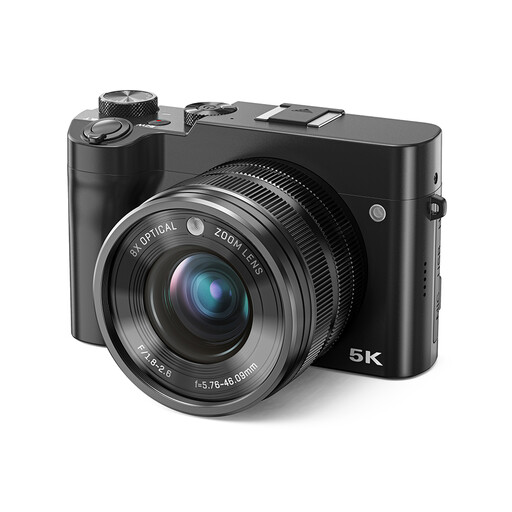
Songdian digital camera with 8× optical zoom
If you want to frame subjects at different distances, the listed optical zoom is worth comparing; check that the lens also starts wide enough to capture the square.
The product name lists 5K, 64 MP, two lenses and colour night vision.
View at Joybuy
 No image available
Songdian 5K digital camera, black
This model is suitable for shots of the square only if its lens settings and controls work for both the wide view you want and distant details.
The product name lists 56 MP, 10× optical zoom and front and rear cameras.
View at Joybuy
Frequently asked questions
Which setting can help when the sky is bright but the façades are dark?
Check a test shot and adjust the exposure if needed. For a mostly still scene, bracketing can produce several exposures; if you want to edit the image afterwards, check whether the exact model supports RAW. Nikon Netherlands describes bracketing for scenes with both bright and dark areas.
Do I need to change lenses on a bridge camera?
No, a bridge camera has a fixed lens. So before you buy, check both the wide-angle setting and the telephoto end: you can’t add a missing range later by fitting a different lens.
What if I’m not happy with a camera I bought online, or it breaks too quickly during normal use?
For online consumer purchases, you generally have a statutory 14-day cooling-off period after delivery, although exceptions may apply. The seller must also provide a remedy under the statutory guarantee if a product doesn’t meet expectations during normal use. ACM ConsuWijzer explains these consumer rights.
Can I share a photo of the square publicly if passers-by are recognisable?
First consider the privacy implications. According to the Dutch Data Protection Authority, an exception applies to personal use that stays private or is shared only with a very limited group; this exception doesn’t apply to wider public distribution. Professional or commercial use requires an applicable legal basis under the GDPR.


