
Restorers focusing on small details
You want to capture lettering, knobs and the texture of paint or wood individually. Getting the focus right for your chosen composition is key.


When choosing a bridge camera for a restored radio, pay particular attention to the focusing distance at the zoom setting you actually want to use; extra telephoto zoom won’t automatically help you capture details on a table. A stable setup and controllable lighting help you take consistent photos. If the knobs and casing are at different distances, Focus Stacking can combine several focus points, provided the model you choose has this feature.
You want to capture lettering, knobs and the texture of paint or wood individually. Getting the focus right for your chosen composition is key.
You want to photograph the whole radio clearly and consistently, paying attention to lighting, the background and a true-to-life appearance.
You want to photograph subjects other than the radio, too. Weigh the extra zoom range against the camera’s close-up capabilities.
Start with the focusing distance at your preferred zoom setting. Then compare how much control you have over lighting and depth of field with the other ways you expect to use the camera.
| What to consider | What to look for when buying | Who is this important for? |
|---|---|---|
| Focusing on small details | Check the macro mode and minimum focusing distance at both the wide-angle and telephoto ends. | If I want lettering and paint texture to fill the frame, I focus on getting the right focus at the composition I’ve chosen. Around 36% of consumers say capturing small details is their top buying priority. |
| Reproducing colour and surface texture | Check whether manual exposure, adjustable white balance and RAW are available if you want to edit your photos. Also allow room for lighting and a tripod. | For a complete product photo, I want to capture colour and surface texture clearly and be able to adjust the lighting. Around 29% of consumers prioritise faithful reproduction and lighting. |
| Sharpness at different depths | Check for aperture control, manual focusing and whether the exact model supports Focus Stacking. | If the knobs and casing are at different distances, I want to choose which parts are in focus. For around 21% of consumers, control over depth of field is the top priority. |
| Use beyond photographing the radio | Decide whether you’ll also photograph subjects at a distance, and check the focusing distance for the radio, the product condition and the included accessories. | If I’m looking for one camera for a range of subjects, I weigh up the zoom range against close-ups on a table. Around 14% of consumers prioritise versatility. |
Panasonic specifies 1 cm at the wide-angle end and 150 cm at the telephoto end for the LUMIX DC-FZ82D. Nikon lists around 1 cm at the wide-angle end and around 7 m at the telephoto end for the COOLPIX P1100.
Compare the wide-angle and telephoto distances separately, and decide in advance which zoom setting you want to use for detail shots.
According to Nikon, the COOLPIX P1100 has 125× optical zoom, but its specified minimum focusing distance at the telephoto end is around 7 m. That range is not the same as a short working distance for a radio on a table.
Assess telephoto zoom for subjects at a distance, and check the close-up mode separately for photographing the radio.
Canon recommends using a tripod for consistent product photos. You may also need to consider a stable setup, lighting or a memory card required for a particular feature.
Check what’s included and what else you’ll need for the features you want to use.
Panasonic lists the DC-FZ82D as unavailable on its Dutch product page. The Dutch Canon shop lists the PowerShot SX70 HS as discontinued and no longer available.
Check the exact model number, condition, accessories and current availability with the retailer you’re considering.
The LUMIX DC-FZ82D and DC-FZ1000M2 offer different trade-offs between close-up photography and zoom range.
According to Sony, the RX10 V is a fixed-lens camera that combines a 1.0-type sensor with a 24–600 mm equivalent zoom range.
According to Canon, the PowerShot SX70 HS combines a 1/2.3-type sensor with 65× optical zoom and manual focusing.
The COOLPIX P1100 is particularly worth considering if you also want to use the same camera for subjects far away.
This selection includes digital cameras with optical zoom. Check whether each model’s focusing distance and controls are suited to capturing the small details of your radio.
 No image available
If you’re considering a digital camera with optical zoom, also check its focusing distance for the small details on your radio.
The product name lists 12× optical zoom, 4K, Wi-Fi and 64 MP.
 No image available
If you want to focus manually on a particular detail, check whether the controls described suit the way you plan to photograph the radio.
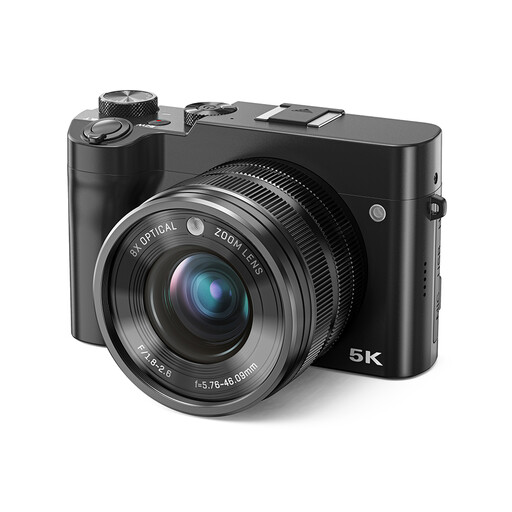
The product name lists 8× optical zoom, 5K, 64 MP and two lenses. The product description mentions manual focusing via the lens ring and an adjustable focus area.
Don’t assume it does. Panasonic specifies 1 cm at the wide-angle end and 150 cm at the telephoto end for the DC-FZ82D. For the P1100, Nikon lists around 1 cm at the wide-angle end and around 7 m at the telephoto end. Check the distances for the exact model at the zoom setting you want to use.
Set up the stationary radio and camera securely, then use the aperture and focus point to choose which parts should be sharp. If your model has Focus Stacking, you can combine different focus points; Panasonic recommends using a tripod for this technique. Check that the feature is available on the model you choose.
Start with a controlled lighting setup and move the light source while checking the image. A tripod helps you keep the composition steady as you adjust the lighting; camera specifications alone can’t guarantee a reflection-free photo.
No. The Dutch government says there is no fixed statutory guarantee period in the Netherlands: you’re entitled to a product that does what you can reasonably expect it to do. If something goes wrong, the seller must provide a solution; your circumstances determine which rights apply.
For a standard online purchase by a consumer, there is usually a statutory cooling-off period of up to 14 days after delivery. ACM ConsuWijzer explains the exceptions and conditions around opening, trying out and returning a product; check these before you buy.