Start with diffused, adjustable lighting, then choose a bridge camera to suit your main aim: RAW capture and sensor size for overview shots, or a focusing distance that works for photographing fabric details. A polarising filter can reduce reflections, but the result depends on the material and the angle of the light. So also check the filter mount and focusing distance at your preferred zoom setting. A high zoom ratio will not eliminate reflections, and a larger sensor is no substitute for suitable lighting.
Who is this guide for?
Makers working with shiny fabrics
You want to control reflections without losing all the visible sheen and texture. Lighting and filter compatibility both matter here: Nikon USA explains that a polarising filter can reduce unwanted reflections, while Adobe explains how direct light can create harsh highlights.
Makers taking colour-accurate overview shots
You photograph the whole patchwork quilt for display or documentation and want to assess colours and lighter areas carefully. RAW, camera controls and lighting are all worth considering; Sony Netherlands and Panasonic Netherlands publish model-specific information on image capture.
Makers photographing stitching and fabric details
You want to photograph seams and individual patches close up, so you need to check the focusing distance at your chosen zoom setting. Panasonic Netherlands and Canon Netherlands list focusing distances and conditions for their specific models.
What should you look for?
| What to consider |
What should you check? |
Who should consider this? |
| Reflections and fabric sheen |
Check the filter size and mount. Take test shots with and without a filter, and change the angle of the light if needed. Nikon USA explains that polarising filters can reduce reflections. |
If I want to reduce distracting reflections while keeping the sheen on certain patches, I’ll consider filter use and lighting; around 29% of consumers put reflection control first. |
| Colour and lighter details |
Check RAW support and the settings for each model. Compare sensor sizes, but don’t assume they alone guarantee a particular colour rendition. |
If I want to assess the colours across the whole patchwork quilt carefully, RAW and even lighting are important; around 29% of consumers make colour rendition their top priority. |
| Seams and small patches |
Check the focusing distance and the zoom setting it applies to. Leave room for your lighting. |
If I want to capture stitching and small patches close up, I’ll check that the camera can focus at my working distance; around 24% of consumers put fabric details first. |
| Total cost and other uses |
Check which adapter or filter you’ll need and whether the extra zoom range will also be useful for other subjects. |
If you want to weigh up which camera and filter accessories are worthwhile, consider how you might use the camera beyond patchwork quilts too; around 18% of consumers put the overall cost into the equation first. |
Common pitfalls
-
Assuming lots of zoom makes a camera suitable for textiles
For a stationary subject, extra telephoto reach won’t solve reflections. The Dutch Consumers’ Association also recommends looking at the image sensor when choosing a camera, rather than just the megapixel count.
Choose a camera for its telephoto reach if you need it for other subjects too. For patchwork, compare lighting control, sensor size and focusing distance first.
-
Looking at the macro distance without checking the zoom setting
For the Panasonic FZ82D, Panasonic lists a focusing distance of 1 cm at the wide-angle setting and 150 cm at the telephoto setting.
Check the distance for the framing you want, and leave enough room for your lighting.
-
Assuming a polarising filter will fit straight on
For the Canon PowerShot SX70 HS, Canon lists the compatible FA-DC67A adapter for a 67 mm filter.
Check the camera model, adapter and filter size as a complete combination before buying any accessories.
A compatible filter adapter and filter may need to be bought separately.
-
Treating different model versions as the same camera
The Panasonic DMC-FZ82 and DC-FZ82D are different model designations. Sony also lists the RX10 IV and RX10 V as separate models.
Compare the full model name and version; don’t assume specifications carry over from one model to another without checking.
Brands to compare
Panasonic
The LUMIX DC-FZ82D is worth considering if you want to compare close-up detail, RAW support and filter mounting. Panasonic lists Focus Stacking and macro focusing from 1 cm at the wide-angle setting.
- Panasonic lists a 55 mm filter size and manual shooting modes for the DC-FZ82D.
- The listed minimum focusing distance is 150 cm at the telephoto setting. The older DMC-FZ82 is not the same version as the DC-FZ82D.
Sony
The Sony RX10 IV is a separate model with a 1.0-type sensor, RAW capture and a fixed zoom lens. Sony specifies a 72 mm filter diameter for this model.
- Sony lists a 13,2 × 8,8 mm sensor and 25× optical zoom for the RX10 IV.
- The minimum focusing distance varies with the zoom setting. The RX10 V is a different model, so don’t attribute the IV’s specifications to it.
Canon
The PowerShot SX70 HS is worth considering if you’re looking for manual focusing, an adjustable screen and a fixed superzoom lens.
- Canon lists macro focusing from 0 cm at the wide-angle setting and manual focusing for the SX70 HS.
- For a 67 mm filter, Canon lists the compatible FA-DC67A filter adapter, which is sold separately. The stated macro distance applies at the wide-angle setting.
Nikon
The COOLPIX P1100 is most relevant if you photograph distant subjects as well as textiles. Nikon lists RAW support and a macro close-up mode.
- Nikon specifies 125× optical zoom for the P1100.
- Extra telephoto reach on its own won’t solve reflections on fabric. Nikon lists the older P950 as discontinued.
Cameras at Joybuy
This Joybuy selection includes digital cameras with optical zoom. Check each version to make sure its focusing distance, focusing controls and filter mount suit your textile set-up.
 Image unavailable
Komery W6 digital camera
One to compare if you’re looking for a digital camera with optical zoom; check that its focusing distance suits your working distance.
12× optical zoom; 4K video; 64 MP; Wi-Fi.
View at Joybuy
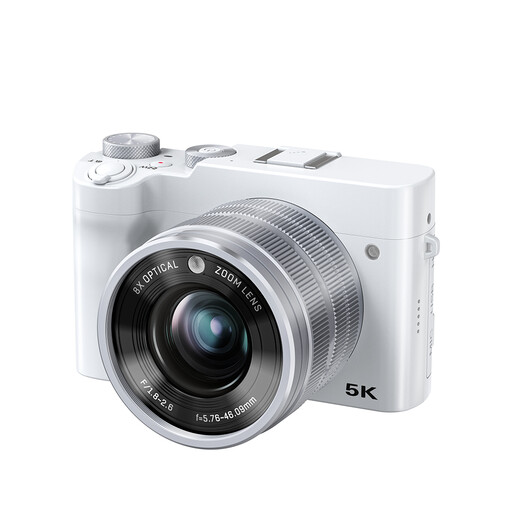 Image unavailable
Songdian digital camera, 8× optical zoom, white
One to compare if you’re looking for optical zoom; check that its focusing distance and controls suit the details you want to photograph.
8× optical zoom; 5K; 64 MP; dual lens; white.
If manual focusing is important for your fabric details, check whether this version has the feature.
View at Joybuy
Frequently asked questions
Will a polarising filter help with every shiny patch on a patchwork quilt?
No. The result won’t be the same with every material or angle of light. Polarising filters can reduce unwanted reflections. If the visible sheen is part of your work, compare test shots with and without a filter.
How should I start with the lighting?
Start with diffused light rather than a direct light source, which can create harsh highlights. Then change the position or angle of the light and check both the fabric texture and its sheen in a test shot.
Is ‘1 cm macro’ enough information to choose a camera?
No. Panasonic states that the FZ82D’s 1 cm focusing distance applies at the wide-angle setting; at the telephoto setting, Panasonic lists 150 cm. Check the focusing distance for the framing you want and allow room for your lighting.
What rights do I have if I buy a new or second-hand camera online from a business?
According to the Dutch government, when you buy from a business remotely, you often have a 14-day cooling-off period, including for second-hand products; there are exceptions. In the Netherlands, goods must be of satisfactory quality under the statutory guarantee, which has no general fixed legal duration. Check the terms and conditions of the seller you’re buying from.
Can I use someone else’s photo to show my patchwork quilt online?
Not necessarily. The Netherlands Chamber of Commerce points out that photos may be protected by copyright; just because a photo is online doesn’t mean you can use it on your own website. Use your own photos or obtain the necessary permission.


